On This Day, 1939: On 21 October 1939, 46 Squadron Hurricanes intercepted Heinkel He 115 floatplanes over the North Sea in the…
Read the entry →Short Sunderland
Short Brothers
Discover how the Short Sunderland served RAF Coastal Command as a long-range maritime patrol flying boat and anti-submarine aircraft.
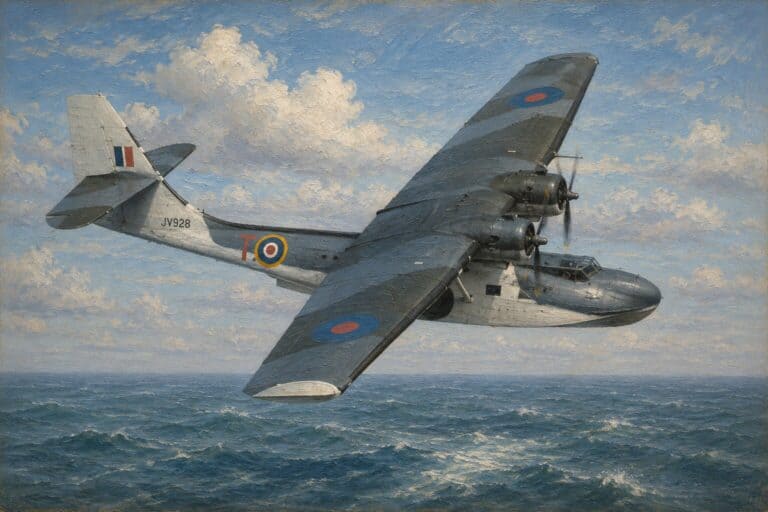
The Short Sunderland was the Royal Air Force’s principal maritime patrol flying boat from the late 1930s to the late 1950s. Built for long-range patrol and anti-submarine warfare, it became one of Coastal Command’s best-known aircraft and the last flying boat to serve in RAF front-line units. Its combination of range, payload and defensive armament gave it a central place in British maritime air power.
The Short S.25 Sunderland developed from the Short S.23 C-Class Empire flying boat used by Imperial Airways on long-distance routes. In response to Air Ministry Specification R.2/33, later revised as R.22/36, Sir Arthur Gouge and his team at Short Brothers adapted the commercial airframe for military patrol and reconnaissance duties. The prototype flew from the River Medway on 16 October 1937, powered by four Bristol Pegasus X engines. Early tests confirmed that the large hull and high-mounted wing provided the space and endurance required by Coastal Command.
During the Second World War, the Short Sunderland became closely associated with anti-submarine operations. German aircrews referred to it as the Flying Porcupine because of its numerous gun positions. A total of 749 aircraft were built across several variants. The type remained in RAF front-line service until 20 May 1959. This account outlines the design origins, technical development and operational record of the Short Sunderland within the wider history of RAF maritime aviation.
Design Origins And Technical Development
The Air Ministry required a long-range patrol aircraft capable of extended operations over open ocean while carrying bombs, depth charges or sea mines. Specification R.2/33, later amended as R.22/36, led to an order for a patrol flying boat based on the S.23 design, revised for military use by Short Brothers.
The aircraft featured a two-deck hull, a high-mounted wing, and four engines in nacelles. The lower deck contained stores, bomb gear and the weapons-handling equipment, while the upper deck housed the flight deck and main crew stations. A normal crew ranged from seven to eleven, depending on mission requirements and equipment fit. Given patrol durations that often exceeded 10 hours, the interior included a galley and bunks to allow rest during extended sorties. Early production versions used Bristol Pegasus engines; the later Mk V adopted American Pratt & Whitney Twin Wasp radial engines, improving performance and reliability.
Armament was integral to the design. Weapons were stowed internally and moved out on racks through openings in the fuselage beneath the wing for release, allowing bombs and depth charges to be carried without permanently exposed external loads. Defensive positions and turret arrangements varied between Sunderland marks and subsequent modifications. This concentration of firepower was intended to allow the aircraft to defend itself against fighter attack while operating at a distance from land bases.
Key design features included:
- Hull and Hydrodynamics: The hull combined seaworthiness with aerodynamic efficiency. A strong planing bottom enabled repeated take-offs and landings on open water, while the broad upper hull provided space for crew and equipment. This balance permitted operation from remote anchorages and coastal bases.
- Crew Accommodation: The internal layout reflected the endurance requirement. Bunks, galley facilities and storage allowed crews to manage long patrols more effectively than in smaller land-based aircraft.
- Armament and Equipment: The combination of turrets, additional gun positions, and internally stowed weapons provided search, strike, and defensive capabilities. As the war progressed, air-to-surface radar and other electronic aids were introduced, improving the detection of submarines and surface vessels in poor visibility.
Operational Service And Combat Record
Operational service for the Short Sunderland began before the outbreak of the Second World War. No. 230 Squadron at RAF Seletar received the type on 22 June 1938. By September 1939, Nos. 204, 210 and 228 Squadrons of the RAF, together with No. 10 Squadron of the Royal Australian Air Force, were operating the aircraft on long-range patrol duties.
During the Battle of the Atlantic, the Short Sunderland became an important component of Allied anti-submarine operations. Its endurance and depth-charge capability enabled patrols across wide areas of the ocean. On 31 January 1940, a Sunderland of No. 228 Squadron participated in the action against U-55 alongside Royal Navy warships; the submarine was subsequently scuttled by its crew. Sunderland crews contributed to U-boat losses both independently and in cooperation with naval vessels and other aircraft.
Operations extended beyond the Atlantic. The aircraft participated in the evacuation from Crete in May 1941 and flew patrol and transport missions across the Mediterranean. Other units operated from African and Far Eastern bases, supporting convoy protection, naval forces and amphibious operations. Sunderland maritime patrols continued into the final months of the war, and the aircraft remained in RAF service for many years afterwards.
In the post-war period, the Short Sunderland continued in service in new roles. During the Berlin Airlift of 1948–1949, Sunderland crews flew approximately 2,120 sorties and carried roughly 4,920 tonnes of freight into Berlin. During the Korean War, RAF Sunderlands operated from Japan on maritime patrol and surveillance duties, helping monitor sea approaches and support United Nations naval operations.
Radar, Patrol Tactics and Air Defence
As the Battle of the Atlantic developed, Sunderlands increasingly used air-to-surface-vessel radar to locate ships and surfaced submarines beyond visual range or in poor visibility. Crews combined radar contacts with visual identification, coordinated attacks and reporting to naval authorities. Depth-charge attacks required careful timing and a low-level approach, while a submarine that submerged before the aircraft reached it could be difficult to engage. The Sunderland’s defensive gun positions provided substantial protection, but its size and relatively low speed left it vulnerable when intercepted by determined fighters. Its long patrol endurance nevertheless made it valuable in convoy protection, ocean reconnaissance and search-and-rescue work.
Final Years in RAF Service
After the war the Sunderland remained useful where extensive sea patrols were required and land-based replacements were not yet available in sufficient numbers. RAF flying-boat squadrons operated in the Far East, including from Singapore, and the type also undertook transport tasks such as the Berlin Airlift. The Mk V, fitted with Twin Wasp engines, was prominent in the post-war fleet. By the late 1950s the RAF was replacing flying boats with land-based maritime patrol aircraft. The final RAF Sunderland operational period ended at Seletar in May 1959, bringing to a close the service’s front-line flying-boat era.
Legacy
The Sunderland’s significance lay in the combination of ocean-going endurance, crew accommodation, search equipment and weapons capacity that allowed it to patrol sea routes for extended periods. Its wartime anti-submarine and reconnaissance work, followed by transport and Far Eastern service, made it one of Coastal Command’s enduring aircraft.
| Dimensions | |
| Wingspan | 112 ft 9.5 in (34.38 m) |
| Length | 85 ft 4 in (26.01 m) |
| Height | 32 ft 10.5 in (10.02 m) |
| Wing area | 1,487 sq ft (138.1 m²) |
| Weights | |
| Empty weight | 34,500 lb (15,649 kg) |
| Max bomb load | 2,000 lb (910 kg) |
| Performance | |
| Maximum speed | 210 mph (340 km/h) |
| Cruise speed | 178 mph (286 km/h) |
| Service ceiling | 17,200 ft (5,200 m) |
| Range | 1,780 mi (2,860 km) |
| Powerplant | |
| Engines | 4 × Bristol Pegasus XVIII radial engines |
| Power | 1,065 hp (794 kW) each |
| Armament | |
| Guns | Up to 12 × .303 in Browning machine guns with up to 2,000 lb (910 kg) of bombs, mines and depth charges |
| Bombs / weapons | 2,000 lb (910 kg) |
Sunderland Sights German Invasion Force off Norway
On 8 April 1940, a No. 204 Squadron Sunderland reported German warships heading for Trondheim, warning…
8 April 2026 · 3 minRAF Coastal Command and the Battle of the Atlantic
How RAF Coastal Command used patrol aircraft, radar and anti-submarine tactics to help secure Britain’s Atlantic…
18 April 2026 · 5 minLaunch of the Berlin Airlift: RAF Operation Plainfare
On 26 June 1948 the RAF launched Operation Plainfare, helping sustain West Berlin by air in…
26 June 2026 · 3 min