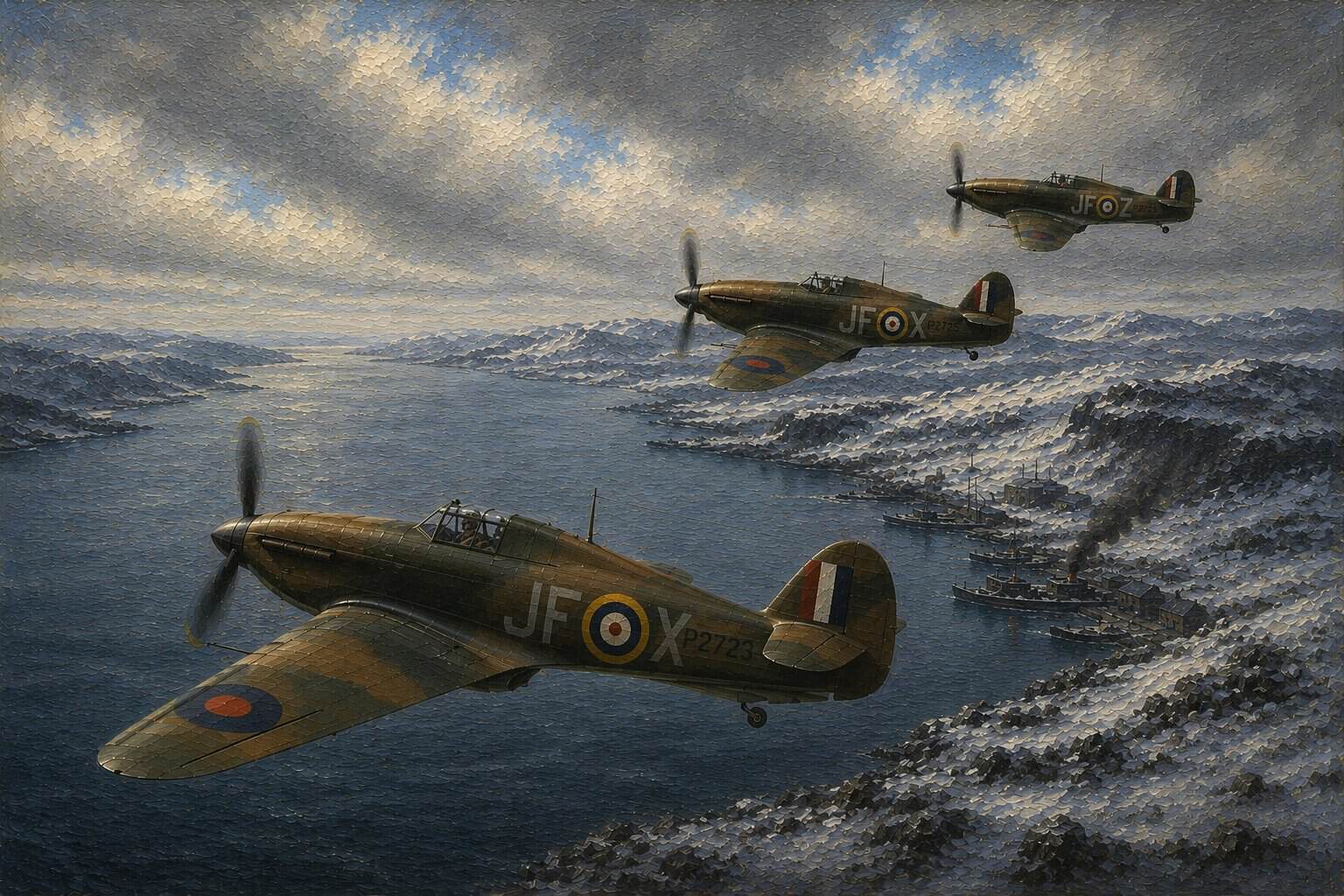
On 7 September 1941, Hawker Hurricanes flew from HMS Argus to Vaenga in order to reinforce the Soviet north and help protect Murmansk and the Arctic supply route. The operation stands out because it brought the RAF and Fleet Air Arm directly into the defence of a critical Allied lifeline at a moment when the Soviet Union had newly entered the war against Germany. It was a practical expression of coalition support delivered through aircraft, carriers and urgent strategic necessity.
The northern emergency of 1941
Germany’s invasion of the Soviet Union in June 1941 transformed the strategic map of the war. Suddenly, the Arctic route to northern Russia became a matter of immense importance. Murmansk and its approaches offered one of the few practicable channels through which aid could reach the Soviet Union. That made the region important not only for shipping, but for air defence as well.
The need was immediate. If the ports and sea lanes in the far north were left exposed, the whole effort to sustain the Soviet war front by sea would be placed in jeopardy. Reinforcement therefore had to be delivered quickly, and carrier transport offered a way of sending fighters directly into the theatre without the delay and complexity of a slower build-up.
HMS Argus and the transfer of Hurricanes
The use of HMS Argus underlined the flexibility of British sea-air cooperation. Hurricanes flown off a carrier to a northern Soviet base represented an operation that was neither a conventional naval strike nor an ordinary RAF deployment. It was a transfer mission shaped by geography, urgency and alliance politics.
Vaenga mattered because it placed fighter aircraft where they could contribute to the defence of the Soviet north and to the wider security of Murmansk and the Arctic route. The operation therefore linked carrier capability, RAF equipment and coalition need in a direct and practical way. It showed that support to an ally could mean far more than diplomatic declarations. It could involve the rapid movement of combat aircraft to a threatened theatre at a decisive moment.
Coalition warfare in practice
The significance of the Hurricanes at Vaenga is also political. In 1941, Britain and the Soviet Union were newly aligned by necessity against Germany, and that relationship required visible proof of commitment. Delivering fighters to the Soviet north helped demonstrate that Britain was prepared to contribute materially to the defence of a partner whose survival now mattered to the wider Allied war effort.
In the RAF story, the operation illustrates how air power operated within coalition warfare. Aircraft could be moved, transferred and deployed in ways that served a larger strategic framework rather than a narrowly British objective. The mission was not about prestige. It was about making an allied front more sustainable under immediate pressure.
Significance
The flight of Hurricanes from HMS Argus to Vaenga on 7 September 1941 matters because it demonstrates British air and naval power working together to secure a vital Allied line of communication. It helped strengthen the defence of the Soviet north, protect Murmansk and support the Arctic route at a critical point in the war. In RAF history, the episode stands as an example of practical coalition support, in which the movement of a single fighter type had consequences far beyond the aircraft themselves.