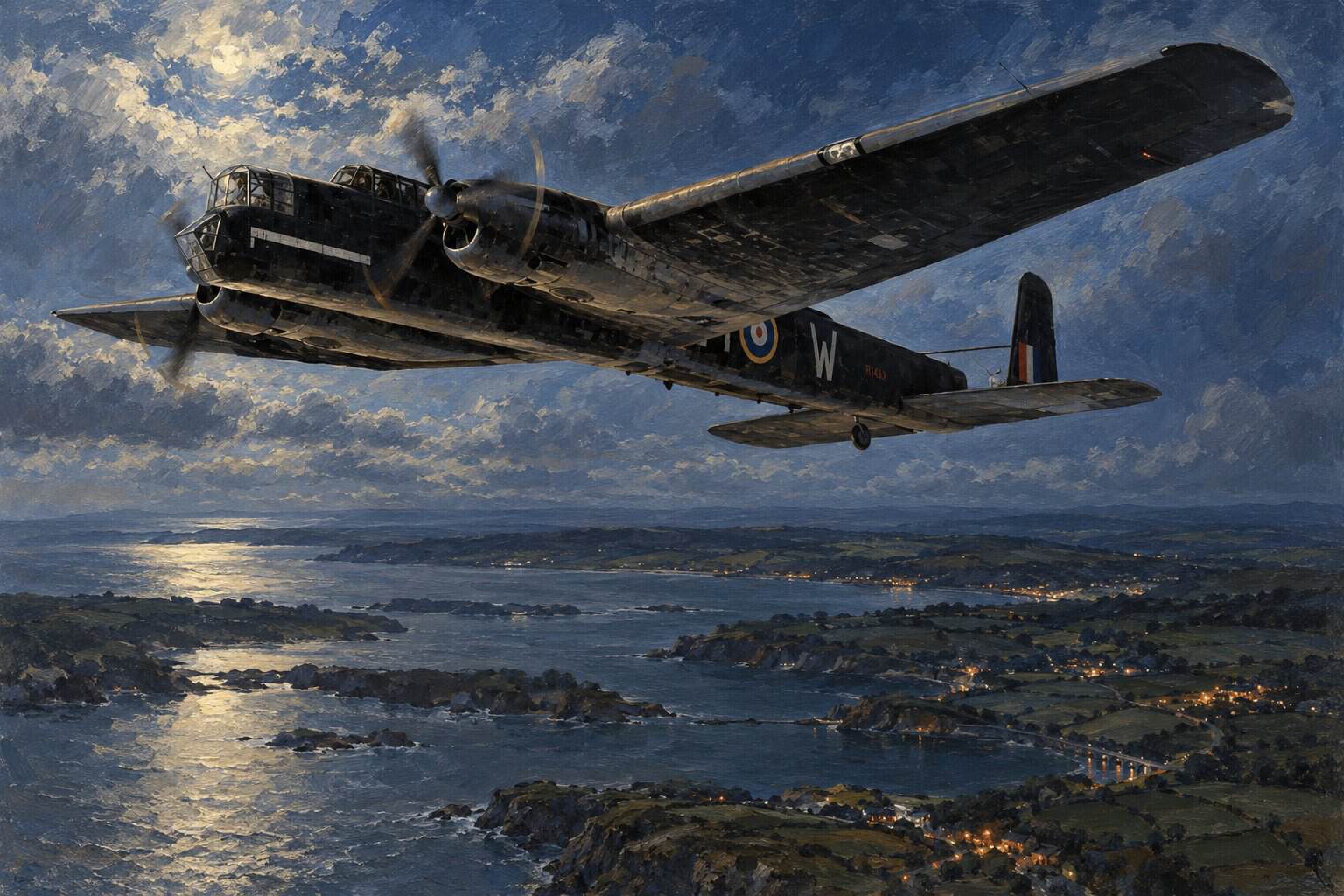
On 14 November 1940, an RAF Armstrong Whitworth Whitley flew from Stradishall towards Morlaix in Brittany carrying a Free French agent for an early clandestine insertion connected with the Special Operations Executive. The aircraft reached the target area, where the agent refused to jump. The crew returned to Britain with their passenger, bringing the attempted insertion to an unsuccessful conclusion.
The sortie took place during the formative months of British support for clandestine activity in occupied Europe. It brought together an RAF crew, a bomber adapted to carrying an agent, and a new organisation seeking practical ways of reaching enemy-held territory.
A New Requirement After the Fall of France
SOE had been created in July 1940, following the defeat of France. Its responsibilities included supporting resistance and conducting sabotage in occupied countries. Establishing contact with people on the ground required secure means of moving personnel across the boundaries of German control.
Aircraft offered a way of carrying agents directly towards inland destinations. Each insertion depended on several distinct stages: preparation in Britain, navigation to a suitable dropping area, the parachute descent and the agent's subsequent movement on the ground. The RAF's contribution therefore extended into a form of flying in which delivery of a single passenger could determine the outcome of an entire operation.
The November flight belonged to the early SOE/SO2 phase, when organisational arrangements were still developing. Its Free French passenger also reflected the part played by the national organisations operating from Britain in sustaining contact with occupied Europe.
The Flight Towards Morlaix
The Armstrong Whitworth Whitley provided the aircraft for the attempt. Already serving as an RAF bomber, the type became an important platform for early clandestine flying. On this occasion, its task was to carry the agent from Stradishall to a dropping area near Morlaix.
Brittany lay across the Channel from Britain, within German-occupied France. For the crew, reaching the target area completed the outward flying stage of the mission. The next step required the passenger to leave the aircraft by parachute and begin his assignment on French soil.
At that point the agent refused to jump. The crew brought him back to base, and the intended insertion ended with both aircraft and passenger returning to Britain. The reason for his decision remains unknown. His return defines the immediate result of the sortie: the agent remained in British hands and the planned deployment into France was unfulfilled.
Towards a Special Duties Service
The Morlaix attempt illustrates the experimental character of clandestine air operations in 1940. Aircrew and the organisations supplying agents were developing a service whose effectiveness depended on close cooperation between flying personnel and passengers undertaking dangerous individual assignments.
During the following period, the RAF's clandestine organisation expanded through dedicated Special Duties units. In March 1942, the Special Duties squadrons moved to Tempsford, which became closely associated with the delivery of agents and equipment to occupied Europe.
The flight of 14 November belonged to the early development of RAF clandestine operations at Stradishall. Although the crew reached the intended dropping area, the agent's refusal prevented the mission from being completed. The experience illustrated the challenges facing the RAF and SOE as they developed the methods that would eventually sustain agent and supply operations across occupied Europe.