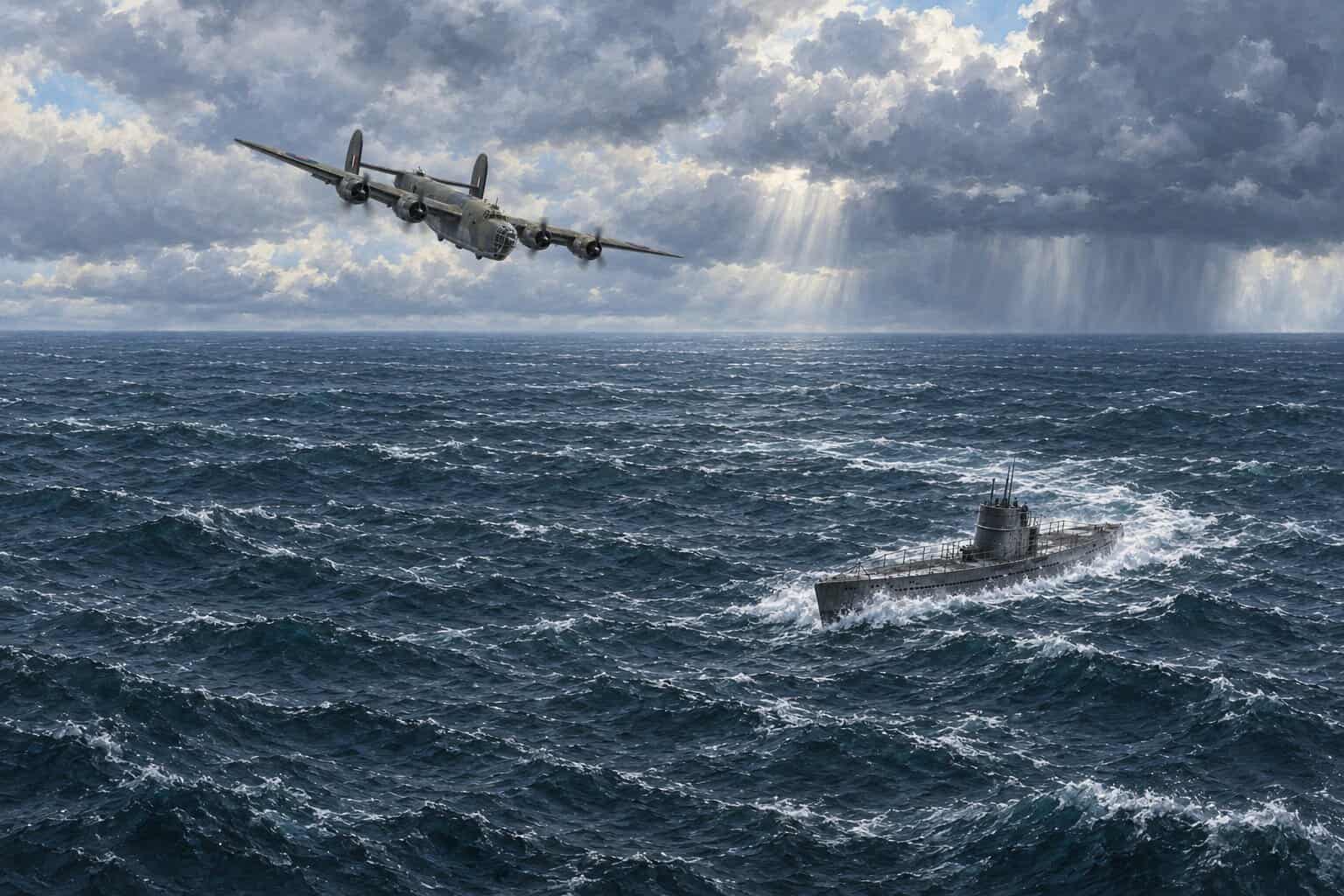
The battle over the Atlantic approaches was one of the least glamorous and most important air campaigns the Royal Air Force fought in the Second World War. It lacked the dramatic compression of the Battle of Britain and it never acquired the grim notoriety of the bomber offensive against Germany. Yet the long struggle over the Bay of Biscay and the western sea lanes touched the survival of Britain just as directly. Convoys carried food, fuel, raw materials and troops. If they were broken in the Atlantic, Britain’s war would narrow into endurance and scarcity. If they were held together, the country could remain in the fight, sustain its alliance with the United States and eventually support the return to the continent.
For the RAF, this was chiefly the business of Coastal Command. For much of the war, Coastal Command lived in the shadow of Fighter and Bomber Commands, often short of aircraft, often asked to do more with machines unsuited to the task. Even so, it became central to the wider anti-submarine campaign. Its aircrews searched vast spaces of sea for brief chances to locate, attack and report. They watched convoy routes, hunted U-boats moving to and from their French bases, protected shipping where they could and gradually extended British reach far beyond the coastline. The campaign over Biscay mattered because it was there that German submarines passed between relative safety in port and the exposed waters of the Atlantic. Once the RAF gained the range, equipment and confidence to make that passage dangerous, the balance of the maritime war began to shift.
A Neglected Front Becomes A Central One
At the start of the war, the RAF entered the maritime struggle without the priority it deserved. British air strategy in the inter-war years had been shaped far more by homeland air defence and the belief in strategic bombing than by sustained anti-submarine warfare. Coastal Command existed, but it did not enjoy the prestige, resources or modern aircraft available elsewhere. The assumption that the Royal Navy would remain the main shield at sea was understandable, but it left the RAF’s maritime arm poorly prepared for a campaign in which range, endurance and specialised equipment would prove decisive.
The early Atlantic fight exposed those weaknesses quickly. U-boats threatened ocean traffic, while long-range German aircraft such as the Focke-Wulf Condor added pressure by shadowing convoys and guiding attacks. RAF patrol aircraft could cover coastal waters and some convoy lanes, but large stretches of ocean lay beyond effective reach. The central problem was not simply bravery or effort. It was geography. Britain needed aircraft that could stay aloft for long periods, search huge areas, communicate effectively with naval forces and attack submarines before they escaped beneath the surface or into bad weather.
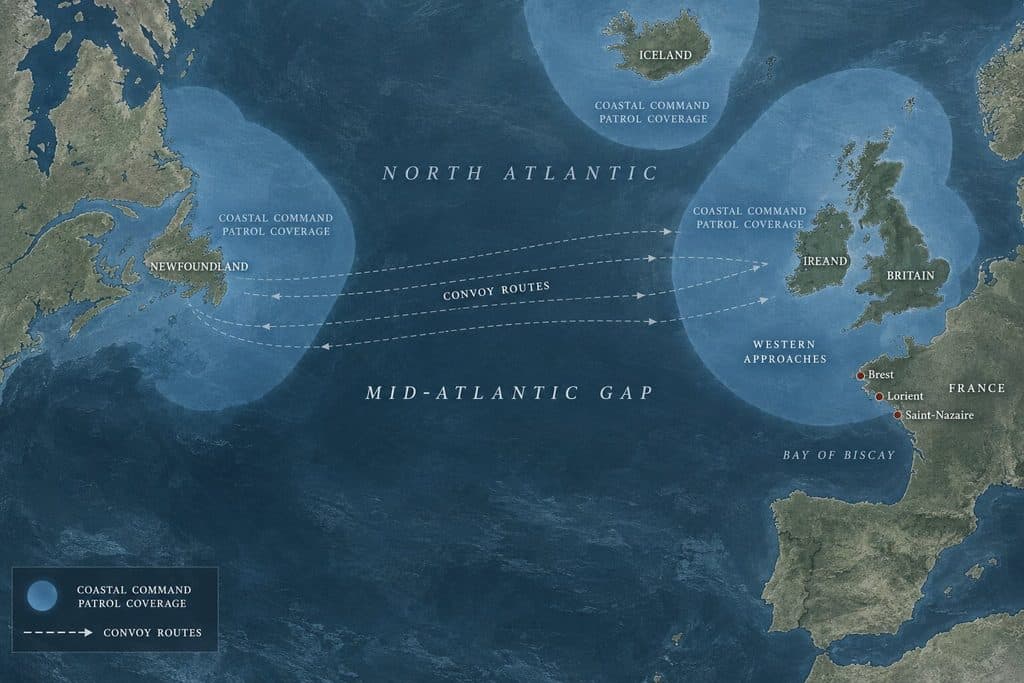
The fall of France made the problem worse. Once German submarines could operate from Atlantic ports such as Brest, Lorient and Saint-Nazaire, the Bay of Biscay became the main corridor between their bases and the open sea. That changed the war map for the RAF. Instead of dealing only with a broad Atlantic emergency, Coastal Command now had a more defined but demanding air front. Patrols over Biscay could in principle strike submarines at a vulnerable moment: on passage, often on the surface, sometimes before they dispersed into the wider ocean. In practice, making that opportunity count required aircraft, radar, weapons and a degree of operational concentration that the Command did not yet possess.
This helps explain why the Atlantic approaches campaign took time to mature. It was not won through a single invention or one dramatic order from above. It grew from the slow recognition that maritime air power could no longer be treated as an auxiliary activity. The RAF had to learn that a war of long patrols, sparse sightings and patient attrition could be as strategically important as the more visible battles fought over cities and fronts.
Closing The Gap In Range And Endurance
For much of the war, the central operational difficulty remained distance. A submarine sighted near the western approaches might already be close to attack positions against a convoy. An aircraft arriving too late, or lacking the endurance to remain on station, could do little more than report. The famous mid-Atlantic gap was therefore not an abstract phrase but a direct expression of technical and organisational limits. Where the RAF could not reach, the U-boat arm enjoyed room to manoeuvre.
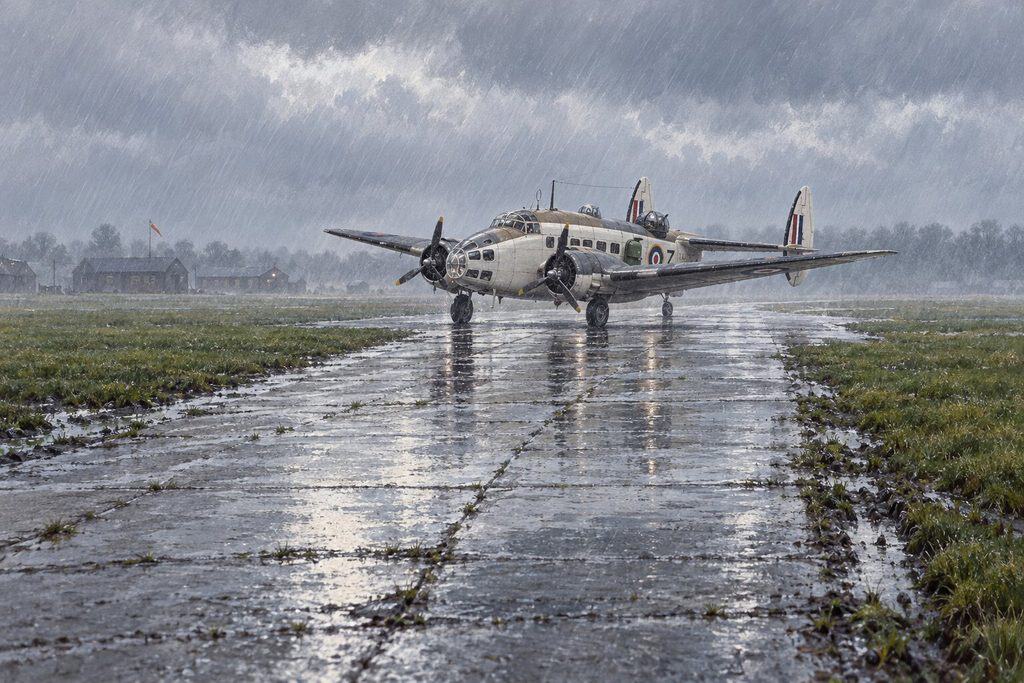
Closing that gap demanded more than simply flying further. It required aircraft designed or adapted for maritime work and crews trained to search the sea rather than the land. Flying boats such as the Sunderland became valuable because they combined endurance with striking power and could operate in harsh oceanic conditions. Land-based aircraft, including the Lockheed Hudson and later the Vickers Wellington, provided additional coverage, while the Consolidated Catalina extended reconnaissance over wider areas. The arrival of the Liberator in maritime service was especially important because it offered the long range needed to contest waters previously left exposed.
The effect of range was cumulative. Every extra hour in the air widened the area under observation, improved convoy coverage and increased the chance that a sighting could be converted into an attack or a useful report to naval forces. Air power at sea depended on this constant extension of presence. In the Atlantic approaches, the RAF’s value often lay in making the ocean less private to the enemy. A submarine commander who could once assume long stretches of unobserved transit had to reckon increasingly with the possibility of being seen.
Longer endurance also changed the rhythm of escort work. Aircraft could meet convoys farther out, remain over threatened sectors for longer and hand over coverage more effectively from one patrol to another. That did not make the Atlantic continuous or safe, but it reduced the number of hours in which a convoy had to rely entirely on surface escorts. The psychological effect was important as well. Merchant seamen, naval commanders and aircrews all understood that air cover, even intermittent air cover, could disrupt shadowing and make a U-boat captain more cautious.
That change also reshaped the meaning of reconnaissance. Maritime patrol was never merely passive observation. Locating a U-boat was already enough to begin an attack, because contact reports could draw in escorts, redirect convoys, or force the submarine to dive and abandon speed. In this sense even an aircraft unable to sink its target might still impose operational cost. Time submerged meant slower progress, reduced tactical freedom and greater strain on crews. As RAF coverage improved, the Atlantic approaches became less a safe road to the convoy routes and more a zone of mounting friction.
The importance of this development is easy to underestimate because its results emerged gradually. There was no single day on which the gap simply vanished. Rather, Coastal Command built a more continuous net of surveillance and pressure. That transformation was one of the RAF’s most important contributions to the Battle of the Atlantic.

The Bay Of Biscay Offensive
The Bay of Biscay gave the anti-submarine air campaign a sharper focus. German submarines sailing from the French Atlantic bases had to pass through waters that were close enough to Britain for repeated patrol effort yet broad enough to remain difficult and dangerous. The bay therefore became a meeting ground between German necessity and growing RAF capability. If submarines could be detected there before they reached the convoy lanes, they could be delayed, damaged, or destroyed at a stage when their loss would have immediate operational effect.
Early patrols over Biscay were hazardous and often inconclusive. Weather shifted quickly, visibility was uncertain and aircraft could spend long hours without sighting anything at all. German fighters also complicated the task. As the Luftwaffe tried to protect U-boat transit routes, RAF crews had to operate not only against the sea and the submarine threat but also against armed opposition in the air. This was not a simple hunter-and-prey story. It was a contested air-sea zone in which the British could not assume safe access.
Even so, the logic of the offensive grew stronger with time. By 1943, Coastal Command aircraft were attacking U-boats in Biscay with increasing frequency. The effect came not just from sinkings, important though they were, but from the change imposed on German behaviour. Daylight movement on the surface became far more dangerous. Submarines were pushed towards submerged transit when possible, which protected them from immediate air attack but sharply reduced speed and operational efficiency. Time lost in passage was time lost in patrol. Wear on crews and machinery increased, and the rhythm of operations became less favourable to the German campaign.
German countermeasures showed how seriously the threat was taken. Fighter escort and heavier anti-aircraft armament on some U-boats could make an attack run costly, and RAF crews flying over Biscay knew that a surfaced submarine might be less helpless than it appeared. Yet even these responses were a kind of British success. Resources spent shielding transit were resources not spent elsewhere, and every adaptation acknowledged that the bay could no longer be treated as routine open water. The offensive had become a pressure point in its own right.
The Biscay offensive also revealed an important truth about RAF maritime warfare: success often depended on persistence rather than spectacle. A submarine that escaped on one patrol might be found on another. An aircraft that failed to attack could still report contact. A shadowed transit route could become a trap once naval and air forces were coordinated effectively. Over time, the bay changed from a necessary German corridor into a stretch of water that carried mounting psychological and material cost.
That mattered strategically because the Atlantic battle was always about pressure over time. The U-boat arm did not need to win every engagement to endanger Britain; it needed only to keep enough pressure on shipping to make losses unsustainable. The RAF’s Biscay campaign worked in the opposite direction. By making submarine deployment more difficult before boats even reached their hunting grounds, it helped erode the offensive power of the entire German system.
Radar, Leigh Light And The Uses Of Maritime Air Power
The RAF’s growing effectiveness over the Atlantic approaches was inseparable from technical change. Aircraft range mattered enormously, but range alone could not solve the problem of finding a small target on a dark or empty sea. Detection, localisation and attack all had to improve together. The maritime air war was therefore one of the clearest examples in the Second World War of how equipment, crew training and operational methods had to work as a single system.
Air-to-surface vessel radar transformed the search. It allowed aircraft to detect surfaced submarines at greater distance and in poorer visibility than visual methods alone could manage. This was particularly important at night or in broken weather, when a U-boat might otherwise pass unseen. Radar did not make the ocean transparent, but it altered the balance between hunter and hunted. A submarine commander could no longer rely on darkness as protection in the same way.
The Leigh Light gave that change a striking practical form. Used with radar-equipped aircraft, it made night attacks far more credible by allowing a submarine detected in darkness to be illuminated at the last moment before the strike. What had once been a broad problem of search became, more often than before, a brief tactical problem of timing and nerve. In the Atlantic approaches this mattered because German crews had often preferred to use darkness for safer surface transit and battery charging. Once that habit became dangerous, the RAF had achieved more than a technical success. It had altered the enemy’s operating pattern.
Weapons and attack doctrine improved as well. Depth charges remained central, but they became more effective as crews learned better attack profiles and as the wider anti-submarine system improved the quality of sightings and tracking. Aircraft were not acting alone in a vacuum. Radar, radio, navigation, signals intelligence and naval cooperation all helped convert fleeting contact into action. Even camouflage, patrol altitudes and approach tactics reflected accumulated experience from a campaign in which small margins often determined whether a submarine escaped.
What emerged by the middle of the war was not simply a collection of useful devices but a mature form of RAF maritime warfare. Air power over the sea had become something more exacting than occasional reconnaissance and more nuanced than crude patrol presence. It was now a method of controlled searching, reporting and striking, built around endurance and information as much as firepower.
Intelligence, Coordination And The Wider Atlantic Battle
No RAF campaign in the Atlantic approaches can be understood in isolation from the naval war around it. Coastal Command’s achievements were greatest when aircraft operated as part of a wider anti-submarine system. The Atlantic battle rewarded cooperation. Convoys, escort groups, shore commands, signals intelligence, high-frequency direction-finding, and patrol aircraft all contributed to the same purpose: locating, fixing, and defeating the U-boat threat before shipping losses became intolerable.
For the RAF, coordination multiplied the value of every sortie. An aircraft that sighted a submarine could summon surface escorts, maintain contact, force the target underwater or divert a convoy from danger. Equally, naval intelligence and traffic analysis could guide patrol effort towards more promising waters instead of leaving crews to search blindly across immense distances. In this respect, the Atlantic air war was not a succession of isolated encounters but a campaign of managed information. The RAF was most effective when it turned its mobility into useful knowledge as well as immediate striking power.
This cooperative structure also imposed discipline on how aircrews flew the campaign. Reporting formats, shadowing procedures, radio practice, and attack methods had to be standardised enough for escort vessels and headquarters to act quickly. The Atlantic approaches were too large, and the opportunities too brief, for improvisation alone to carry the burden. What looks, in retrospect, like a broad strategic success rested in part on this unglamorous professionalisation: the routine yet exact work of making ships, aircraft, and operations rooms understand the same battle in near-real time.
The Bay of Biscay again showed this clearly. Patrol lines, repeated searches and coordinated responses made the transit routes increasingly hazardous. German attempts to adapt, whether through fighter protection, altered procedures or more cautious movement, never fully removed the pressure. The RAF did not need perfect interception to make a difference. It needed to keep the enemy uncertain, visible and delayed often enough for the wider system to take effect.
This was also where the institutional reputation of Coastal Command began to change. A command once treated as secondary demonstrated that sustained maritime aviation could have strategic weight. It defended convoys both indirectly and directly. It narrowed the operational freedom of U-boats. It tied German resources to protection and adaptation. And it helped make possible the broader Allied recovery in 1943, when shipping losses fell, anti-submarine methods improved and the German offensive at sea began to lose momentum.
The point is not that the RAF won the Battle of the Atlantic alone. It did not. Sea power, industrial output, escort carriers, shipborne radar, better weapons and codebreaking were all indispensable. But the RAF’s role in the Atlantic approaches was one of the places where British air power most clearly shaped events beyond the land battlefield. It gave the Allied maritime system reach, speed, and pressure that surface forces alone could not provide everywhere at once.
Limits, Losses And Strategic Consequences
The campaign over Biscay and the Atlantic approaches should not be romanticised. It remained a hard and imperfect form of warfare. Crews flew exhausting patrols over cold water with no guarantee that a mission would produce contact. Weather could destroy careful plans. Mechanical failure over the sea was often fatal. Even a successful sighting might end with a submarine diving before a decisive attack could be made. For long stretches of the war, Coastal Command also had to fight for resources against other strategic priorities.
There were operational limits as well. Air cover could be extended, but not infinitely. The Atlantic remained vast. German adaptation never ceased, and the anti-submarine struggle retained a restless quality, with each British improvement prompting a response. Air power also depended on infrastructure: bases, maintenance, trained crews, navigational competence and a command system able to process reports quickly. The campaign’s eventual effectiveness rested as much on patient institutional work as on battlefield courage.
Yet its consequences were substantial. By turning the Atlantic approaches into a dangerous operating environment, the RAF helped reduce the efficiency of the U-boat arm at a decisive stage of the war. Submarines forced to transit submerged, disperse cautiously or break contact under air threat arrived later, hunted less effectively and faced greater cumulative strain. Every delay in Biscay could echo across the convoy battle farther west. Every aircraft extending patrol reach helped shrink the enemy’s room for manoeuvre.
There was also a larger institutional legacy. The Atlantic campaign showed that the RAF could not be understood solely in terms of home defence and strategic bombing. It possessed a maritime dimension that was critical when national survival depended on sea communications. Coastal Command’s aircrews proved that long-range patrol, anti-submarine warfare and reconnaissance demanded a distinct professional mastery. In that sense, the Atlantic approaches formed part of a wider correction in British strategic thinking. Air power at sea was not a peripheral convenience. Under the pressures of total war, it became an essential instrument.
Conclusion
The RAF’s struggle over the Bay of Biscay and the Atlantic approaches was a campaign of distance, repetition and slowly earned advantage. It began with shortages of aircraft, equipment, and institutional priority, and matured into one of the most effective forms of maritime air pressure the Service developed during the war. By improving range, radar, night-attack methods, and cooperation with the Royal Navy, Coastal Command helped turn a dangerous German transit corridor into a zone of attrition.
That achievement did not arrive in a single dramatic moment, nor did it belong to the RAF alone. It was part of the larger Allied recovery in the Battle of the Atlantic. But the RAF’s contribution was distinctive and indispensable. In the long empty reaches west of Europe, and above the grey waters of Biscay, British air power helped make the sea less hospitable to the U-boat war. That was enough to matter at the highest strategic level, because Britain’s road to survival and eventual victory still ran across the Atlantic.