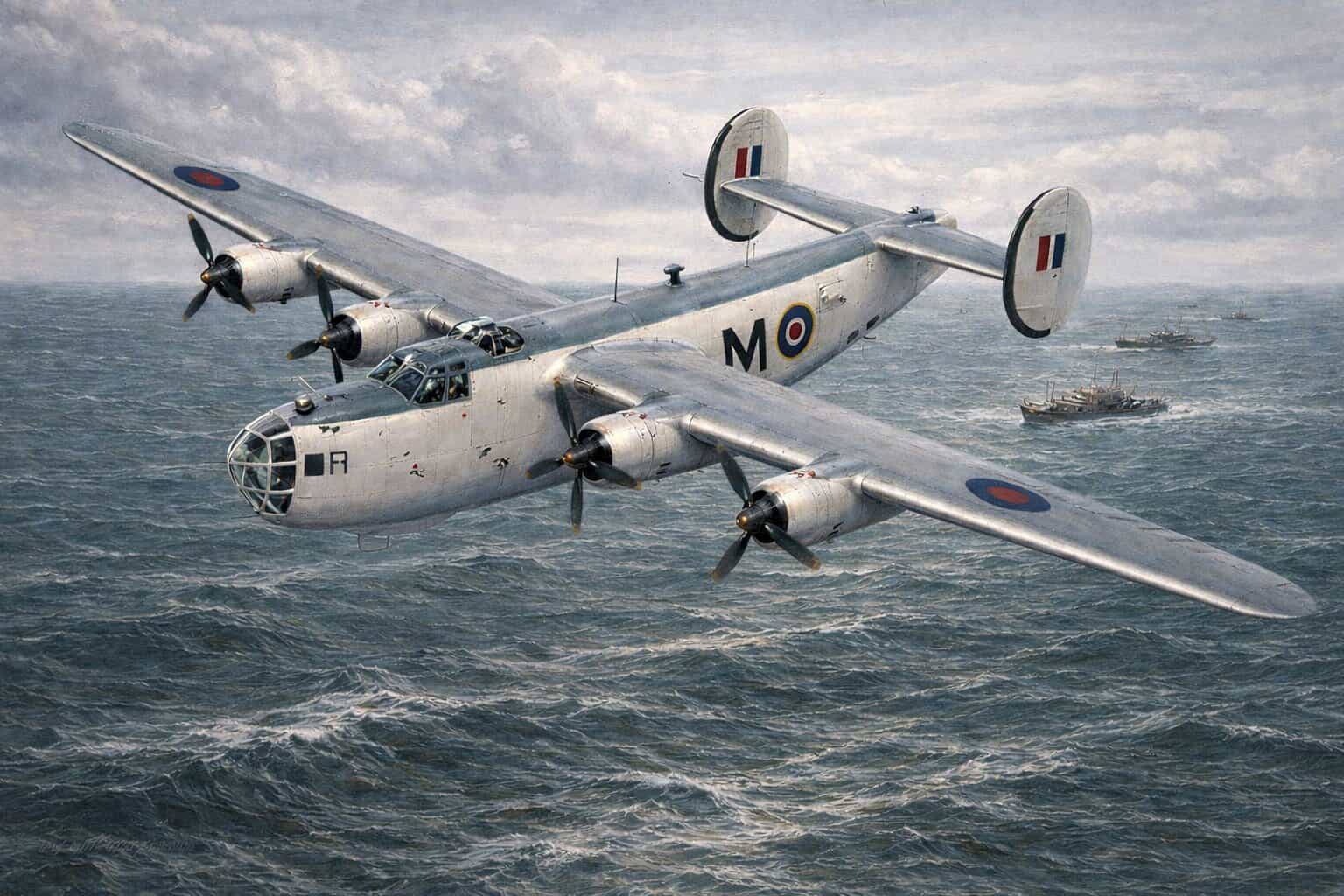
RAF Coastal Command’s convoy patrols were among the least dramatic but most necessary air operations of the Second World War. Britain remained dependent on sea communications for food, fuel, raw materials, reinforcements and military stores. If merchant shipping could not be protected, the country’s capacity to continue the war would be weakened at every level. Convoy patrols sat close to the centre of national survival.
These patrols were not confined to a single sea lane or a single tactical problem. Coastal Command aircraft escorted ocean convoys in the Atlantic approaches, guarded shipping moving around Britain’s own coasts and worked in close association with the Royal Navy against submarines, surface raiders and fast attack craft. Their contribution was cumulative rather than spectacular. Aircraft did not always destroy the enemy directly, but their presence altered enemy behaviour, extended the reach of escort forces and reduced the freedom with which German units could attack.
Why Convoy Protection Mattered
Britain entered the war as a maritime power dependent on imported food, oil and industrial materials. That dependence made merchant shipping a strategic target. German naval policy sought to cut the Atlantic lifeline, above all through the U-boat campaign. At the same time, coastal traffic around the British Isles faced threats from submarines, mines and fast attack craft operating from occupied ports.
Convoy protection had two overlapping dimensions. Ocean convoys carried supplies from North America and the wider Empire and had to be shepherded across immense distances. Coastal convoys, though less celebrated, were also essential. Coal moving from north-east England, for example, remained important to power generation and industry farther south. Protecting these routes was part of keeping the British war economy functioning.
What air power offered was reach. Naval escorts could remain with the convoy, but aircraft could search ahead, widen the defended zone, spot shadowing submarines and respond quickly to sightings. The relationship between ship and aircraft was therefore fundamental to the entire system.
Coastal Command And The Convoy Battle
Convoy patrols demanded close coordination between RAF Coastal Command and the Admiralty. Coastal Command headquarters and its regional groups organised air coverage over defined maritime areas, while naval escort groups protected the convoy itself. The objective was not simply parallel effort but overlapping protection, with aircraft and ships reinforcing one another wherever possible.
As the war progressed, this system became broader and more effective. Bases in the United Kingdom remained central, but forward operating locations were increasingly important in extending patrol range. Allied access to Iceland and later the Azores helped push air cover farther into waters that had previously been difficult to protect. That mattered because the mid-ocean gap had offered U-boats one of their best opportunities to attack beyond reliable Allied air reach.
In British coastal waters, regular patrols along the east and south coasts helped guard local convoy routes against attacks by small surface forces and submarines. The pressure on these routes increased as shipping density rose during the build-up to the liberation of Western Europe.
Aircraft and Methods
Coastal Command employed a varied force because convoy work required endurance, observation and anti-submarine striking power rather than a single ideal aircraft type. The Consolidated Liberator became especially important for long-range patrol work and for extending air cover deep into the Atlantic. The Short Sunderland provided endurance, useful defensive armament and the ability to operate as a flying boat over wide maritime areas. The Consolidated Catalina contributed long-range reconnaissance and rescue capability, while aircraft such as the Lockheed Hudson and coastal variants of the Vickers Wellington served in medium-range patrol and escort duties.
Attack methods developed with experience. Aircraft carried depth charges and later other anti-submarine weapons, but their value did not lie only in the moment of attack. A sighted U-boat forced to submerge lost speed, freedom of manoeuvre and the ability to maintain shadowing contact with a convoy. In this way, even patrols that ended without a confirmed sinking could still protect shipping by denying the enemy favourable conditions.
This was one of the defining features of convoy air patrols. Their effect was often indirect but strategically important. Constant pressure wore down the U-boat arm not just by destruction but by forcing it into less advantageous patterns of operation.
Technology And The Turn Of The Battle
Technical improvement transformed convoy patrols. Air-to-Surface Vessel radar made it easier to detect submarines and hostile surface craft in poor visibility and at night. German counter-measures challenged early sets, but centimetric radar restored a critical Allied advantage. The Leigh Light added a further step by allowing aircraft to illuminate submarines detected by radar after dark, making night attack far more practical than before.
These developments were particularly valuable in waters such as the Bay of Biscay, where submarines moving to and from their patrol areas became vulnerable during transit. They also mattered in the wider Atlantic campaign, where the combination of longer-range aircraft and improved detection steadily reduced U-boats' freedom to attack on the surface.
By May 1943, German submarine losses had reached a level that forced a temporary withdrawal from the North Atlantic convoy battle. Air power was not the only reason for that turning point, but it was one of the essential reasons. Aircraft extended defensive cover, improved the ability to find and harry submarines and made convoy routes steadily harder to attack.
Wider Significance
The significance of convoy patrols lies partly in what they made possible. Bomber offensives, army campaigns and later the preparation for the return to Western Europe all depended on secure maritime supply. Coastal Command’s patrol aircraft helped protect the shipping on which those efforts rested.
They also demonstrated a distinctive form of RAF air power. This was not a short, dramatic campaign decided in a few weeks. It was a long war of endurance, coordination and technical adaptation. Coastal Command crews flew in bad weather, over monotonous and dangerous waters, often with little public recognition compared with more visible parts of the air war.
Yet convoy patrols were among the clearest examples of air power applied directly to national survival. Through constant patrols, improved technology, and close cooperation with naval escorts, Coastal Command helped turn convoy defence from an emergency necessity into an effective and sustained system of maritime protection.