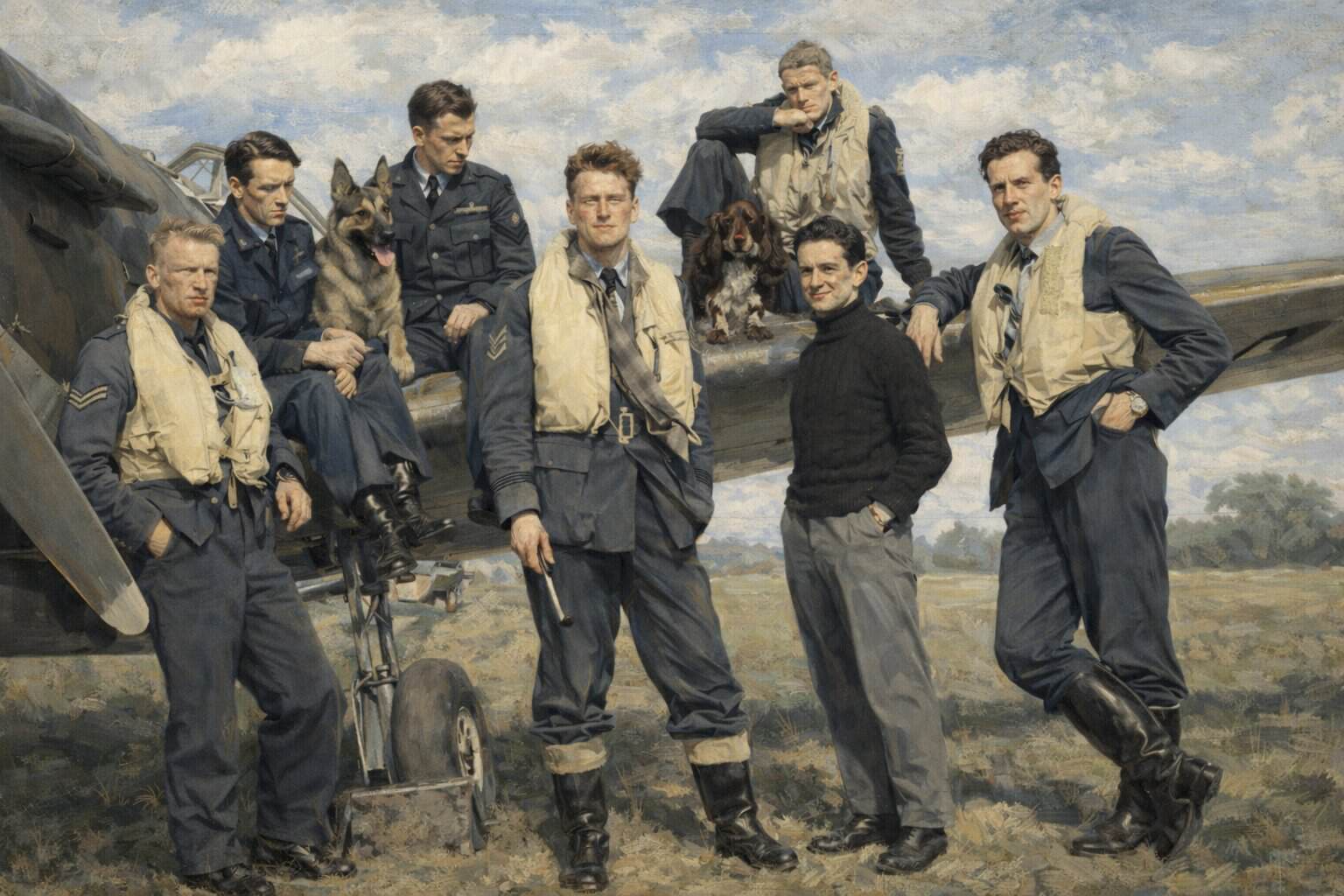
RAF aircrew training during the Second World War developed from a relatively modest pre-war system into a vast international pipeline that sustained Britain’s air war across several commands and many theatres. The process mattered because modern air operations could not be maintained by aircraft production alone. Pilots, navigators, bomb aimers, wireless operators and air gunners all required time, specialist instruction and progressive testing before they were fit for combat.
At the start of the war, the RAF did not have enough trained aircrew to meet the demands of expansion. Aircraft numbers, instructors, airfields and weather conditions all limited output within the United Kingdom. Wartime pressure initially encouraged shortened courses, but operational experience soon showed that inadequate preparation carried its own cost. The training system was therefore enlarged, standardised and, in many cases, moved overseas so that quantity could be increased without abandoning quality.
Selection and Induction
The route to the front line began with selection. Aircrew entered the RAF as volunteers and were assessed through medical examination, eyesight and colour-vision testing, aptitude measures and interview. This stage was both a filter and an allocation process. A candidate unsuitable for pilot training might still be directed into another aircrew specialism if he showed the right qualities.
Those accepted entered the service formally and passed through an induction period that emphasised discipline, physical conditioning and adaptation to RAF routine. Establishments such as the recruiting centre at Lord’s were part of this early experience, but the important point was functional rather than ceremonial. The RAF had to turn civilian volunteers into men able to absorb instruction, accept service discipline and move into a demanding technical environment.
Induction was often austere. Accommodation could be basic, routine was strict, and the transition from civilian life was deliberate. This was not yet flying training in the specialist sense, but it prepared recruits for the more exacting stages that followed.
Ground School And Elementary Flying
Initial Training Wings provided the academic foundation. Subjects such as mathematics, navigation, aircraft recognition, principles of flight, wireless work and service organisation gave future aircrew the theoretical knowledge required for specialist instruction later on. Physical training remained important, and failure at this stage could still result in re-mustering or removal from the aircrew stream.
For pilot trainees, the next decisive step came at Elementary Flying Training School, where the de Havilland Tiger Moth introduced the fundamentals of aircraft handling. Dual instruction, basic manoeuvres, take-off and landing practice, stalls and circuit work all formed part of this early flying syllabus. The first solo flight mattered symbolically, but it also marked the point at which an instructor could judge whether a trainee possessed the judgment and control needed to continue.
Elementary flying was therefore another stage of selection. Not every trainee who reached an EFTS would emerge as a pilot. Some transferred into other aircrew roles, while others left the aircrew pipeline altogether.
Advanced Training And Overseas Expansion
Those who continued to pilot training moved on to Service Flying Training Schools, where aircraft such as the North American Harvard introduced greater speed, more complex systems and more demanding flying tasks. Instrument work, formation flying, navigation and advanced handling all became more important. The Link Trainer added a useful synthetic environment in which procedural and instrument practice could be repeated without the cost and risk of constant airborne instruction.
As the war progressed, the RAF learned that throughput speed could not be the only measure of success. Early wartime compression of courses produced men who reached squadrons quickly but were not always prepared for operational conditions. Course length and flying hours increased. Early graduates might qualify with around 150 hours, while later wartime pilots often had substantially more total hours.
The biggest structural answer to the RAF’s training problem lay overseas. The British Commonwealth Air Training Plan and related schemes created a large training network centred on Canada, with other important facilities in Southern Rhodesia, South Africa, India and elsewhere. The advantages were obvious: more space, often better weather and relative safety from enemy action. By 1945, around 110,600 pilots had been trained across nine countries, alongside large numbers of other aircrew specialists.
This overseas system did not sever training from RAF needs. Rather, it expanded capacity within a common framework. Trainees still followed standardised courses designed to meet RAF operational requirements, even if they reached those courses only after long sea journeys and transfer through imperial routes.
Operational Training And The Front Line
Qualification as a pilot or specialist aircrew member did not mean immediate readiness for combat. Operational Training Units provided the final transition from training establishment to active squadron. Here, fighter pilots converted to operational aircraft, bomber crews learned to function as teams, and Coastal Command personnel practised the navigation and tactical methods needed for maritime work.
OTUs were crucial because they introduced the realities that pure flying schools could only approximate. Night flying, cross-country navigation, tactical procedure and crew integration all became central. In bomber training, especially, effectiveness depended not on one man’s skill alone but on the ability of a crew to operate together under pressure.
Even after arrival at a front-line squadron, training did not end. Instrument practice, formation work, tactical rehearsals and conversion to new equipment remained part of operational life. Radar, navigation systems and evolving tactics meant that a wartime aircrew career was one of continued learning as well as combat service.
Significance
The wartime RAF training system became one of the service’s great organisational achievements. It transformed a limited domestic structure into a multi-stage and international process capable of sustaining air operations on a global scale. That expansion was not merely administrative. It reflected hard lessons about the relationship between training quality, operational effectiveness and attrition.
Its importance is easy to state in broad terms, but worth keeping concrete. Fighter Command, Bomber Command, Coastal Command and transport operations all depended on a steady supply of men who had been selected, instructed, tested and converted to operational standards. Aircraft alone could not generate that capability.
RAF aircrew training in the Second World War was therefore more than a preparatory system. It was one of the foundations on which Britain’s air war rested, linking recruitment at home and across the Commonwealth to the front-line squadrons that carried the conflict into the air.