Operation Millennium was the codename given to RAF Bomber Command’s first thousand-bomber raid, launched against Cologne on the night of 30–31 May 1942. Conceived under the command of Air Chief Marshal Arthur Harris, it was intended both to inflict substantial damage on a major German city and to demonstrate that Bomber Command could concentrate air power on a scale not previously achieved in the European air war. In RAF terms, the operation marked a decisive public and operational statement about the direction of Britain’s night bombing offensive.
Why was Cologne chosen as the target?
Cologne was a major industrial and rail centre, and its position on the Rhine made it easier for crews to find at night than many smaller targets. It also lay within range of Gee, the new radio navigation aid fitted to the leading bombers.
By the spring of 1942, Bomber Command remained under pressure to justify its effectiveness. Earlier bombing efforts had often produced dispersed results, and debate continued over accuracy, method and strategic value. Harris, newly appointed as Commander-in-Chief of Bomber Command, sought an operation that would demonstrate what concentration could accomplish if a very large force were brought against a single target in a compressed period.
Cologne was selected because it was a major industrial and communications centre and, just as importantly, a large urban target that could be identified at night more readily than many smaller objectives. The plan depended on assembling aircraft not only from front-line bomber squadrons but also from operational training units and other sources normally outside a single major raid. That decision made Operation Millennium unusual from the outset: it was not simply an enlarged routine bombing mission, but a deliberately staged demonstration of concentrated bomber strength.
How many aircraft took part in the thousand-bomber raid?
Bomber Command dispatched 1,047 aircraft against Cologne on the night of 30 to 31 May 1942, and 868 of them reported bombing the city (Royal Australian Air Force). Many came from Operational Training Units, because front-line squadrons alone could not reach a thousand.
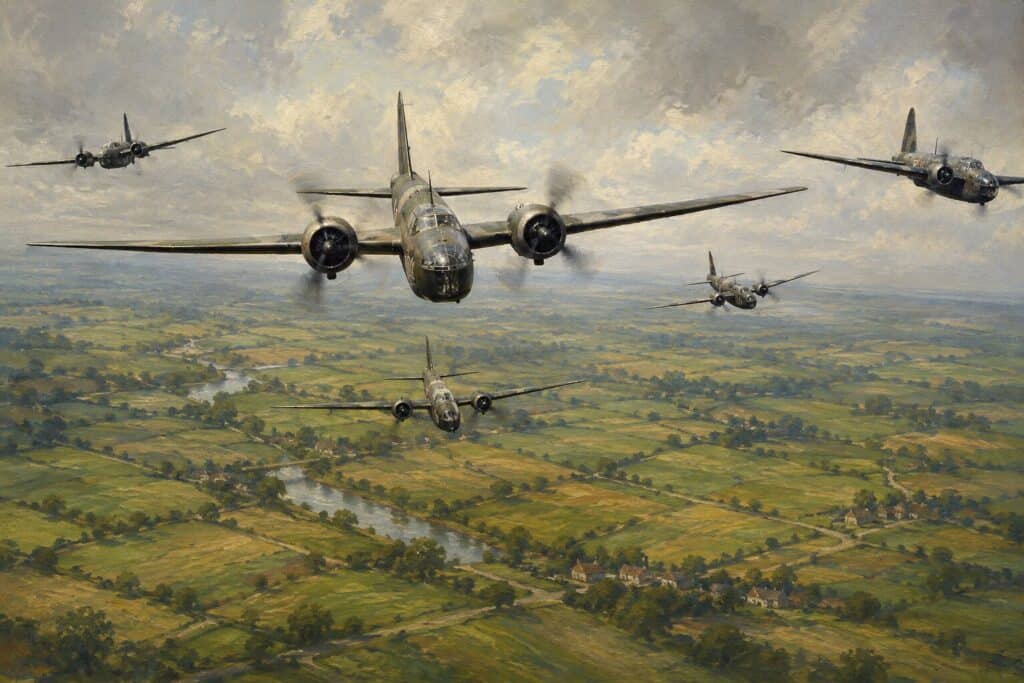
The operation was mounted by RAF Bomber Command under Harris, with a force of 1,047 aircraft dispatched. The attacking stream included heavy bombers such as the Avro Lancaster, Handley Page Halifax and Short Stirling, alongside Wellingtons, Whitleys, Hampdens and Manchesters. Because front-line squadrons alone could not supply a thousand aircraft, Bomber Command also drew on Operational Training Units, committing aircraft and crews normally engaged in training. This expanded the force considerably but exposed less experienced crews to the hazards of an operational raid. The size of the force was itself central to the operation’s purpose.
Recent developments in navigation and raid control helped make such concentration more practical. Bomber Command could not claim precision in the modern sense, but it planned to concentrate the bomber stream along a relatively narrow route and bring the main attack over Cologne in roughly 90 minutes. This compressed the time available for German night-fighter controllers and defences to intercept individual aircraft and increased the pressure on the city’s fire services. Operation Millennium therefore combined material force with organisational experiment.
Execution Of The Operation
The raid was carried out during the night of 30–31 May 1942. Aircraft crossed to the Continent in a planned stream rather than in a widely scattered succession, an approach designed to reduce the time available for interception and to increase the density of bombing over the target area. Cologne’s industrial districts, transport links and built-up centre were all vulnerable to a mixture of high explosive and incendiary attack.
For the RAF, the operation tested whether scale could partially compensate for the limitations still affecting night bombing. The raid did not eliminate those limitations, but it demonstrated that a large and concentrated force could produce visible destructive effect and make a considerable impression both in Germany and in Britain. It also showed the administrative reach of Bomber Command, which had assembled and dispatched an air effort beyond anything it had previously attempted in a single night.
How many aircraft did Bomber Command lose over Cologne?
Bomber Command lost 41 aircraft, 39 to enemy action and two in a collision (Guinness World Records). On the ground, 469 people in Cologne were killed.
Operation Millennium caused heavy damage across Cologne and started widespread fires. Of the force dispatched, approximately 868 aircraft reported bombing Cologne, dropping around 1,455 tons of bombs. Contemporary damage assessments recorded approximately 3,330 buildings destroyed. In Cologne 469 people were killed, with many more injured and thousands made homeless. These figures convey the consequences for Cologne’s population as well as the scale of the RAF operation. The raid also achieved its secondary aim: it proved that Bomber Command could mount a massed night attack of more than 1,000 aircraft and sustain the complex planning required to deliver it.
That success came at a cost. Bomber Command lost 41 aircraft on the operation, a reminder that even a carefully organised raid remained hazardous. Among those killed was Flying Officer Leslie Manser of No. 50 Squadron, whose Avro Manchester was severely damaged. Manser remained at the controls to give his crew a chance to escape and was awarded a posthumous Victoria Cross. The result combined operational achievement with significant attrition. Even so, the raid carried weight out of proportion to a single night’s destruction because it signalled that the RAF intended to prosecute the strategic bombing offensive with greater scale and concentration than before.
Why was Operation Millennium important?
It proved that Bomber Command could plan and deliver a massed night attack by more than 1,000 aircraft, and it secured political backing for the bomber offensive at a time when its value was in doubt. The bomber stream tactic used over Cologne became standard practice for the rest of the war.
Operation Millennium did not by itself decide the bombing war, nor did it resolve the continuing questions over accuracy, civilian damage and strategic effect that would remain central to the bomber offensive. Its importance lay instead in what it revealed about RAF capability and doctrine in mid-war. It was the clearest early expression of Harris’s determination to use mass as an operational instrument and to present Bomber Command as a decisive arm of British strategy.
The operation also sat at an important moment in the development of Britain’s heavy-bomber force. Aircraft such as the Lancaster, Halifax and Stirling were becoming increasingly central to the RAF’s offensive reach, and Cologne showed how those resources could be concentrated for political, psychological and military effect. In that sense, Operation Millennium stands less as an isolated spectacle than as a milestone in the evolution of the wider bomber campaign.
Conclusion
Operation Millennium was a landmark RAF operation because it joined symbolic intent to practical execution. By dispatching a force of 1,047 aircraft against Cologne, Bomber Command demonstrated a new scale of offensive capacity while accepting the losses and limitations that still accompanied night bombing in 1942. Its lasting significance lies in the way it marked the transition from earlier bomber operations to a more concentrated and expansive phase of the RAF’s strategic air offensive.