On This Day, 1918: By 30 September 1918, Allied air power was helping breach the Hindenburg Line through reconnaissance, artillery support and…
Read the entry →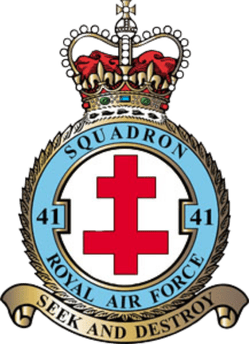
41 Squadron
Seek and Destroy
History of 41 Squadron RAF, from Western Front combat and Battle of Britain Spitfires to Jaguar operations and Typhoon test work at Coningsby.
Active RAF test and evaluation squadron responsible for Typhoon operational capability, weapons integration and tactics development; historically employed in fighter, reconnaissance and ground-attack roles.
No. 41 Squadron was formed during the First World War and entered active service on the Western Front in the autumn of 1916. After its early use, the F.E.8 underwent the difficult transition from obsolete pusher fighters to more capable scout aircraft, eventually operating the S.E.5 family. In that form, it took part in the major air fighting of the later war, including Arras, Cambrai and Amiens, while also carrying out ground-attack work at a time when the air war was still being defined in practice. By the Armistice, 41 Squadron had established a record of determined front-line service before being disbanded in the post-war reductions.
Inter-war growth and the Spitfire war
The squadron re-formed at RAF Northolt in 1923 and passed through a sequence of inter-war fighter types that mirrored the wider development of the RAF, from the Sopwith Snipe and Armstrong Whitworth Siskin to the Bristol Bulldog, Hawker Fury and, on the eve of war, the Supermarine Spitfire. A deployment to Aden during the Abyssinian crisis showed that the unit could be used beyond home defence, but its most consequential period came after 1939.
Flying Spitfires, 41 Squadron fought over Dunkirk and then in the Battle of Britain, operating chiefly from the south-east at the point where Fighter Command bore the greatest pressure. It remained in action through the defensive phase of 1940 and then moved into the offensive air war, flying sweeps, escorts and cross-Channel operations over occupied Europe. The squadron was involved in the air fighting over Dieppe and later followed the Allied advance after the Normandy landings, operating from continental airfields in support of the campaign into Germany.
Cold War re-formations and Jaguar operations
Like many long-lived RAF units, 41 Squadron experienced several post-war disbandments and re-formations as the Service adapted to new aircraft and strategic tasks. It flew the Gloster Meteor and then the Hawker Hunter era of early jet fighters before assuming the all-weather fighter role with the Gloster Javelin at RAF Wattisham. A further re-formation at RAF West Raynham placed the squadron in the Bloodhound surface-to-air missile role, illustrating how squadron identity sometimes outlasted a single aircraft category.
From the 1970s, the unit returned to a flying role with the McDonnell Douglas Phantom and then the SEPECAT Jaguar, becoming closely associated with tactical reconnaissance and low-level strike work. In the Gulf War of 1991, its Jaguar force took part in Operation Granby, linking the squadron's earlier fighter heritage with the expeditionary air operations of the late Cold War.
Test and evaluation in the modern RAF
The squadron's current role gives it a distinctive place within today's Royal Air Force. Reformed in the twenty-first century as a fast-jet operational evaluation unit and later as the Test and Evaluation Squadron, it became responsible for developing and assessing tactics, weapons integration, and operational capability for the Eurofighter Typhoon.
Based at RAF Coningsby, 41 Squadron now stands at the meeting point of front-line experience and technical development. Its history therefore runs from improvised First World War combat, through the Spitfire battles of 1940 and the jet age, to the modern business of proving how RAF combat aircraft should fight.
Western Front 1916–1918
Somme 1916
Arras 1917
Cambrai 1917
Somme 1918
Lys
Amiens
Dunkirk 1940
Battle of Britain 1940
Home Defence 1940–1944
Fortress Europe 1940–1944
Dieppe
France and Germany 1944–1945
Arnhem
Walcheren
Arabian Gulf 1991
Battle of Arras
Battle of Cambrai
Battle of Amiens
Dunkirk evacuation
Battle of Britain
Dieppe air battle
Arnhem
Walcheren
Operation Granby
| Period | Station | Notes |
|---|---|---|
| 1916 | Gosport | Squadron formation and work-up. |
| 1916–1919 | Saint-Omer and Abeele | Western Front operations. |
| 1919 | RAF Tangmere and RAF Croydon | Return to Britain before disbandment. |
| 1923–1935 | RAF Northolt | Inter-war fighter service. |
| 1935–1936 | RAF Khormaksar | Deployment during the Abyssinian crisis. |
| 1939–1945 | RAF Catterick, RAF Hornchurch, Tangmere sector stations and later advanced landing grounds in north-west Europe | Spitfire war service. |
| 1951–1958 | RAF Biggin Hill | Meteor and early jet fighter period. |
| 1958–1963 | RAF Wattisham | Javelin all-weather fighter phase. |
| 1965–1970 | RAF West Raynham | Bloodhound missile-defence role. |
| 1972–1977 | RAF Coningsby | Phantom reconnaissance and strike transition. |
| 1977–2006 | RAF Coltishall | Jaguar era, including Gulf War service. |
| 2006–present | RAF Coningsby | Fast-jet operational test and evaluation. |
| Name | Dates | Notes |
|---|---|---|
| Donald Finlay | 1938–1939 | Notable pre-war and early wartime commanding officer associated with the squadron’s Spitfire phase. |
Battle of Britain
How the Battle of Britain saw RAF Fighter Command defeat the Luftwaffe’s attempt to gain the air superiority…
Operation Granby
How Operation Granby saw the RAF fight in the 1991 Gulf War, from Tornado strike missions to the…


Phantom FGR.2s Reach Akrotiri During the Cyprus Crisis
On 23 July 1974, two RAF Phantom FGR.2s of No. 41 Squadron reached Akrotiri to support…
23 July 2026 · 3 minSiskin IIIA Becomes the RAF’s First All-Metal Fighter
On 27 March 1927, the Armstrong Whitworth Siskin IIIA entered RAF service, becoming the Service’s first…
27 March 2026 · 3 minD-Day Air Power and the RAF Over Normandy, 6 June 1944
On D-Day Allied air forces flew nearly 15,000 sorties, and the RAF helped secure the Normandy…
6 June 2026 · 3 min