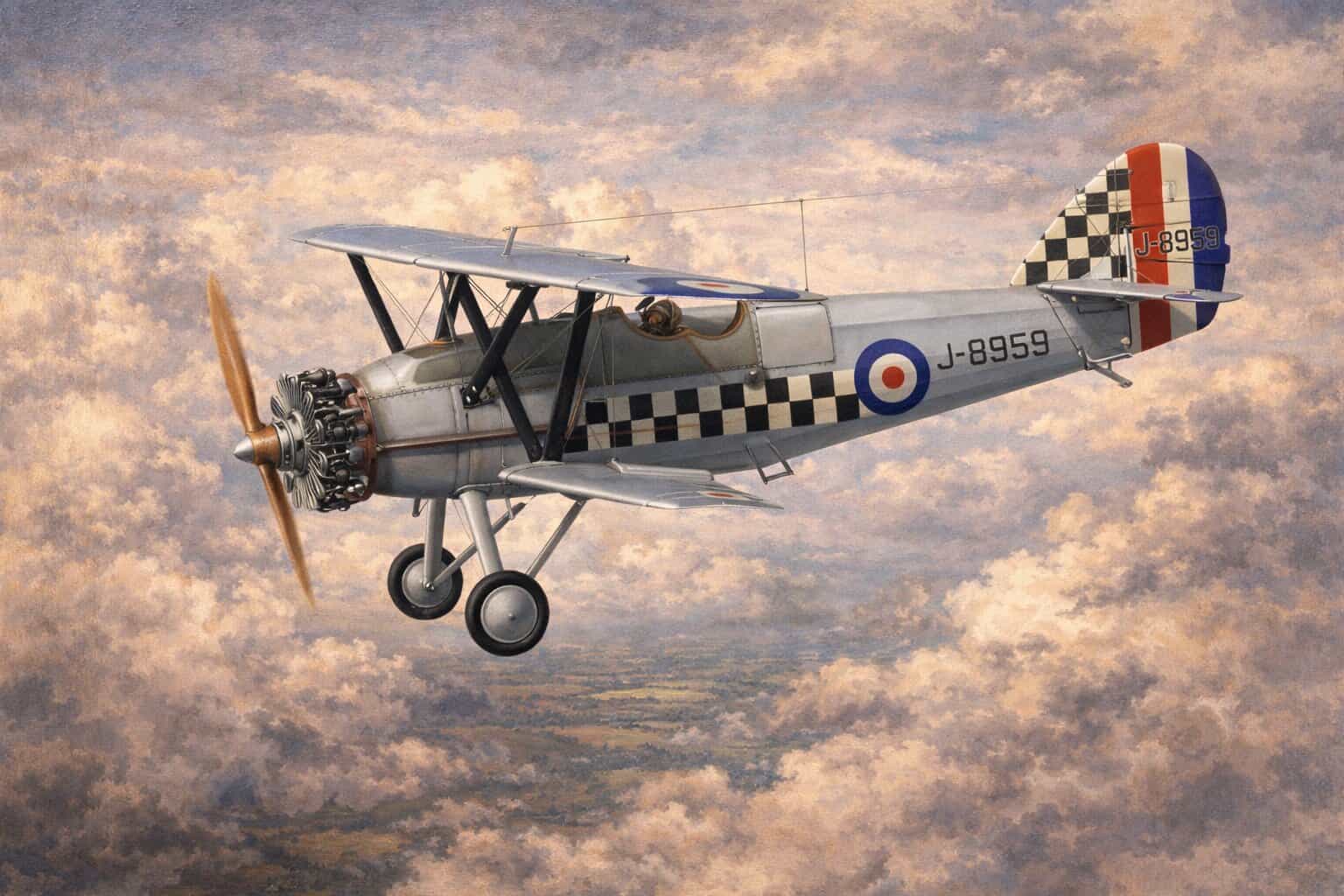
On 27 March 1927, the Armstrong Whitworth Siskin IIIA entered Royal Air Force service with No. 41 Squadron, marking an important step in RAF fighter development. The moment was significant not because it announced a dramatic combat debut, but because it signalled a technological change within the Service. The Siskin IIIA was the RAF’s first all-metal fighter to reach squadron service, and its arrival showed that the era of wood-and-fabric construction was beginning to give way to a more modern approach.
In the years after the First World War, the RAF was still defining both its purpose and its equipment. Britain had emerged from the conflict with powerful memories of air fighting over the Western Front. Still, the peacetime Service that followed was smaller, financially constrained and expected to do more with less. New aircraft had to offer not merely performance but also durability, practicality, and scope for future development. In that context, the Siskin IIIA mattered as much for what it represented as for what it did.
A New Kind of Fighter
The Siskin was a single-seat biplane fighter, but in terms of construction, it pointed beyond the methods that had dominated military aviation during the Great War. Metal airframes offered important advantages. They promised greater strength, improved resistance to wear, and a more standardised form of production and maintenance than traditional wooden structures could easily provide. For an air force looking to professionalise and modernise in the interwar period, those qualities were highly attractive.
The Siskin IIIA sat at an interesting point in aviation history. In appearance, it still belonged to the biplane age, yet in structure it anticipated the more advanced combat aircraft that would follow. It was not a final answer to fighter design, nor was it intended to be. Rather, it formed part of a longer technical progression in which the RAF tested how new materials and new engineering methods might improve operational aircraft.
Service entry with No. 41 Squadron gave that progression practical form. An aircraft becomes militarily meaningful only once it moves beyond prototype or trial status and enters everyday squadron use. The Siskin IIIA’s acceptance into front-line service showed that all-metal construction had advanced from theory and experimentation into regular RAF practice.
Significance for the RAF
For the RAF, the Siskin IIIA’s importance lay in its role within a broader interwar transition. The Service of the late 1920s was still some distance from the high-speed monoplane fighters that would define the Second World War, but the route towards them was built through aircraft such as this one. Every step in materials, construction, and maintenance standards helped lay the groundwork for later advances.
The Siskin IIIA also reflected the RAF’s continuing effort to maintain a credible fighter arm during a period when defence policy was shaped by economy and uncertainty. There was no immediate prospect in 1927 of the kind of total air war that would come a decade later. Even so, the Service could not afford to stand still. Introducing more modern aircraft into squadron service was part of efforts to preserve institutional knowledge, technical competence and operational readiness.
Wider Air-War Reflection
Seen in retrospect, the Siskin IIIA belongs to the often-overlooked story of interwar preparation. Aircraft of the late 1920s rarely attract the fame of the Spitfire or Hurricane, yet they were essential links in the chain of RAF development. They carried the Service from its First World War inheritance into a more modern age of aeronautical design.
The entry of the Armstrong Whitworth Siskin IIIA into service on 27 March 1927 was therefore a modest but meaningful milestone. It did not transform air power overnight, but it marked the RAF’s first operational step into all-metal fighter construction. In that sense, it stands as an early sign of the technical evolution that would eventually shape Britain’s air defence in the years ahead.