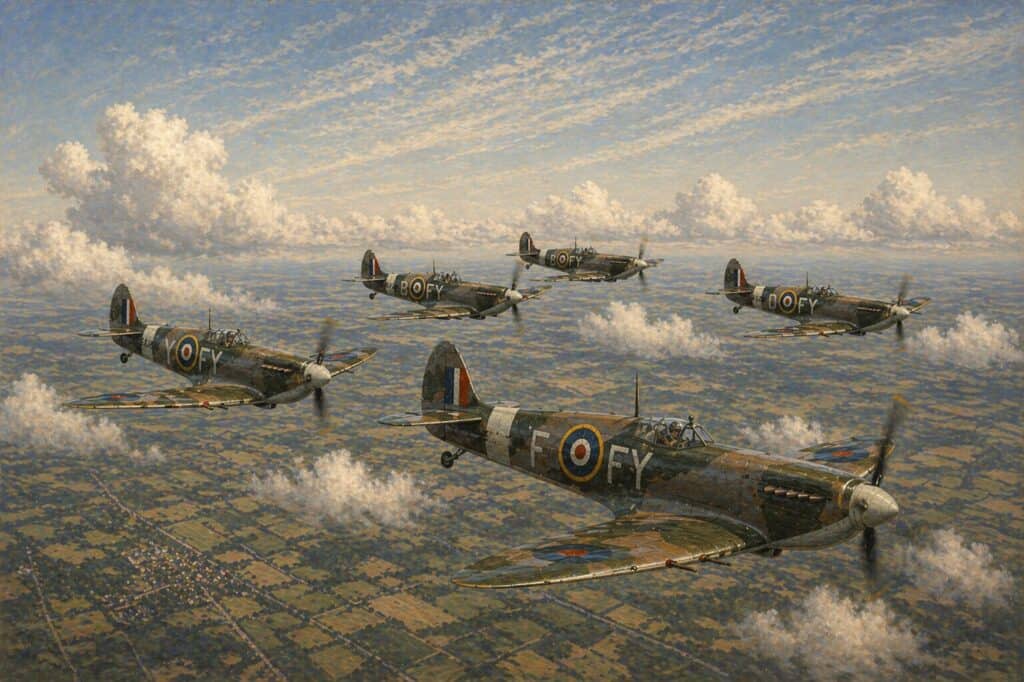
Operation Jubilee was the Allied raid on Dieppe on 19 August 1942. For the RAF, it produced one of the most intense single days of air combat of the Second World War to that date. The operation formed part of the wider Allied effort to test German coastal defences, gain experience in combined operations and maintain pressure in Western Europe before a full invasion was possible.
Air superiority was treated as essential to the operation. RAF and Dominion squadrons were required to protect the naval force, cover the landings and challenge the expected Luftwaffe response. The resulting air battle became one of the defining features of the operation and provided costly but important lessons in amphibious air support.
Strategic Context And Planning
By 1942, there was strong political and military pressure for offensive action in Western Europe. Limited raids were seen as a way to gain operational experience and test German reactions. In this setting, air power was expected to help make a temporary assault on a defended port feasible.
RAF tasks extended beyond fighter escort. Aircraft had to protect the convoy crossing, support troops on the beaches, attack coastal positions and engage the Luftwaffe over northern France. A significant planning decision was the absence of heavy preliminary bombing against Dieppe itself. This reflected concern about civilian casualties and physical obstruction of the port, but it also meant that German defences remained largely intact when the assault began.
RAF Aircraft And Air Battle
Operation Jubilee involved one of the largest concentrations of RAF and Dominion fighter strength yet assembled for a single day in 1942. More than seventy squadrons took part, using aircraft led primarily by the Supermarine Spitfire and, in fighter-bomber form, the Hawker Hurricane.
Spitfires provided standing patrols over the beaches and convoy routes, while Hurricanes and other aircraft undertook low-level attacks against gun positions and defences. The scale of effort reflected the importance attached to continuous air cover over the operation.
The resulting battle was sustained and costly. German fighters benefited from operating close to their bases in northern France, while RAF aircraft crossing from southern England had limited endurance over the target area. Even so, the RAF maintained intense activity throughout the day, flying repeated sorties in support of the raid.
Losses and Immediate Results
Operation Jubilee resulted in heavy Allied air losses. More than one hundred Allied aircraft were destroyed, and aircrew casualties were substantial. German losses were significant but generally lower.
The ground assault on Dieppe failed at high cost, but the air battle revealed important strengths and limitations in RAF support to amphibious operations. The RAF demonstrated that it could sustain high sortie rates over enemy-held territory and engage large numbers of German aircraft in direct support of a seaborne assault. At the same time, the operation exposed the limits imposed by range, endurance, target identification and inadequate suppression of coastal defences.
Historical Significance
Operation Jubilee is significant in RAF history less for battlefield success than for operational learning. The raid helped demonstrate that air superiority was essential to any later invasion attempt, but it also showed that fighters alone could not compensate for the survival of strong defences on the ground.
Lessons from Dieppe informed later planning for amphibious operations, particularly regarding bombardment, inter-service coordination, and the maintenance of sustained air cover over a beachhead. In this sense, the air battle over Dieppe forms part of the wider path by which Allied air and amphibious methods improved before Normandy.
Conclusion
Operation Jubilee brought the RAF into one of the most intense single days of air fighting of the war up to 1942. Through repeated sorties over Dieppe, RAF and Dominion squadrons attempted to shield the raid, contest Luftwaffe intervention and support troops on the beaches.
The operation ended in failure on the ground and heavy losses in the air, but it provided important experience regarding the relationship between air power, combined operations, and the practical difficulties of attacking a defended port. That makes Jubilee an important and costly episode in RAF operational history.