On This Day, 1999: On 16 November 1999, plans to upgrade RAF Jaguar Adour engines marked a further step in sustaining the…
Read the entry →Consolidated Catalina
Consolidated Aircraft Corporation
Explore the Consolidated Catalina, the RAF flying boat that found Bismarck, hunted U-boats, and served across the Atlantic and Indian Ocean.
The Consolidated Catalina was among the Royal Air Force’s most important long-range maritime aircraft of the Second World War. Introduced into RAF service in 1941, the American-designed flying boat combined exceptional endurance with the ability to operate from sheltered water rather than a conventional runway. Coastal Command used it to search vast areas of ocean, protect convoys, locate enemy ships and submarines, and conduct rescue missions. Its role in finding the German battleship Bismarck in May 1941 became one of the best-known examples of maritime reconnaissance influencing a major naval operation.
The Catalina was comparatively slow and vulnerable when confronted by fighters or concentrated anti-aircraft fire. Its value lay instead in its reach, persistence and the crews’ ability to find and report targets across immense stretches of water. The type served in the Atlantic and in distant overseas theatres, helping the RAF extend aerial coverage to places that shorter-range aircraft struggled to reach.
When did the Catalina enter RAF service?
The Catalina was the American Consolidated PBY flying boat, whose prototype first flew on 28 March 1935, and the RAF began flying it in 1941. Coastal Command used it for long-range ocean patrol alongside the Sunderland and, later, the Liberator.
The Catalina began as Consolidated’s Model 28, developed for the United States Navy as a long-range patrol bomber. The prototype first flew on 28 March 1935. Its high-mounted parasol wing, deep boat hull and retractable wingtip floats were chosen to combine useful aerodynamic performance with practical water operations. The resulting aircraft became the PBY in American service, with later versions incorporating improvements to equipment, engines and construction.
Britain ordered Catalinas as the demand for long-range maritime patrol aircraft grew. The RAF faced the problem of searching enormous ocean areas for submarines and surface raiders while protecting shipping routes essential to Britain’s survival. Flying boats could use suitable stretches of sheltered water as bases, providing flexibility where large runways were unavailable or difficult to construct.
Early RAF Catalinas entered service during 1941. The aircraft complemented, rather than simply replaced, other Coastal Command types. Sunderlands, Hudsons and later Liberators each offered different combinations of speed, endurance, weapons and operating arrangements. The Catalina’s particular strength was its ability to remain airborne for prolonged periods and conduct wide-ranging searches.
Airframe, Engines and Crew
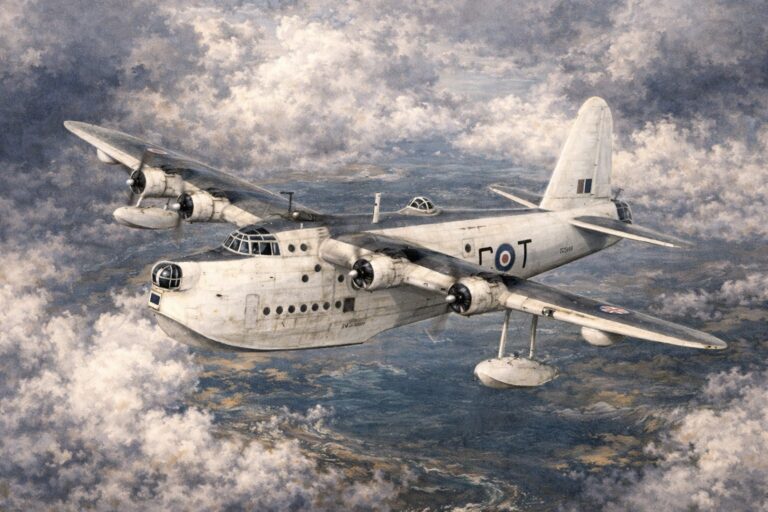
The Catalina was a twin-engined flying boat with a distinctive parasol wing mounted above its hull. Most wartime versions were powered by two Pratt & Whitney radial engines. The high wing helped keep the engines and propellers clear of spray, while the broad hull provided buoyancy for take-offs, landings and mooring. The wingtip floats could retract upwards in flight to reduce drag.
Its crew varied with version and mission but typically included pilots, navigation and radio personnel, and gunners. Long patrols demanded sustained cooperation between those responsible for flying, navigation, lookout duties, communications and weapon operation. Fatigue was a significant operational consideration, especially when crews spent many hours searching featureless sea in poor weather.
The aircraft’s large fuel capacity supported endurance measured in many hours, although actual patrol time depended on load, weather, routing and the distance to the search area. Its modest speed meant that reaching a distant patrol station could consume a considerable part of a sortie. Once there, however, the Catalina could continue searching or shadowing for longer than many contemporary aircraft.
Weapons, Equipment and Variants
Catalinas carried defensive machine guns in positions that varied with the model, including nose, waist and rear-facing installations. They could also carry bombs and depth charges for attacks on surface vessels and submarines. The available load depended on the aircraft’s variant, fuel requirements and mission. The type was primarily a patrol aircraft with an offensive capability, rather than a fast strike bomber.
RAF Catalinas came from a wider family of PBY variants. Some were conventional flying boats, while later amphibious configurations added retractable wheels and could operate from land as well as water. The presence of an undercarriage changed basing possibilities but also introduced weight and maintenance considerations. Equipment fit differed among batches and through wartime modification, so equipment varied from aircraft to aircraft.
Navigation and radio equipment were central to operations. Aircraft operating hundreds of miles from land had to maintain reliable position estimates and report sightings accurately enough for naval forces or other aircraft to act. Radar later strengthened search capability, particularly when visibility was poor, but crews still depended on careful visual observation and sound navigation.
Coastal Command and Flying-Boat Bases
Nos. 209 and 240 Squadrons were among the RAF units that operated the Catalina early in its service. Flying-boat stations such as Castle Archdale on Lough Erne in Northern Ireland offered access to the Atlantic approaches while providing sheltered water for aircraft operations. Bases required moorings, servicing facilities, boats, fuel supplies and arrangements for moving crews and equipment between shore and aircraft.
Water operations created challenges absent from ordinary airfields. Wind, waves, visibility and the condition of the anchorage affected take-off and landing. Salt water accelerated corrosion, while maintaining engines and equipment on an aircraft afloat could be awkward and time-consuming. Ground crews and marine support personnel were essential to keeping patrol aircraft available.
Castle Archdale became particularly associated with long-range reconnaissance over the Atlantic. Its position allowed Catalinas to reach western approaches and conduct searches in waters vital to British shipping. The aircraft’s endurance made such patrols practical, but long distances still required careful fuel planning and reliable weather information.
How did a Catalina find the Bismarck?
On 26 May 1941 a Catalina of No. 209 Squadron from Lough Erne, captained by Flying Officer Dennis Briggs with US Navy Ensign Leonard Smith at the controls, found the battleship Bismarck after British forces had lost contact. Its report let the Royal Navy close in, and Bismarck was sunk the next day.
In May 1941, the German battleship Bismarck attempted to break into the Atlantic during Operation Rheinübung. After the Battle of the Denmark Strait and the loss of HMS Hood, British forces sought to maintain contact with the battleship and prevent her from reaching safety. Bismarck temporarily evaded her pursuers, making renewed reconnaissance essential to the Royal Navy’s efforts.
On 26 May, a Catalina of No. 209 Squadron operating from Castle Archdale located Bismarck again. The aircraft was flown by a crew that included RAF personnel and American naval aviators serving in a training and familiarisation capacity before the United States formally entered the war. Ensign Leonard B. Smith of the United States Navy was at the controls when the battleship was sighted, while the aircraft’s RAF captain was Flying Officer Dennis Briggs.
The sighting restored the British command’s knowledge of Bismarck’s position. It did not itself destroy or disable the ship, and finding the battleship was distinct from the later task of maintaining contact. Other aircraft and naval units contributed to subsequent shadowing and attack. The Catalina’s achievement was to locate a fast-moving target across a vast ocean at the critical moment when its position had become uncertain.
The report helped the Royal Navy direct forces towards the battleship. Carrier aircraft from HMS Ark Royal subsequently attacked Bismarck, and British surface forces brought the action to its conclusion on 27 May. The episode showed how long-range air reconnaissance could have strategic consequences far beyond the firepower carried by the aircraft making the sighting.
The Battle of the Atlantic
Throughout the Atlantic campaign, Catalinas flew patrols intended to detect U-boats, escort shipping and gather information about enemy movements. Convoys depended on the combination of naval escorts, intelligence and air cover. An aircraft sighting a submarine could force it to dive, interrupt its approach to a convoy and reduce its ability to travel quickly on the surface.
Patrols were often uneventful in visible terms. Crews might spend hours scanning the ocean without seeing an enemy vessel, yet the possibility of aircraft appearing could influence submarine tactics. The value of air cover therefore included deterrence, reconnaissance and the disruption of enemy operations as well as confirmed attacks.
The Catalina contributed to expanding coverage over ocean approaches, but it could not independently close every gap in the Atlantic. Aircraft range, the availability of bases, weather and the number of serviceable machines all limited coverage. Very-long-range Liberators and other Coastal Command aircraft became especially important as the air campaign developed. The Catalina formed one part of a broader system of maritime air power.
Radar and Search Tactics
Radar improved the ability of maritime patrol aircraft to detect ships and submarines, particularly in darkness or poor visibility. Catalina equipment evolved during the war, with radar installations differing by version and period. Operators had to interpret contacts and guide pilots towards positions where crews could identify a target visually or prepare an attack.
The distinction between radar search and visual identification mattered. A radar return did not automatically reveal whether a contact was a submarine, merchant ship or friendly vessel. Crews had to combine equipment readings with navigation, intelligence and observation. Weather and sea conditions could further complicate the process.
The Leigh Light, used for illuminating submarines during night attacks, was particularly associated with aircraft such as the Wellington and Liberator. The Catalina’s contribution to radar-assisted maritime patrol lay principally in extending search and contact-reporting capabilities, with individual aircraft carrying equipment appropriate to their operational assignment.
Attacking U-boats
When a Catalina found a surfaced submarine, the crew had to decide whether an attack was possible. Depth charges required a suitably timed and positioned release, usually during a low approach. A submarine that spotted the aircraft could attempt to dive, while one remaining on the surface might fight back with anti-aircraft guns.
Approach geometry was critical. The pilot needed to bring the aircraft into an effective position while the crew identified the target, prepared weapons and maintained accurate height and speed. The Catalina’s size and modest speed made it vulnerable during such attacks, particularly against submarines carrying heavier anti-aircraft armament later in the war.
Results were not always immediately clear. A submarine might disappear beneath the surface without having been sunk, while oil or debris could be misinterpreted. Wartime claims therefore need to be distinguished from losses established by subsequent research. The wider anti-submarine campaign depended on repeated patrols, accurate reporting and cooperation with naval escorts, not solely on the number of submarines credited to individual aircraft.
Why did John Cruickshank win the Victoria Cross?
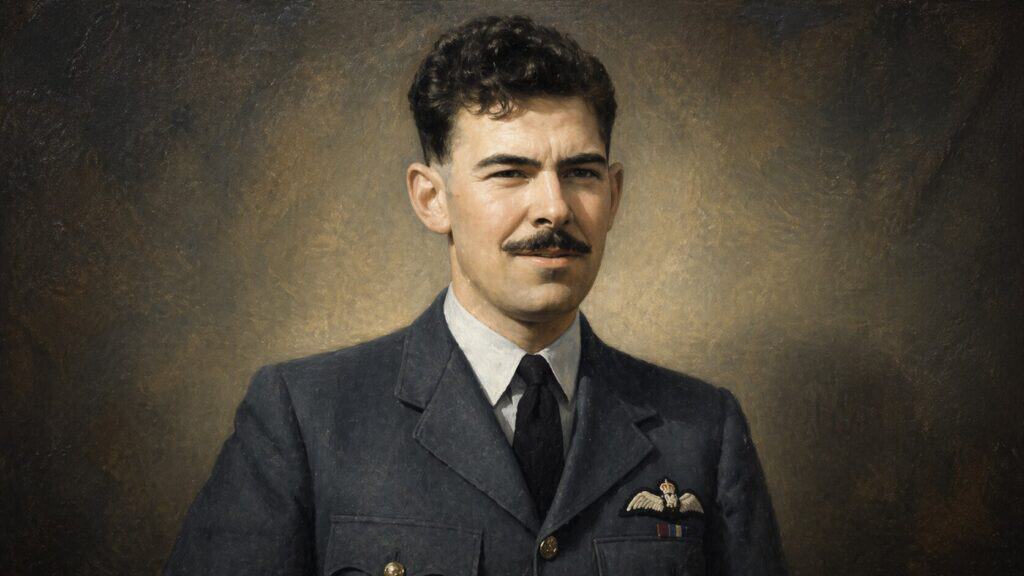
On 17 July 1944 Flying Officer John Cruickshank of No. 210 Squadron attacked a U-boat off Norway in his Catalina and was hit 72 times by its return fire. Despite his wounds he helped bring the aircraft home on a flight of more than five hours, and he was awarded the Victoria Cross.
One of the most remarkable Catalina actions took place on 17 July 1944. Flying Officer John Alexander Cruickshank of No. 210 Squadron attacked a German submarine, long recorded as U-347 and now identified as U-361, in waters off northern Norway. His Catalina encountered intense defensive fire during the engagement. Cruickshank was gravely wounded, and other members of the crew were also hit.
Despite his injuries, Cruickshank continued to direct the operation and help bring the aircraft home. The attack and the subsequent return required extraordinary endurance from the crew. Cruickshank’s determination under fire and his conduct during the long flight back formed the basis of his Victoria Cross award.
The action captures both the Catalina’s capabilities and the hazards of maritime patrol. The aircraft had the range to reach distant submarine operating areas and the weapons to attack a contact, but it was exposed to devastating fire when it approached at low level. Its successful return depended on the crew’s discipline and cooperation as well as the aircraft’s endurance.
Cruickshank’s Victoria Cross should be understood within the broader record of Coastal Command crews who conducted long patrols in dangerous conditions, frequently without the public attention accorded to fighter and heavy-bomber operations.
Air-Sea Rescue and Special Duties
The Catalina’s ability to alight on water made it suitable for certain air-sea rescue tasks. Where sea conditions permitted, a flying boat could approach survivors directly rather than merely reporting their location or dropping supplies. This was a valuable capability in remote areas where ships might take many hours to reach a casualty.
Landing on the open sea was nevertheless hazardous. Swell, wind and waves could damage the hull or make take-off impossible. Rescue crews had to judge whether a water landing would save lives or place their own aircraft and passengers at unacceptable risk. The Catalina’s ability to operate from water did not mean that it could safely land in every sea state.
The aircraft also undertook transport, communications and special duties in regions where established airfields were scarce. Its endurance and ability to use sheltered anchorages made it useful for linking isolated bases and conducting reconnaissance across dispersed island and coastal areas.
The Indian Ocean and Far East
RAF Catalinas served well beyond the Atlantic. No. 205 Squadron operated the type in the Far East and Indian Ocean region, including from bases associated with Singapore and Ceylon. These theatres demanded long over-water patrols, reconnaissance and support for maritime communications across vast distances.
The Japanese advance in 1941–42 made maritime reconnaissance particularly urgent. Allied forces needed information about naval movements, shipping and threatened approaches, often while airfields and established bases were under pressure. Flying boats offered a degree of basing flexibility, although suitable anchorages, servicing facilities and protection remained necessary.
In the Indian Ocean, Catalinas helped patrol shipping routes and support wider Allied operations. Their role varied with the campaign, but the common requirement was endurance: aircraft needed to search extensive areas where ships could otherwise move without observation. Overseas Catalina service formed an important part of the RAF’s global maritime war rather than a minor extension of Atlantic operations.
Final Wartime Operations
Coastal Command continued anti-submarine patrols until the final days of the European war. A Catalina of No. 210 Squadron was involved in a U-boat attack on 7 May 1945, an action commonly associated with Coastal Command’s last U-boat claim of the conflict.
By 1945, maritime patrol operations had changed markedly from those of 1941. Radar, intelligence, improved weapons and closer coordination with naval forces made anti-submarine warfare more systematic. The Catalina remained useful, but newer land-based aircraft could offer greater speed, improved equipment and different operational advantages.
Why was the Catalina important to the RAF?
Its endurance let Coastal Command search huge areas of ocean, shadow warships and protect convoys far from land, and its ability to land on water made it useful for rescue. It was slow and vulnerable to fighters, but in maritime patrol range mattered more than speed.
After the war, the Catalina’s RAF career drew to a close as changing requirements and the growing availability of suitable airfields reduced the advantages of flying boats. Long-range land-based maritime aircraft increasingly offered a more practical combination of speed, payload, sensors and support arrangements.
The Catalina’s legacy rests on the strategic value of persistence. It helped the RAF search the Atlantic approaches, shadow surface vessels, protect convoys and attack submarines. Its role in the rediscovery of Bismarck demonstrated the consequences of finding the right target at the right moment, while the courage of crews such as John Cruickshank’s showed the dangers involved in bringing maritime patrol operations to a successful conclusion.
Slow by the standards of fighter aircraft, the Catalina nevertheless performed tasks for which speed was not the decisive quality. Its endurance, flexible basing and ability to carry out reconnaissance, patrol, attack and rescue duties made it one of the RAF’s most valuable maritime aircraft of the Second World War.
| Dimensions | |
| Wingspan | 104 ft 0 in (31.70 m) |
| Length | 63 ft 10 in (19.46 m) |
| Height | 20 ft 1 in (6.12 m) |
| Wing area | 1,400 sq ft (130.1 m²) |
| Weights | |
| Empty weight | 20,910 lb (9,485 kg) |
| Max takeoff weight | 35,420 lb (16,066 kg) |
| Max bomb load | 4,000 lb (1,814 kg) |
| Performance | |
| Maximum speed | 196 mph (315 km/h) |
| Cruise speed | 125 mph (201 km/h) |
| Service ceiling | 15,800 ft (4,816 m) |
| Range | 2,520 mi (4,056 km) |
| Powerplant | |
| Engines | 2 × Pratt & Whitney R-1830 Twin Wasp radial engines |
| Power | 1,200 hp (895 kW) each |
| Armament | |
| Guns | 2–3 × .303 in machine guns; up to 4,000 lb (1,814 kg) of bombs, depth charges, or torpedoes |
| Bombs / weapons | 4,000 lb (1,814 kg) |
David Hornell Wins the Victoria Cross in Anti-Submarine Attack
Flight Lieutenant David Hornell sank U-1225 on 24 June 1944, then fought to save his crew…
24 June 2026 · 3 minRAF Coastal Convoy Patrols in the Second World War
How RAF Coastal Command convoy patrols protected Atlantic and coastal shipping in the Second World War,…
23 April 2026 · 5 minCruickshank VC Attack on U-361 Sinks U-Boat in 1944
On 17 July 1944, Flt Lt John Alexander Cruickshank pressed home a Catalina attack on U-361…
17 July 2026 · 3 min