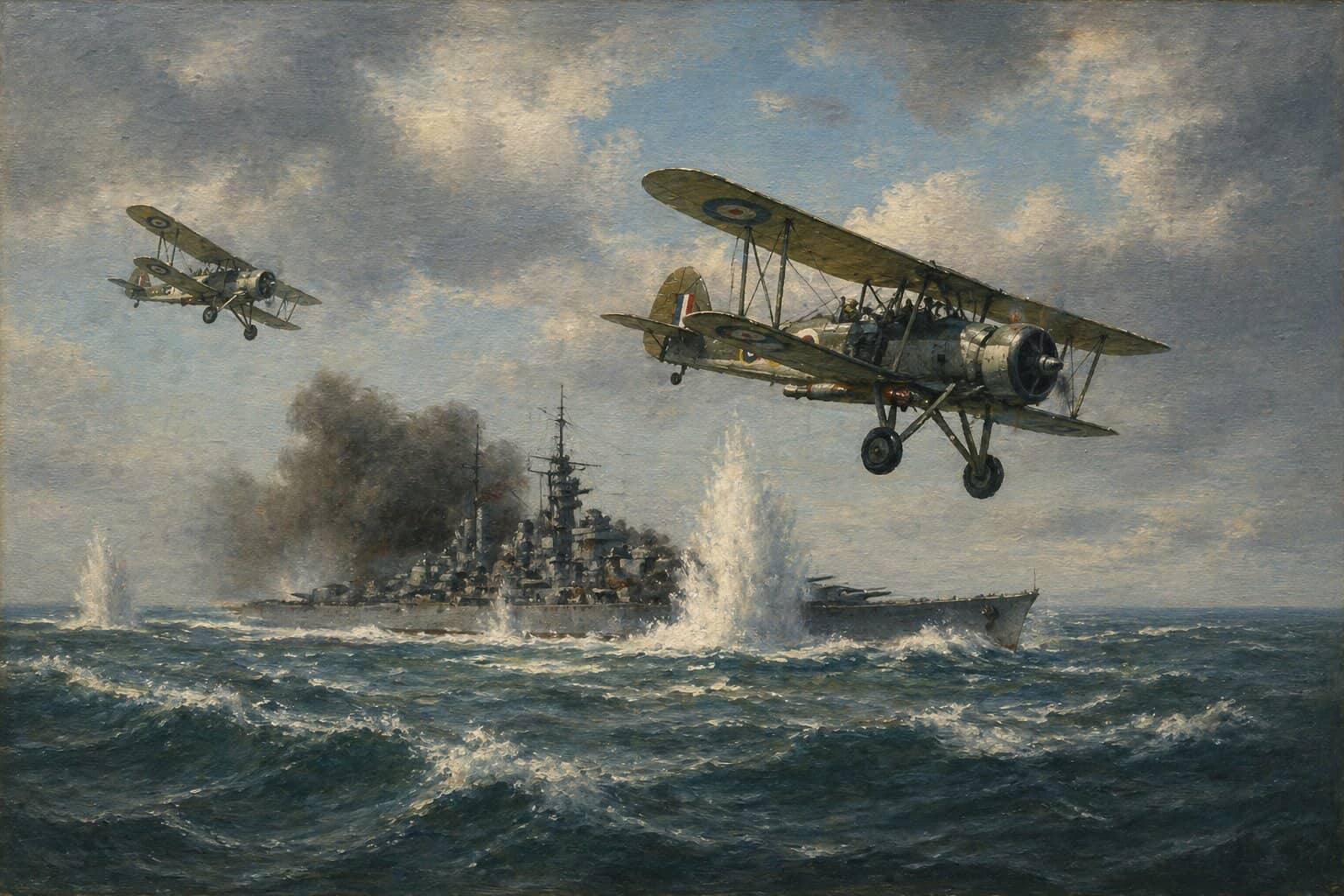
On 27 May 1941, Royal Navy surface forces overwhelmed the damaged battleship Bismarck, bringing the German breakout attempt into the North Atlantic to an end. The sinking was a naval climax, but it emerged from a wider campaign of search, pursuit and pressure in which air power had played an important supporting part. By the time the final gunfire came, the decisive issue was no longer whether Bismarck would threaten the Atlantic, but how quickly she could be finished.
The end of the breakout attempt
Bismarck’s sortie had represented a grave danger because a powerful German battleship operating against Atlantic trade routes could force Britain into an expensive and urgent naval response. Once the ship broke into open waters, the problem was not merely to fight her but to find her, hold contact and bring superior force to bear. Maritime warfare at that scale depended upon information as much as armament.
That is why the final destruction of Bismarck should be seen in the context of the whole hunt. Earlier reconnaissance and shadowing had helped turn a potentially elusive sortie into a sustained pursuit. The battleship that was sunk on 27 May was not a free predator at large, but a hunted vessel whose position and condition had gradually been brought under pressure by the combined British effort.
Air power and the hunt
Although Bismarck was ultimately destroyed by naval gunfire, aircraft had already demonstrated their value in the operation. Reconnaissance had helped establish awareness of her movements, and the broader pursuit showed how air and sea power could reinforce one another. In maritime warfare, the side that can search effectively often creates the conditions for subsequent success.
That matters in RAF terms because it highlights a form of contribution that is sometimes overshadowed by more dramatic combat narratives. The RAF’s role in events connected with Bismarck lay, above all, in reconnaissance and the broader provision of intelligence to commanders facing a fast-moving surface threat. The principle was clear: if a major enemy unit could be found and followed, the chances of decisive interception increased sharply.
Results and significance
The sinking removed one of the most formidable threats then facing Britain’s ocean lifelines. It also carried a psychological effect out of proportion to the destruction of a single ship. Bismarck had seemed both powerful and dangerous, and the determination shown in the pursuit signalled that Britain would commit major effort to destroy such a threat before it could reshape the Atlantic battle.
For British forces, the result was therefore both practical and symbolic. A dangerous breakout had been defeated, and the episode reaffirmed the importance of joint maritime action in the defence of the convoy routes on which Britain depended. The naval force delivered the final blow, but it did so within a wider operational framework shaped by reconnaissance, tracking, and pressure from the air as well as the sea.
A wider reflection on the air war at sea
The end of Bismarck offers a useful reminder that air power in the Second World War was not confined to bombing cities or fighting over land fronts. It also influenced the maritime war by locating enemy ships, extending commanders' eyes, and helping to compress vast ocean spaces into something more manageable. In that sense, the story belongs as much to the history of information and reach as to the history of firepower.
On 27 May 1941, the destruction of Bismarck closed one of the most famous chases of the war. It also confirmed the value of reconnaissance and shadowing in maritime operations, where finding and holding a surface raider could be as decisive as the final destruction itself.