On This Day, 1939: On 21 October 1939, 46 Squadron Hurricanes intercepted Heinkel He 115 floatplanes over the North Sea in the…
Read the entry →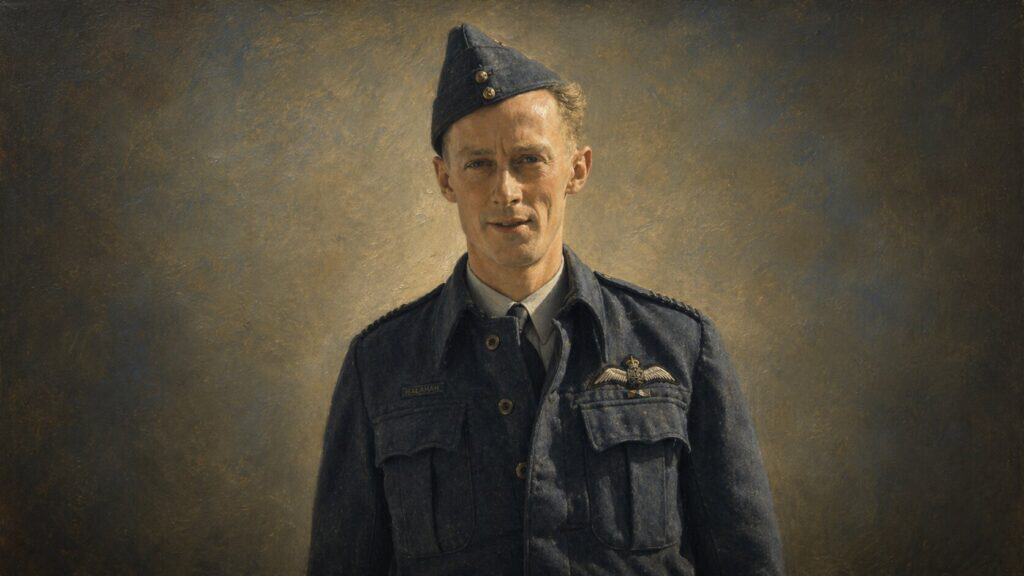
Distinguished Flying Cross and Bar (DFC)
George Walton Holden
George Walton Holden was a decorated Bomber Command officer who briefly led 617 Squadron before being killed on the Dortmund–Ems Canal raid.
Early Life
George Walton Holden belonged to the generation of Bomber Command officers whose careers were formed entirely within the expansion and demands of the Second World War. The surviving official and near-official record is much fuller on his service career than on his early life, but it is clear that he had entered the Royal Air Force by 1934 and was therefore a pre-war entrant who matured as an airman before the great expansion of the wartime bomber force. By the time his name begins to appear prominently in the public record, he was already an operational pilot of considerable experience.
That pre-war entry is significant. Officers and senior non-commissioned aircrew who had joined before 1939 formed an important professional core within Bomber Command. They carried into wartime operations a degree of training continuity and service experience that could not be quickly improvised once the air offensive intensified. Holden’s subsequent decorations and appointments suggest that he belonged to that cadre of dependable operational leaders whose careers advanced through proven service rather than public prominence.
Entry into Service
Holden’s recorded wartime progression shows him first as a non-commissioned airman in the Royal Air Force Volunteer Reserve and later as a commissioned officer. In September 1941 the London Gazette announced the award of the Distinguished Flying Medal to Warrant Officer George Walton Holden of 25 Squadron. That places him firmly within the group of experienced bomber pilots whose gallantry was recognised before commissioning. A Gazette notice published shortly afterwards recorded his appointment as a Pilot Officer on probation in August 1941, showing the transition from senior non-commissioned rank to commissioned status.
This pattern was not unusual in wartime Bomber Command. A number of highly capable sergeants, flight sergeants and warrant officers were commissioned after distinguished operational service. In Holden’s case, the shift from Warrant Officer to commissioned officer coincided with increasingly responsible bomber appointments and with service in squadrons equipped for the expanding night offensive against Germany.
Operational Career
By 1941 Holden was flying Handley Page Halifax bombers with 35 Squadron. Squadron records preserved in secondary research based on the Operations Record Book place him as captain of Halifax aircraft on operational sorties in the summer of that year, including the daylight attack on the battleship Scharnhorst at La Pallice on 24 July 1941. Those records describe his aircraft sustaining serious damage and casualties among the crew, yet returning safely to England. This aligns with the broader pattern of Bomber Command operations in 1941, when crews were often required to attack strongly defended targets with aircraft and tactics still undergoing rapid development.
His later career is more clearly documented in the London Gazette. By February 1943 he was an Acting Wing Commander with 102 Squadron and already held the Distinguished Flying Cross, to which a Bar was then awarded. The published citation described a sortie in January 1943 in which severe icing and the failure of an outer engine left his aircraft difficult to control. Holden nevertheless continued to the target, flew over the area to ensure success, and bombed accurately. The citation concluded that he had always displayed outstanding courage and determination in completing his task.
In June 1943 he was further recognised with the Distinguished Service Order while still with 102 Squadron. That sequence of awards indicates not a single exceptional episode alone, but a sustained record of gallantry and leadership within the main bomber offensive. By mid-1943 he had risen into the ranks of the more experienced bomber commanders on whom Bomber Command increasingly relied.
Major Actions or Commands
Holden’s most historically notable appointment came after Operation Chastise. A Royal Air Force Museum transcript on 617 Squadron after the dams raid records that, after the squadron moved from Scampton to Coningsby, it had a new commander: Squadron Leader George Holden. The unit had also been re-equipped with Lancasters adapted to carry a 12,000 lb blast bomb and was being prepared for a new role in special operations. Holden therefore took command at a moment when 617 Squadron was beginning to evolve beyond its initial fame as the Dambusters.
On the night of 15/16 September 1943, eight aircraft of the squadron were dispatched against an embanked section of the Dortmund–Ems Canal. The same RAF Museum account states that bad weather and heavy defences took a severe toll: five of the eight aircraft, including that of the squadron commander, failed to return, and the canal was left undamaged. Holden was killed on this operation. His period in command of 617 Squadron was therefore extremely short, but it fell within an important and difficult stage in the unit’s wartime development.
Later Life and Death
Holden did not live to see either the later achievements of 617 Squadron or the post-war fame that would attach to its operations. Commonwealth War Graves Commission casualty records show that he died on 16 September 1943, aged thirty, and identify him as the son of Frederick Charles Holden and Beatrice Holden, of Twickenham. He is buried in Reichswald Forest War Cemetery in Germany.
Because his death occurred in active command and before the end of the war, his later memory has remained bound to Bomber Command’s operational history rather than to a post-war public role. Unlike Guy Gibson, whose career was fixed in public memory by Operation Chastise, Holden is more often encountered in specialist squadron histories, casualty studies, and works on the evolution of 617 Squadron after the dams raid.
Historical Significance
George Walton Holden’s significance lies in the combination of two related histories. The first is that of the wider Bomber Command offensive, in which he emerged as a decorated and trusted operational commander, receiving the DFM, DFC and Bar, and DSO across a relatively short but distinguished wartime career. The second is that of 617 Squadron in the period immediately after Operation Chastise, when Holden briefly took over command during the squadron’s transition to a broader special-duties role.
His story also illustrates how Bomber Command leadership was renewed and sustained by officers who were not necessarily the most famous public figures of the war but who had already established strong operational reputations. Holden’s record suggests precisely that kind of career: one built through repeated flying, increasing responsibility, and the confidence of senior command. His death in September 1943 prevented any later accumulation of public distinction, but the documentary record shows that he had already earned a significant place within the history of RAF bomber operations.
16 September 1943
Ted Swales VC: Master Bomber on the Pforzheim Raid
On 23 February 1945, Ted Swales led the Pforzheim raid as Master Bomber and died after…
23 February 2026 · 3 minConvoy Peewit and Luftwaffe Attacks in the Battle of Britain
On 7 August 1940, Convoy Peewit came under Luftwaffe attack in the Channel as RAF fighters…
7 August 2026 · 3 minRAF Losses and Attrition Across the Second World War
How RAF losses in war included combat, training and hidden attrition, shaping policy, doctrine and the…
28 April 2026 · 6 min