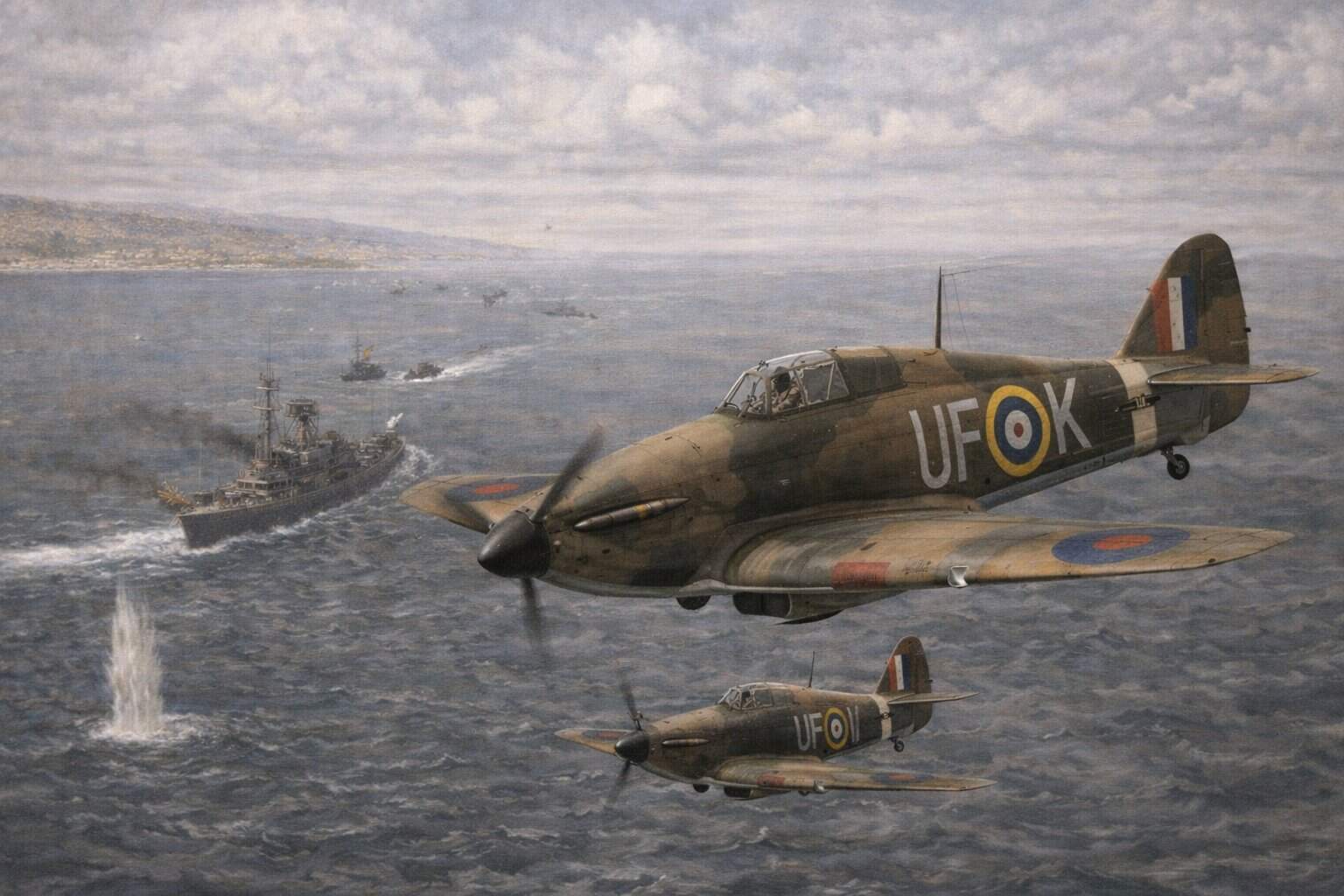
On 20 January 1942, Royal Air Force Hawker Hurricanes engaged a large formation of Japanese bombers over Singapore, claiming several enemy aircraft destroyed in one of the more determined defensive actions mounted during the final stages of the Malayan campaign. The interception demonstrated that, despite mounting losses and the steady Japanese advance down the peninsula, organised air resistance from Singapore had not yet ceased.
By mid-January 1942, Allied forces in Malaya had been forced into successive withdrawals. Japanese land forces had advanced rapidly from the north, supported by effective air operations that targeted airfields, transport routes, and troop concentrations. Singapore had become the principal remaining base for Allied air units in the region. Reinforcements in the form of Hawker Hurricanes had begun arriving earlier in the month, offering a qualitative improvement over some of the older fighter types previously deployed.
Strategic Situation Over Malaya
The defence of Singapore depended in part on maintaining some degree of air cover. Japanese bombers, operating with fighter escort, had struck military and infrastructure targets across the island and in southern Malaya. Airfields were under constant threat, and maintenance facilities were frequently disrupted by attack.
Hurricanes based in Singapore were tasked with intercepting incoming formations and contesting air superiority. The aircraft, though robust and combat-proven in earlier theatres, faced experienced Japanese aircrews flying agile fighters and operating in coordinated formations. Numerical superiority often lay with the attackers.
The Interception of 20 January
On 20 January, radar and visual reports indicated the approach of a substantial Japanese bomber force. RAF Hurricanes were scrambled to intercept before the bombers could reach their targets. The engagement that followed took place at altitude over or near Singapore Island.
In the ensuing combat, RAF pilots attacked the bomber formation, seeking to break up the approach and inflict losses before bombs could be released. Contemporary accounts describe multiple Japanese aircraft being shot down or damaged during the interception. While precise numbers vary across surviving records, it is clear that the Hurricanes disrupted the raid’s formation and reduced its effectiveness.
The action was conducted under hazardous conditions. Japanese fighter escort attempted to protect the bombers and engage the Hurricanes directly. Despite these challenges, RAF crews pressed their attacks, demonstrating both tactical coordination and individual determination.
Immediate Results and Ongoing Strain
Although the 20 January interception resulted in confirmed Japanese losses, it did not fundamentally alter the strategic balance. Japanese air strength in the theatre remained considerable, and Allied resources continued to diminish. Aircraft availability was affected by combat attrition, mechanical wear, and the limitations of maintenance capacity under siege conditions.
Nevertheless, the engagement provided a measure of encouragement to defenders. It demonstrated that effective interceptions were still possible and that Japanese formations were vulnerable when engaged decisively. Such actions contributed to the cumulative defensive effort mounted during the final weeks before the fall of Singapore in February 1942.
Significance in the Wider Campaign
The defence mounted on 20 January 1942 illustrates the resilience of RAF units operating under adverse circumstances. The arrival of Hurricanes had strengthened the fighter force at a critical juncture, even if only temporarily. Their performance during interceptions showed that, when properly coordinated, Allied fighters could challenge Japanese air operations.
In the broader context of the Far Eastern air war, the engagement highlights the importance of air power in shaping ground outcomes. Japanese success in Malaya was supported by sustained aerial superiority, and the struggle for control of the skies directly influenced the course of the campaign.
Though the eventual surrender of Singapore would follow within weeks, the actions of 20 January remain indicative of continued resistance during a deteriorating situation. The Hurricanes’ interception of Japanese bombers demonstrated that Allied air units retained operational capability and resolve, even as the strategic position became increasingly untenable.