On This Day, 1944: On 27 November 1944, the RAF Fauld explosion devastated an underground bomb store and nearby workplaces, killing about…
Read the entry →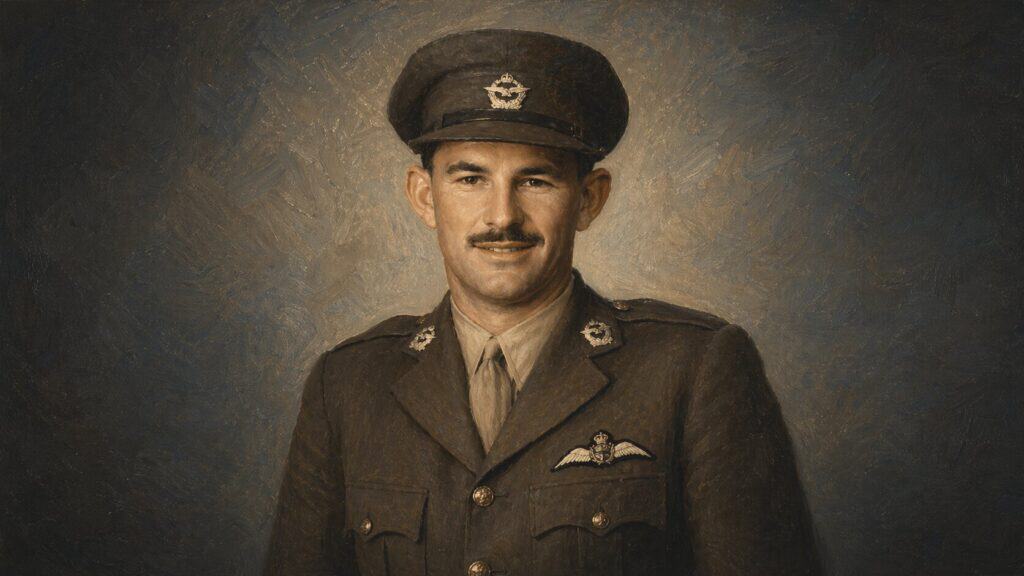
Major
Edwin Swales
Profile of Edwin Swales VC DFC, South African pathfinder pilot of 582 Squadron, killed after leading the RAF attack on Pforzheim in 1945.
Who was Edwin Swales?
Edwin Essery “Ted” Swales was a South African Air Force officer, born at Inanda in Natal on 3 July 1915, who flew Lancasters with the RAF’s No. 582 Squadron in the Pathfinder Force. He won the DFC in December 1944 and a posthumous Victoria Cross as master bomber on the raid on Pforzheim on 23 February 1945 (Commonwealth War Graves Commission).
Edwin Essery Swales, widely known as Ted Swales, was born at Inanda in Natal on 3 July 1915. He grew up in South Africa and was educated in Durban, later working in civilian life before the war. Like many Commonwealth servicemen of his generation, his route into distinguished wartime service developed through earlier military experience and then through the expanding air war of the 1940s.
Before transferring to flying duties, Swales served in the Natal Mounted Rifles. He saw active service in East Africa and North Africa, giving him operational experience before he ever entered a bomber cockpit. That earlier service helps explain the steadiness and authority for which he was later remembered in RAF Pathfinder operations.
How did Edwin Swales join the Pathfinders?
Swales served with the Natal Mounted Rifles in East and North Africa, transferred to the South African Air Force in January 1942 and was seconded to the RAF in August 1943 after gaining his wings. In June 1944 he joined No. 582 Squadron at RAF Little Staughton, part of No. 8 (Pathfinder Force) Group.
Swales transferred to the South African Air Force on 17 January 1942. He trained as aircrew during a period when the Commonwealth air forces were feeding increasing numbers of men into the RAF’s global war effort. He received his wings at Kimberley on 26 June 1943 and in August 1943 was seconded to the Royal Air Force while retaining his South African status and rank.
His emergence as a heavy-bomber pilot was unusual. Pathfinder Force normally drew heavily on experienced bomber captains who had already completed a full operational tour. Swales nevertheless reached No. 582 Squadron in No. 8 Group, the Pathfinder Force, in June 1944. That appointment placed him in one of Bomber Command’s most exacting roles, where accuracy, judgement under pressure and the ability to control a raid mattered as much as ordinary airmanship.
Why did Edwin Swales win the DFC?
Swales won the Distinguished Flying Cross for the daylight raid on the Gremberg railway yards at Cologne on 23 December 1944, when his Lancaster was attacked by five German fighters and he manoeuvred so that his gunners could fight them off. He pressed on and completed the attack, one of 43 operations he flew.
Flying the Avro Lancaster with 582 Squadron from RAF Little Staughton, Swales entered operations in July 1944. Pathfinder crews flew ahead of the bomber stream. Their task was to identify, mark and direct the bombing with precision so that the main force could find and strike the aiming point. In practice, this meant repeated exposure to flak, night fighters and the intense pressure of making correct decisions in real time.
Swales soon established a reputation for calm captaincy. On 23 December 1944, he took part in the daylight raid on the Gremberg railway yards at Cologne, following target marking under heavy opposition. During the operation, his aircraft came under attack from five enemy fighters. Swales manoeuvred skilfully, enabling his gunners to engage the attackers; one enemy aircraft was believed destroyed. He nevertheless completed the mission. For that conduct, he was awarded the Distinguished Flying Cross.
By early 1945, Swales had become one of the experienced captains on whom Pathfinder operations depended. He is credited with 43 operational sorties. That total was substantial for a heavy-bomber pilot in the later war, particularly in a specialist force whose duties frequently demanded prolonged exposure over defended targets.
Why did Edwin Swales receive the Victoria Cross?
As master bomber over Pforzheim on 23 February 1945, Swales stayed over the target directing the attack after a night fighter knocked out two engines and his rear guns. He then held his crippled Lancaster steady over Allied territory while his crew baled out, and was killed when it crashed.
Swales is chiefly remembered for the night of 23 February 1945, when he served as master bomber for the RAF attack on Pforzheim. In that role, he was responsible for locating the target area accurately and issuing bombing instructions to the main force behind him. It was one of the most demanding appointments in Bomber Command, since the master bomber had to remain over or near the target long enough to control the attack even while under fire.
During the raid, his Lancaster was attacked by a German night fighter and badly damaged. Two engines were put out of action and the rear guns became unusable, yet Swales remained at his post and continued to direct the raid until he was satisfied that the bombing had been properly delivered. That decision was central to the Victoria Cross he was later awarded. The citation emphasised courage in combat and disciplined persistence in completing the task as the aircraft became increasingly vulnerable.
His responsibility did not end once the bombs had fallen. With the Lancaster crippled, he turned towards friendly territory rather than abandoning the crew over hostile ground. After reaching Allied-held territory, Swales ordered his crew to abandon the aircraft. He held the Lancaster steady while they parachuted to safety. The Lancaster, PB538, then crashed near Valenciennes in northern France with Swales still at the controls (IBCC Losses Database).
The raid on Pforzheim itself remains one of the most destructive attacks carried out by Bomber Command, with severe civilian loss of life and destruction across the town. Swales’s conduct on that operation is therefore remembered within two histories at once: the history of individual gallantry and crew leadership, and the wider, often contested history of the late-war bombing offensive.
Where is Edwin Swales buried?
Swales was killed on 23 February 1945, aged 29, and is buried at Leopoldsburg War Cemetery in Belgium. His Victoria Cross was gazetted posthumously in April 1945.
His crew all survived. His Victoria Cross was awarded posthumously, and together with his Distinguished Flying Cross, it fixed his place among the best-known South African airmen to serve with Bomber Command.
Because he died on operations only weeks before the end of the war in Europe, there was no post-war RAF or civil career through which his reputation could be reshaped. His public memory rests overwhelmingly on wartime service, especially his final sortie.
Why is Edwin Swales important in RAF history?
Swales was the only member of the South African Air Force to win the Victoria Cross in the Second World War, and his last flight shows the burden carried by Pathfinder master bombers, who stayed over the target longest. He represents the many Commonwealth airmen who served in Bomber Command.
Edwin Swales occupies an important place in RAF and Commonwealth air-war history because he combined several strands of that story in one career. He was a South African serviceman whose path took him from ground warfare into the multinational bomber offensive. He served in the Pathfinder Force, where technical skill and composure under pressure were indispensable. And he became one of the comparatively few bomber aircrew to receive the Victoria Cross.
His story also illustrates the burden carried by master bombers. They had to stay in the most dangerous part of the raid long enough to direct others effectively. In Swales’s case, the qualities recognised by the VC were inseparable from that responsibility. He is remembered for sacrifice and for the professional precision and leadership expected of Pathfinder crews at the highest level of Bomber Command operations.
| Dates | Role | Unit | Aircraft |
|---|---|---|---|
| 1935–1942 | Natal Mounted Rifles | South African Army | |
| 17 January 1942 – 26 June 1943 | Aircrew training and service | South African Air Force | |
| 22 August 1943 – June 1944 | Seconded for RAF service and heavy-bomber training | Royal Air Force | |
| June 1944 – 23 February 1945 | Pathfinder pilot and master bomber duties | 582 Squadron | Avro Lancaster |
Edwin Swales is remembered chiefly through his Victoria Cross and through the disciplined leadership shown on his final Pathfinder sortie. His reputation rests not only on personal courage, but on the rare responsibilities of a master bomber whose task was to control the raid under direct attack. Because he died on the devastating Pforzheim operation, his memory also sits within the broader and sometimes contested history of Bomber Command’s late-war area bombing campaign.
Ted Swales VC: Master Bomber on the Pforzheim Raid
On 23 February 1945, Ted Swales led the Pforzheim raid as Master Bomber and died after…
23 February 2026 · 3 minRAF Bomber Command Begins the Dresden Raids
On 13 February 1945, RAF Bomber Command began the Dresden raids with a major night attack…
13 February 2026 · 4 minHow the Dowding System Worked in Britain’s Air Defence
How the Dowding system linked radar, observers, plotting rooms and fighter control to direct RAF interceptions…
6 October 2026 · 2 min