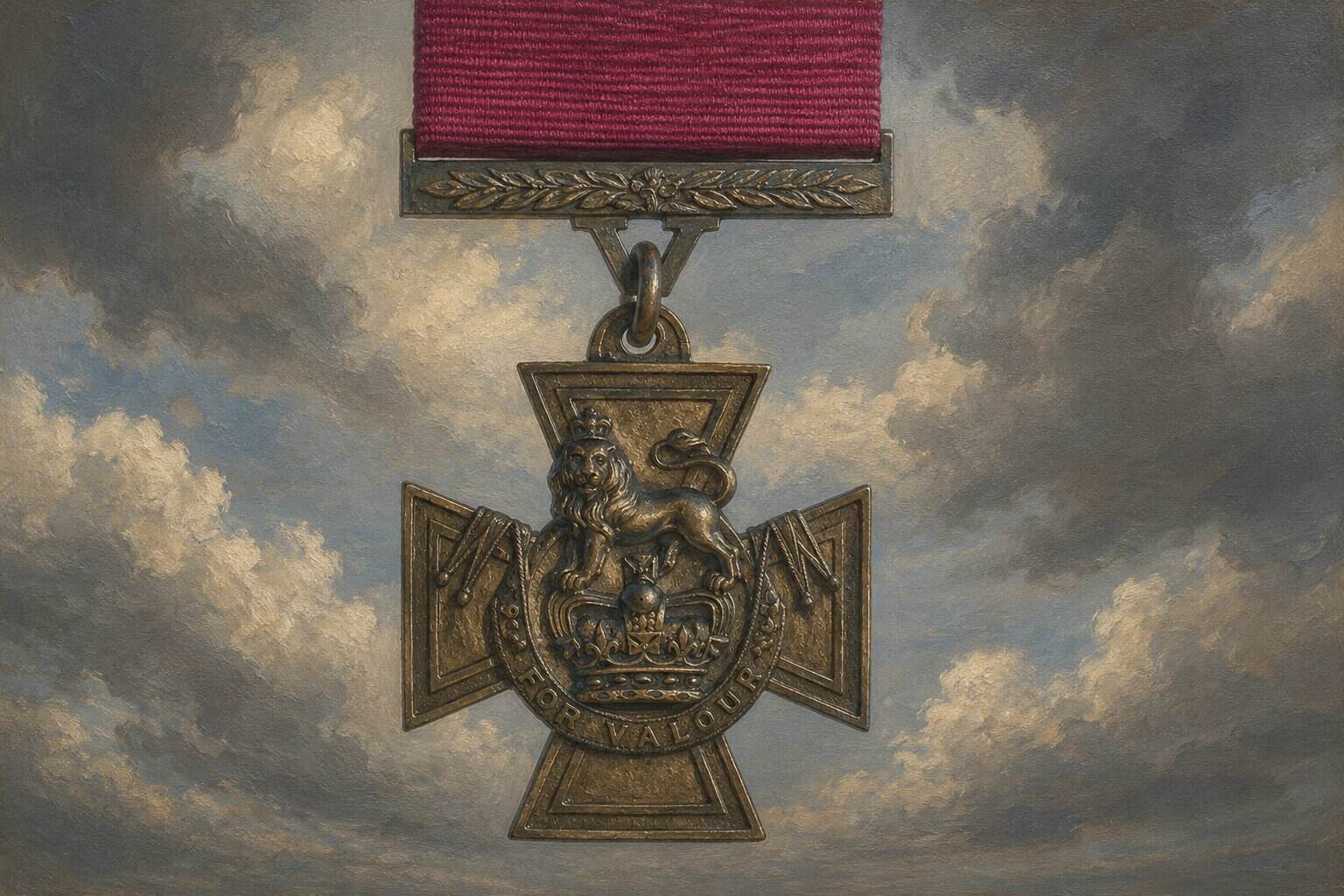
The Victoria Cross in RAF service occupied a singular place within Britain’s wartime honours system. It was the highest decoration available for valour in the presence of the enemy, yet in air warfare it remained exceptionally rare. Its recipients were not rewarded simply for courage in the general sense, since courage was assumed throughout operational flying. Rather, the award marked those moments when an individual’s conduct under immediate danger stood apart even within the already hazardous conditions of RAF operations.
Background
When the Royal Air Force became an independent service in 1918, it inherited an honours structure formed before air power had become a major arm of war. By the Second World War, that structure had to account for a very different form of combat. Aircrew operated at speed, often at night, frequently over hostile territory, and usually as part of highly organised crews or formations. Gallantry in that environment could take several forms: persistence in pressing home an attack after severe damage, determination in bringing an aircraft home to save a crew, or leadership of exceptional steadiness in operations where the margin for survival was already narrow.
The Victoria Cross sat above a wider range of wartime decorations, including awards that more commonly recognised distinguished flying service. Its rarity mattered. Many RAF operations demanded nerve, discipline and endurance, but only a very small number of actions were judged to meet the extreme threshold required for the Victoria Cross.
Operational Circumstances
The record of RAF Victoria Cross awards shows how often the decoration was linked to moments of acute operational crisis. In bomber warfare, crews faced concentrated anti-aircraft fire, night fighters, navigation difficulty and the persistent risk of fire or structural damage. Under those conditions, an award could recognise a decision to continue towards the target when withdrawal might have seemed the safer course, or an act carried out in the open air of a damaged aircraft in order to preserve the lives of others.
Examples associated with figures such as Roderick Learoyd, Hughie Idwal Edwards and Norman Cyril Jackson illustrate the varied nature of such gallantry. The circumstances differed, but the common element was not theatrical heroism. It was the combination of duty, judgement and physical courage under conditions in which failure, injury or death were immediate possibilities. These were not symbolic decorations attached to abstract reputation; they were responses to specific operational acts.
Bomber operations feature prominently in this history, but the pattern was not confined to a single command. The demands of modern air war meant that gallantry could arise in attack, defence, survival or leadership. What distinguished the Victoria Cross cases was the degree to which the action could be identified as extraordinary, even against the severe norm of wartime flying.
Leadership And Example
Some RAF Victoria Cross narratives also became inseparable from questions of command and example. Guy Gibson’s name was bound to Operation Chastise and the work of 617 Squadron, where personal courage was closely tied to the burden of leadership. Leonard Cheshire came to represent another side of the same tradition: repeated exposure to danger, operational authority and the expectation that commanders would share the risks faced by their crews. In such cases, the decoration came to signify not only one moment of bravery but also a broader standard of conduct within an operational force.
That did not mean the award was routine for successful leaders. On the contrary, the threshold remained deliberately severe. The existence of many highly decorated RAF personnel who did not receive the Victoria Cross underlined how sparingly it was used. The distinction preserved the award’s particular status and prevented it from becoming a general badge of wartime fame.
Judgement, Rarity And Memory
The Victoria Cross in RAF service also reveals something about the difficulty of judging gallantry in air operations. Many sorties were collective undertakings in which navigator, pilot, wireless operator, air gunner and engineer might all display fortitude together. In other cases, aircraft were lost with few witnesses. The acts that entered the official record were therefore only one part of a much larger history of danger endured by RAF crews across Bomber Command, Fighter Command, Coastal Command and other wartime formations.
Even so, the men who received the Victoria Cross came to occupy a powerful place in RAF memory. Their stories were repeatedly retold because they offered a clear human focus within a form of warfare often defined by machinery, distance, and mass operations. They helped put a face to the broader demands placed on wartime aircrew, while also reminding later generations that the decoration represented exceptional conduct rather than the ordinary measure of service.
Wider Context
In the wider history of the RAF, the Victoria Cross stands less as a catalogue of individual legends than as evidence of the extreme conditions under which the service fought. It marks the point at which operational duty, personal decision and immediate danger converged so sharply that the highest award for gallantry was judged appropriate. The decoration’s importance in RAF history lies not only in its prestige, but in what it reveals about the character of air warfare, the burdens placed upon crews and commanders, and the way wartime service has been remembered ever since.