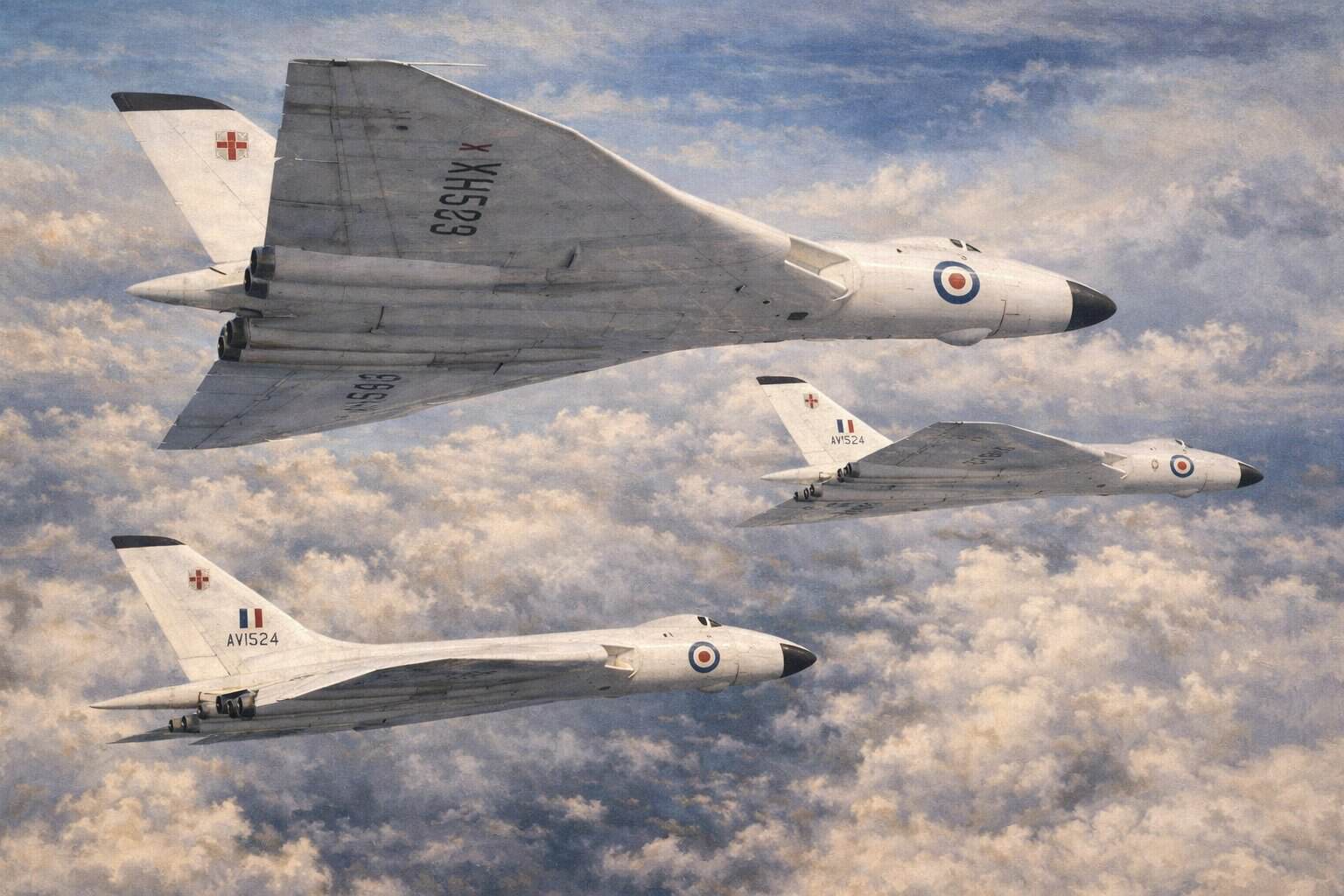
Britain’s transition from V-Force to Polaris transferred the principal strategic nuclear deterrent from RAF bombers to Royal Navy submarines. Between the mid-1950s and 1969, improving Soviet air defences, the search for longer-range weapons and the cancellation of the American Skybolt programme reshaped the RAF’s nuclear task. Polaris offered a concealed launching platform at sea and a means of preserving a retaliatory force through an enemy attack.
The change developed over several years. RAF crews adapted their aircraft and tactics while the government negotiated access to a new missile system and the Royal Navy prepared its submarines. The political decision at Nassau in December 1962 and the operational handover in 1969 were separate stages in that process.
Why did Britain move its nuclear deterrent from the RAF to the Royal Navy?
Britain moved its strategic deterrent to sea because improving Soviet air defences made it ever harder for V-bombers to reach their targets, and the American Skybolt missile meant to keep them credible was cancelled in December 1962. Polaris submarines, hidden at sea, could survive a first strike and still retaliate, so the Royal Navy took over the deterrent on 1 July 1969.
How did the V-Force carry Britain’s nuclear deterrent?
The Vickers Valiant entered RAF service in 1955, followed by the Avro Vulcan and Handley Page Victor. Together these aircraft formed the V-Force, placing Bomber Command at the centre of Britain’s strategic nuclear policy. Their initial method of delivery combined high-altitude flight with free-fall nuclear bombs. Speed, height and defensive equipment were intended to help the bombers reach their targets through hostile airspace.
Maintaining the V-Force as Britain’s nuclear deterrent required an organisation capable of keeping aircraft, weapons and crews ready for rapid action. Its credibility depended on both surviving an attack on its bases and penetrating the defences around its targets. These were related but distinct operational problems.
Soviet interceptor development and surface-to-air missiles steadily narrowed the protection offered by altitude. The destruction of an American U-2 over the Soviet Union on 1 May 1960 demonstrated the reach of missile defences against a high-flying aircraft. For the RAF, the increasing threat strengthened an existing requirement to improve bomber survivability and extend the distance from which weapons could be released.
How did the V-Force respond to Soviet missiles?
The V-Force switched to low-level penetration from 1963 to fly under Soviet radar, and armed Vulcans and Victors with the Blue Steel stand-off missile so they could release their weapons before reaching the target. Both measures bought time, but neither solved the problem of survivability for long.
The RAF responded by changing the way its bombers would approach defended territory. The transition began in 1963, when V-bomber squadrons started training for low-level penetration. Implementation varied between units and aircraft types. Squadrons equipped with Blue Steel began their low-level training in 1964, as the missile and its carrier aircraft required modifications for the revised operating conditions. Flying close to the ground complicated radar detection and reduced the time available for an effective interception. It also imposed demanding navigation, crew-training and aircraft-fatigue requirements.
Stand-off weapons addressed the final approach to the target. Blue Steel, carried by suitably equipped Vulcans and Victors, allowed the bomber to release a nuclear-armed missile before reaching the target itself. Its introduction extended the usefulness of the existing aircraft, and its employment was adapted for low-level operations. Adapting Blue Steel for low-level release came at a cost. Its range in this configuration fell to approximately 50 nautical miles, requiring the launching aircraft to approach considerably closer to its target. The adaptation extended the weapon’s usefulness but reinforced the requirement for a successor offering much greater stand-off range.
The planned American Skybolt air-launched ballistic missile promised a much greater stand-off distance. Britain selected it as the next major improvement to the bomber deterrent, with the Avro Vulcan intended to carry it. The attraction was operational and organisational: a new weapon could extend the effective life of an established bomber force and its supporting infrastructure.
Skybolt therefore became central to British planning for the later 1960s. The RAF’s immediate adaptation through low-level flight and Blue Steel accompanied preparations for a longer-term missile capability.
What happened to Skybolt and the Nassau agreement?
The United States cancelled the Skybolt missile in late 1962 over cost and development problems, removing the weapon Britain had chosen to keep its bombers credible. At Nassau on 21 December 1962, Harold Macmillan and John F. Kennedy agreed instead that the United States would supply Polaris missiles for British-built submarines.
American priorities changed the prospects for that plan. Skybolt encountered rising costs and development difficulties, while the United States possessed alternative strategic missile systems. Britain had placed much greater weight on Skybolt as the successor weapon for its bomber force.
On 17 December 1962, Defence Minister Peter Thorneycroft told the House of Commons that he had stressed the serious consequences for Britain of cancellation (Hansard). He reported American concerns about cost, timing and performance, alongside the relative success of alternative systems. The disagreement reflected different national requirements for the same proposed weapon.
At Nassau, Prime Minister Harold Macmillan and President John F. Kennedy negotiated the replacement arrangement announced on 21 December 1962. Kennedy confirmed the decision to cancel American production plans for Skybolt. He offered continued joint development, with Britain sharing future development costs, but Macmillan declined because of uncertainty over success, completion and cost.
The resulting agreement provided for the United States to supply Polaris missiles without warheads. Britain would construct the submarines and provide their nuclear warheads. The forces were to support the Western Alliance, with the British government retaining an exception where it judged supreme national interests to be at stake. The Polaris Sales Agreement of April 1963 subsequently established the supply arrangements.
Nassau changed the planned delivery system and the service responsible for operating it. It also preserved a British nuclear force within a close technological relationship with the United States and a NATO strategic framework.
Why were submarines a better deterrent than bombers?
A Polaris submarine on patrol could hide anywhere in a wide sea area, so an enemy could not destroy it in a surprise attack, and its ballistic missiles did not have to fly through air defences. That gave Britain a secure second-strike capability that bombers on known airfields could no longer guarantee.
Polaris addressed the vulnerability of a deterrent concentrated at identifiable land bases. A submarine on patrol could conceal its position over a wide sea area. An enemy contemplating an attack would have to reckon with missiles carried by a platform whose location remained uncertain.
That concealment supported a second-strike capability: the ability to retaliate after an enemy had attacked. A submarine-launched ballistic missile also removed the requirement for a bomber and its crew to fly through the air-defence system surrounding the target. The combination of a concealed platform and ballistic delivery offered a different basis for deterrent credibility.
Building that capability required submarines, trained crews, weapons integration and shore support. The RAF continued to carry the strategic responsibility during the transition. HMS Resolution began Britain’s first Polaris deterrent patrol in June 1968. Continuous at-sea deterrence followed in April 1969, establishing the submarine patrol system before the formal transfer of responsibility (Royal Navy).
What did the RAF do after the deterrent moved to sea?
The RAF kept a nuclear role after 1969: Vulcans, and later Buccaneers and Tornados, carried WE.177 bombs as NATO theatre nuclear strike aircraft until the weapon was withdrawn in 1998. Other V-bombers became tankers and maritime reconnaissance aircraft.
On 30 June 1969, the RAF’s V-Force relinquished its strategic Quick Reaction Alert commitment, and responsibility for Britain’s strategic nuclear deterrent passed to the Royal Navy on 1 July.
RAF nuclear operations continued. Vulcans equipped with WE.177 weapons retained a theatre nuclear strike role, including commitments to NATO. Their crews and aircraft remained part of the alliance’s military planning after the national strategic deterrent had moved to sea. Other V-bomber airframes served in reconnaissance and aerial-refuelling roles, extending the operational value of aircraft developed for the nuclear bomber force.
Why does the move from V-Force to Polaris matter?
The transfer to Polaris ended the RAF’s responsibility for Britain’s principal strategic nuclear deterrent after fourteen years, a role it had held since the first Valiants. The story of how it began is told in the Chronicle’s article From Bomber Command to the V-Force. The V-Force had adapted to increasingly effective Soviet defences through low-level tactics and stand-off weapons, but those measures could not provide the survivability offered by submarines concealed at sea. The Nassau agreement established the means of making that transition, and the handover in 1969 completed it. RAF Vulcans continued to undertake theatre nuclear strike duties, while other V-bomber aircraft remained valuable in supporting roles. Britain’s strategic deterrent had moved to the Royal Navy, but the RAF’s contribution to nuclear operations continued.