On This Day, 1960: On 10 October 1960, No. 83 Squadron formed at RAF Scampton as the first Vulcan B.2 unit, ahead…
Read the entry →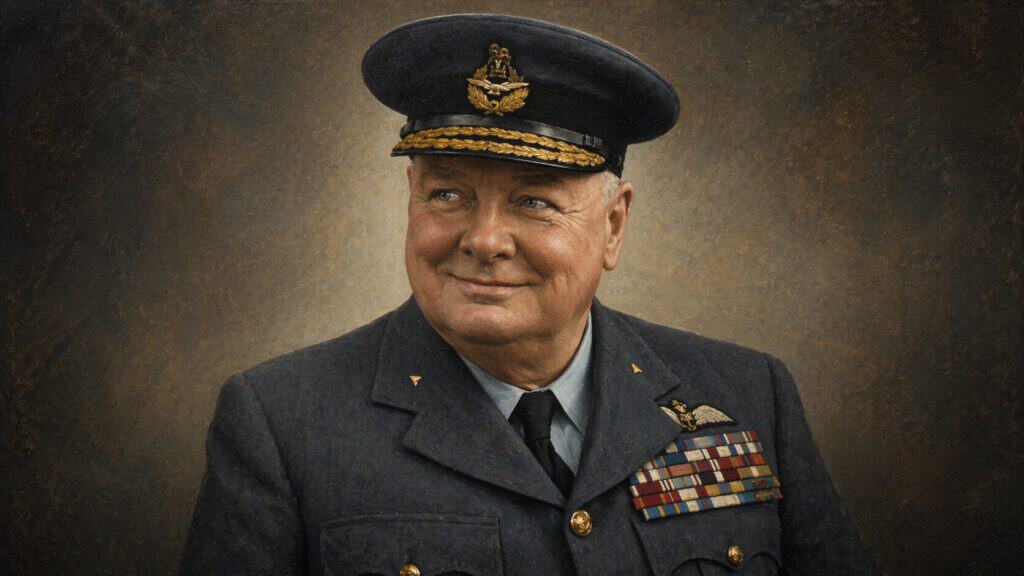
Lieutenant
Winston Churchill
A profile of Winston Churchill's place in RAF history, from the Battle of Britain to the bomber offensive and Britain's wider air strategy.
Early Life
Winston Leonard Spencer Churchill was born at Blenheim Palace, Woodstock, on 30 November 1874. The son of Lord Randolph Churchill and Jennie Jerome, he grew up within the political and aristocratic world of late Victorian Britain, though his early school record was uneven and often troubled. After Harrow, he entered the Royal Military College, Sandhurst, and was commissioned into the 4th Queen's Own Hussars in 1895.
Churchill's early adult life combined military service, journalism and deliberate self-promotion. He sought active service in Cuba, on the North-West Frontier of India, in the Sudan and during the South African War. Those experiences gave him both public visibility and a practical understanding of imperial warfare, logistics and modern firepower. They also helped shape the forceful, highly personal style with which he later approached defence and strategy.
Entry into Service
Although Churchill is remembered chiefly as a statesman rather than as a career serviceman, his military background shaped how he handled war. His army service exposed him to campaigning under difficult conditions and taught him the value of communications, morale and material preparation. Just as important, his reporting and published books trained him to explain war to a wider public, a skill that later became central to his political authority.
He entered Parliament in 1900 and over the following decades held a succession of major offices. By the time of the Second World War he had already served in government through the First World War and the interwar years, including as First Lord of the Admiralty. His record was mixed and at times controversial, but it left him with deep experience of high command, procurement and the relationship between political decision-making and military operations.
Operational Career
Churchill became Prime Minister on 10 May 1940, at the moment when the German offensive in the west opened a crisis for Britain and its allies. For RAF history, his importance lies less in personal service than in political leadership at the point when air power became central to national survival. He was not an operational commander and did not direct tactical air operations, but he set the political framework within which the RAF fought the decisive campaigns of the war.
During the Battle of Britain, Churchill understood that Fighter Command's survival was indispensable. He relied on the judgement of senior commanders such as Hugh Dowding and Keith Park while insisting that Britain continue the war rather than seek terms. His speeches helped turn the defence of British airspace into a national cause, and his tribute to "the Few" became one of the defining public formulations of the campaign. The phrase has endured partly because it linked the RAF's immediate operational struggle to the broader political meaning of resistance in 1940.
Churchill also gave sustained backing to aircraft production, air defence and the wider integration of science, industry and operations. The expansion of fighter output, radar-based warning and command systems, and the steady reinforcement of RAF front-line strength all depended upon political choices as well as technical and operational skill. Churchill's wartime leadership did not create those systems on its own, but it helped preserve and resource them when failure would have had strategic consequences far beyond the air campaign itself.
Major Actions or Commands
As Prime Minister and Minister of Defence, Churchill's influence reached across every major phase of Britain's air war. He supported the use of the RAF not only in home defence but also in maritime patrol, imperial communications, strategic bombing, airborne operations and support for the liberation of Europe. Under his premiership, the RAF expanded into a truly global force operating across Europe, the Mediterranean, the Atlantic, Africa and Asia.
His relationship with Bomber Command was especially consequential. Churchill backed the bombing offensive against Germany as one of the few means by which Britain could strike directly at the Reich before a return to the continent became possible. That support helped sustain the growth of Bomber Command under Arthur Harris and tied the RAF closely to the wider Allied strategy of pressure on German industry, infrastructure and morale. At the same time, Churchill's association with area bombing has remained one of the most debated parts of his wartime record. The destruction of German cities, and the human cost involved, continue to shape historical judgements of both Churchill and the strategy he endorsed.
Churchill also understood air power as an instrument of coalition warfare. He worked with Allied leaders while relying on British commanders and air staffs to translate policy into operations. The RAF's contribution to the anti-submarine war, the North African campaign, the invasion of Europe and long-range support to Britain's global commitments all developed within that political framework. In that sense his role was one of direction, priority and endurance rather than cockpit experience or formal command within the service itself.
Later Life and Death
After victory in Europe, Churchill was turned out of office in 1945 but remained a commanding public figure. He returned as Prime Minister from 1951 to 1955, by which time the RAF was entering the jet and nuclear age. His second premiership belonged to a different strategic world, one shaped by the Cold War, deterrence and the changing position of Britain in international affairs.
Beyond politics, Churchill remained a prolific writer and painter, and in 1953 he received the Nobel Prize in Literature. His later years were marked by declining health. He suffered several strokes and died in London on 24 January 1965, aged ninety. His state funeral reflected the scale of his place in British public life and in the memory of the Second World War.
Historical Significance
Churchill occupies an unusual position in RAF history because he was neither air chief nor aviator, yet few civilian leaders are more closely associated with the service's defining wartime story. He gave political backing to the RAF at the moment of existential danger in 1940, sustained the long and costly air offensives that followed, and helped fix the language through which those campaigns were remembered. His significance lies in leadership, resolve and strategic sponsorship rather than in direct operational command.
That importance must also be fully recognised. Churchill's reputation has often been enlarged by wartime memory and national myth, and some parts of his record remain contested, especially regarding imperial policy and bombing strategy. Even so, his role in preserving Britain as a base for continued air warfare, and in treating the RAF as a central instrument of national power, makes him indispensable to any serious account of Britain's air war in the twentieth century.
| Dates | Role | Unit | Aircraft |
|---|---|---|---|
| 1895-1900 | Army officer and war correspondent | 4th Queen's Own Hussars and attached campaigns in Cuba, India, the Sudan and South Africa | |
| 1940-1945 | Prime Minister and Minister of Defence | United Kingdom Government | Directed Britain's war policy and sustained the RAF in home defence and offensive operations |
| 1951-1955 | Prime Minister | United Kingdom Government | Oversaw defence policy as the RAF entered the early jet and nuclear era |
Churchill is remembered in RAF history as the civilian leader who gave the service political backing at its moment of greatest danger and helped define the public memory of 1940. His legacy extends beyond the Battle of Britain to the wider strategic use of British air power, including Bomber Command's offensive against Germany. That legacy is enduring but not uncomplicated, since his wartime leadership is still debated in relation to area bombing, imperial policy and the uses of state power.


Low-Level Lancaster Strike on MAN Works at Ausburg
Augsburg Raid: J. D. Nettleton led Lancasters against Augsburg in 1942, a low-level daylight strike remembered…
17 April 2026 · 3 minGloster Meteor Flies First RAF Jet Sortie Against V-1s
On 27 July 1944, a No. 616 Squadron Gloster Meteor flew the RAF’s first operational jet…
27 July 2026 · 3 minRAF Fighter Command: Structure, Battles and Wartime Evolution
How RAF Fighter Command was organised, how it fought the Battle of Britain, and how it…
16 April 2026 · 7 min