On This Day, 1939: On 21 October 1939, 46 Squadron Hurricanes intercepted Heinkel He 115 floatplanes over the North Sea in the…
Read the entry →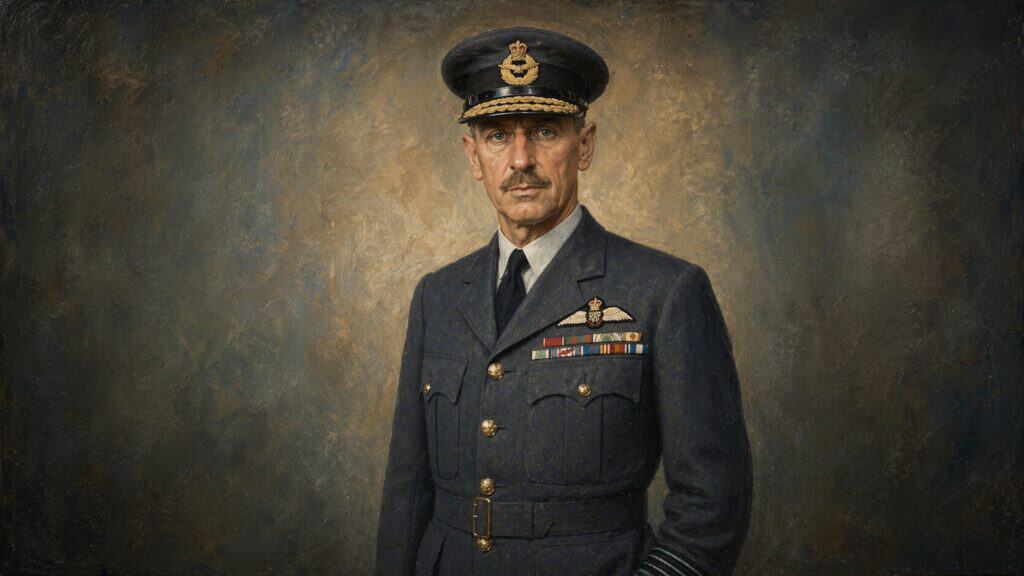
Air Chief Marshal
Hugh Dowding
Hugh Dowding built and led RAF Fighter Command’s integrated air-defence system, making him a central architect of Britain’s survival in 1940.
Early Life
Hugh Caswall Tremenheere Dowding was born on 24 April 1882 at Moffat in Dumfriesshire. He belonged to the generation that saw military aviation move from novelty to instrument of national survival. His early professional life was not initially shaped by flying at all: he entered the Army and served as an artillery officer before aviation became a serious military proposition.
That background mattered. Dowding’s later approach to air defence often reads as methodical rather than romantic: a preference for measured preparation, controlled expenditure of resources, and an insistence that systems and training mattered as much as individual daring. The qualities that made him effective in 1940 were built over decades, in staff work and command appointments that rewarded patience and organisation.
Entry into Service
Dowding’s path into aviation began before the First World War, when he qualified as a pilot and moved into the Royal Flying Corps as war arrived. In that period, flying was still dangerous even without an enemy: aircraft were fragile, engines unreliable, and training methods evolving. For officers who persisted, the reward was rapid responsibility, because the service expanded faster than experienced leaders could be produced.
During the First World War he served in the RFC and held command appointments, including leadership within operational units. Those years formed his view that the service had to balance aggressive employment with sustainability — pilots were not an inexhaustible resource, and the longer a war continued, the more training and retention shaped outcomes.
Operational Career
In the inter-war period Dowding became a senior RAF officer during a time of doctrinal argument. Strategic bombing had influential advocates, yet the requirement for home defence never vanished; it merely seemed less urgent until the later 1930s. Dowding’s progression through senior appointments culminated in his selection to lead the newly created Fighter Command in 1936.
From that post, his task was as much administrative as tactical. Fighter Command needed modern aircraft, trained pilots, workable maintenance and supply systems, and — above all — a mechanism for controlling combat at speed. The RAF Museum’s treatment of Dowding places him at the centre of this transformation, emphasising his determination and his grasp of “all aspects of aerial warfare” as contemporaries understood it.
Major Actions or Commands
Dowding’s defining command was Fighter Command during the crisis year of 1940. As the situation deteriorated in the spring, Fighter Command faced the immediate demands of supporting the campaign in France and then the defence of Britain itself. The Battle of Britain demanded not simply bravery, but a sustainable tempo: squadrons could be committed, recovered, rotated, and reconstituted under constant pressure.
Dowding’s contribution was therefore not a single decision, but an approach. Fighter Command’s success depended on using limited strength intelligently. His insistence on preserving the home defence — and on refusing to exhaust fighter squadrons beyond recovery — has remained one of the central themes in assessments of the period.
The end of 1940 also exposed the politics of wartime command. Disagreements about tactics and the handling of night defence during the opening months of the Blitz fed into wider dissatisfaction among powerful figures. Dowding was replaced as head of Fighter Command in November 1940, a change that did not alter the battle already won, but did reshape how the RAF’s internal story of 1940 was told in subsequent years.
Later Life and Death
Dowding continued in other duties before retiring from the RAF in 1942. He remained a figure of national recognition, and his name endured as shorthand for the leadership and systems that made Fighter Command effective. He died on 15 February 1970 at Royal Tunbridge Wells.
His commemoration reflects his place in national memory: memorials, museum holdings, and the continuing prominence of the Battle of Britain narrative keep him close to the centre of RAF public history.
Historical Significance
Dowding matters to RAF history because he represents the difference between having fighters and being able to use them effectively. In 1940, Britain’s air defence was not simply a collection of squadrons; it was a system that linked detection, control, and interception under pressure. Dowding’s pre-war work in building Fighter Command into an organisation capable of that work is why the RAF Museum frames him as an “architect” of victory.
Held the Royal Victorian Order at Knight Grand Cross level (GCVO), reflected in his formal styling during and after his Fighter Command tenure.
RAF Withdraws from Crete Under Luftwaffe Air Superiority
On this day in 1941, the RAF withdrew its remaining aircraft from Crete as Luftwaffe air…
19 May 2026 · 3 minOperation Calendar Reinforces Malta with Spitfire Deliveries
Operation Calendar: Spitfires reached Malta from USS Wasp in 1942, but heavy follow-up raids quickly exposed…
20 April 2026 · 3 minLeonard Trent and the Amsterdam Power Station Raid
Squadron Leader Leonard Trent won the Victoria Cross after pressing home the 1943 Amsterdam power station…
3 May 2026 · 3 min