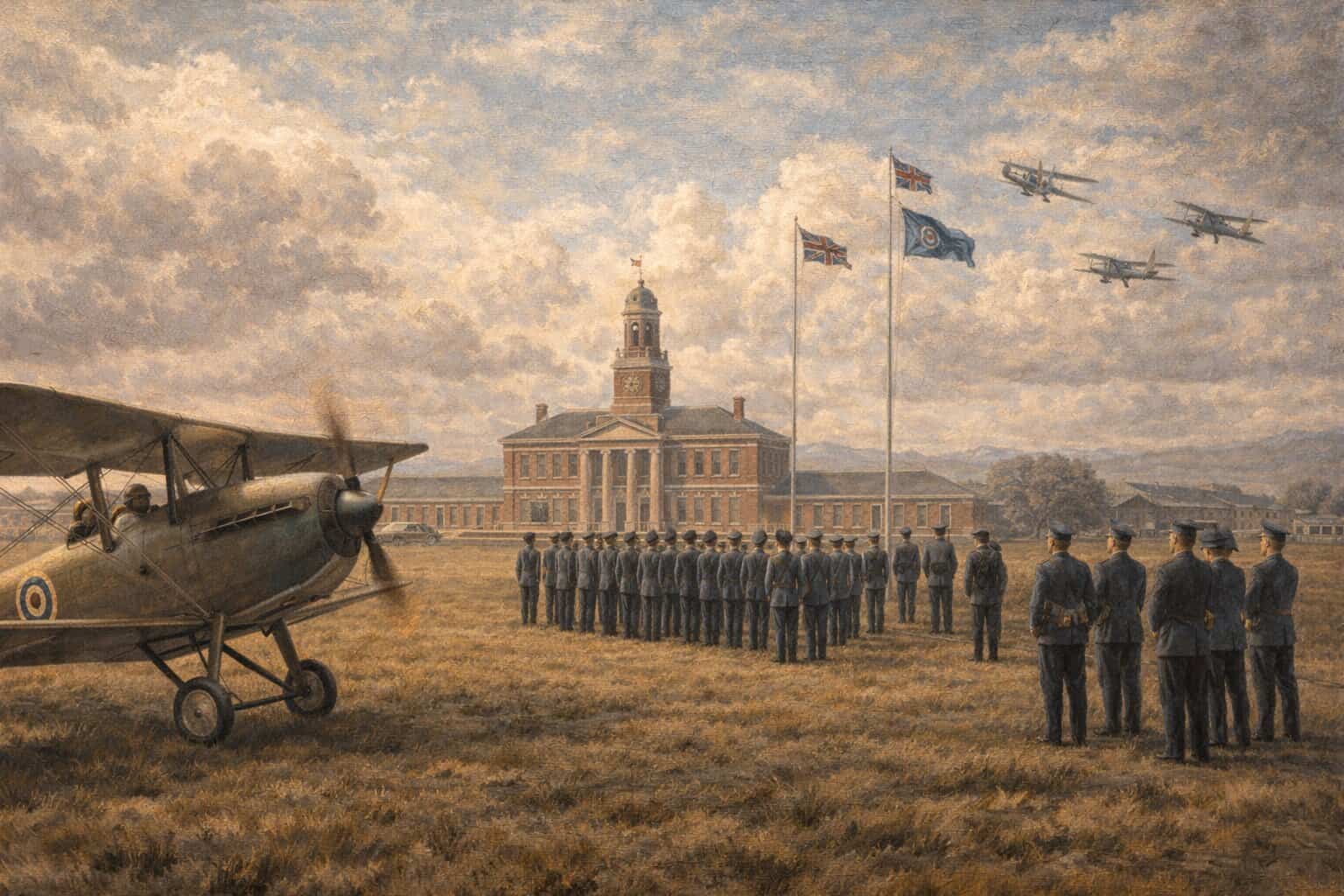
On 5 February 1920, the Royal Air Force College at Cranwell formally opened its doors, marking the beginning of a new era in the professional education of RAF officers. Established little more than a year after the creation of the Royal Air Force itself, the College was intended to provide a permanent institution for the training and development of future leaders of Britain’s independent air service. The first commandant of the College was Air Commodore C. A. H. Longcroft, a senior officer who had served with distinction during the First World War.
The opening of the College also brought administrative changes. With the creation of the institution, RAF Headquarters Cranwell was granted command status, reflecting the growing importance of the station as a centre for officer training and aviation education within the young Royal Air Force.
The Need for Professional Officer Training
The Royal Air Force had been formed on 1 April 1918 through the amalgamation of the Royal Flying Corps and the Royal Naval Air Service. In the immediate aftermath of the First World War, the service faced the challenge of transforming itself from a wartime force into a permanent peacetime organisation.
One of the priorities identified by RAF leadership was the need for a structured system of officer training. During the war, many officers had entered the flying services through accelerated training schemes designed to meet the urgent demands of combat. While effective under wartime conditions, these arrangements were not considered suitable for the long-term professional development of an independent air force.
Senior planners believed that the RAF required an institution comparable to the training academies of the British Army and Royal Navy. Such a college would educate future officers not only in flying and technical skills, but also in leadership, discipline, and the wider responsibilities of command.
Establishment of the College at Cranwell
The site chosen for the new institution was Cranwell in Lincolnshire, which had already served as a major training centre during the First World War. The location possessed existing aviation facilities, including airfields and accommodation, making it well suited to the needs of the new College.
The Royal Air Force College Cranwell was established to train young officer cadets who would form the future leadership of the service. The curriculum combined academic education with military training and practical experience in aviation. Cadets were expected to develop not only technical knowledge but also the qualities required of officers in a modern air force.
The appointment of Air Commodore C. A. H. Longcroft as the first commandant reflected the importance placed on strong leadership during the College’s formative years. Longcroft had previously served as a senior officer in the wartime flying services and brought considerable operational experience to the role.
Early Training and Development
The early years of the College focused on establishing a balanced programme of education and training. Cadets studied a range of subjects that included navigation, engineering principles, military history, and leadership. At the same time, they underwent flying training and practical instruction in the operation of military aircraft.
The intention was to produce officers who were not only skilled aviators but also capable leaders capable of adapting to the rapidly evolving world of aviation technology. During the interwar period, air power theory and technological innovation were developing rapidly, and the RAF recognised that its officers needed a strong intellectual foundation to meet these challenges.
Cranwell quickly became a central institution within the RAF’s organisational structure. The presence of the College helped establish a professional officer corps and fostered a distinct service identity during the formative years of the Royal Air Force.
Long-Term Significance
The opening of the Royal Air Force College at Cranwell in February 1920 had lasting significance for the development of the service. By creating a permanent academy for officer training, the RAF ensured that future generations of officers would receive a consistent and structured education.
Over time, Cranwell became synonymous with the training of RAF officers. Many individuals who later held senior command positions within the Royal Air Force, and in some cases within NATO and allied air forces, began their careers as cadets at the College.
The institution also played an important role in shaping RAF culture and traditions. Ceremonies, training practices, and educational standards established during the early years helped define the ethos of the service for decades to come.
A Foundation for the Modern RAF
Seen in the broader context of RAF history, the events of 5 February 1920 represented a crucial step in transforming the Royal Air Force from a wartime creation into a permanent professional service. The establishment of the Royal Air Force College Cranwell provided the foundation for the training of officers who would go on to lead the RAF through the interwar years, the Second World War, and the complex challenges of the modern era.
More than a century later, Cranwell remains a central institution within the RAF. Its opening in 1920 stands as one of the defining milestones in the early development of the world’s first independent air force.