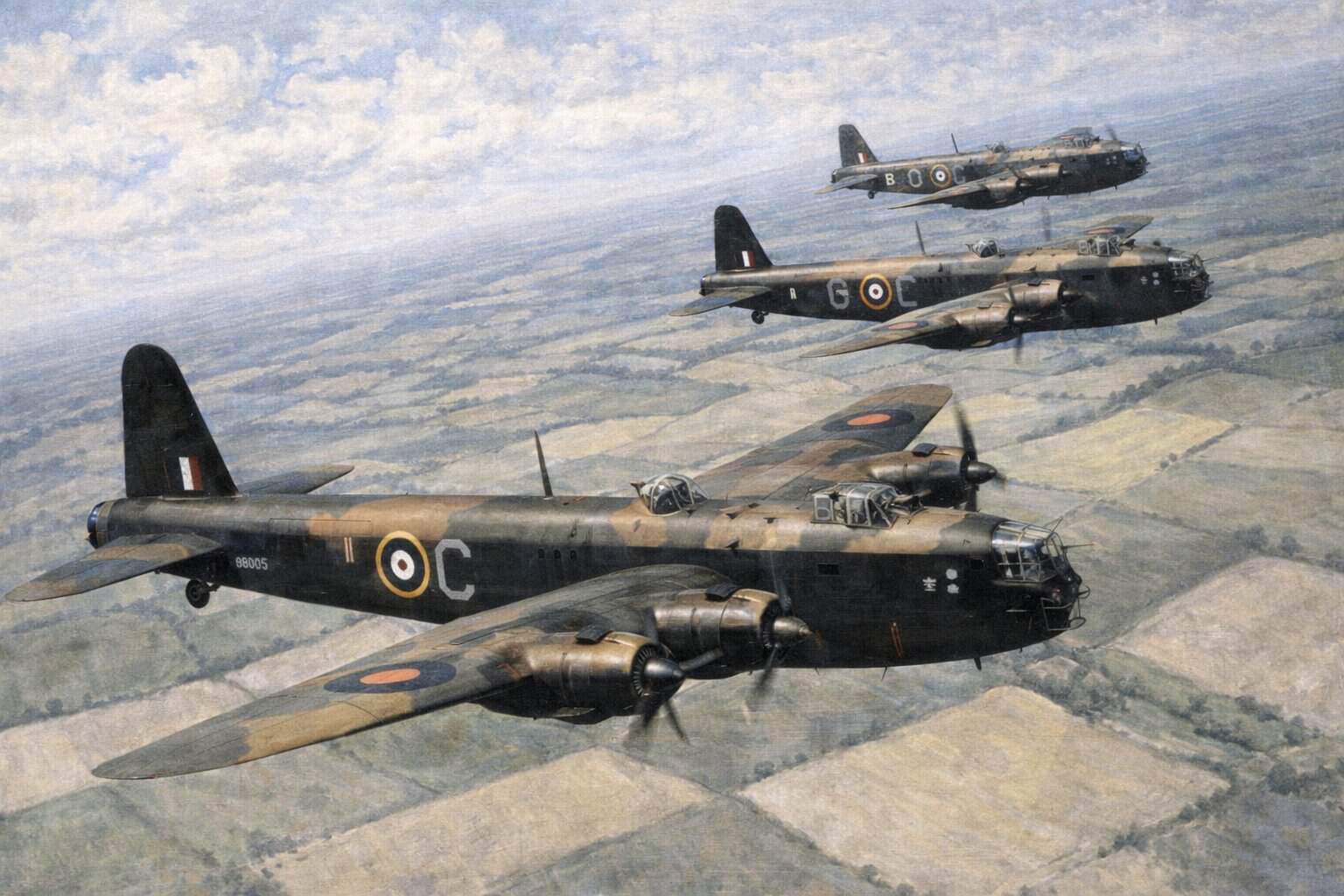
RAF bombing strategy did not begin the Second World War in the form for which Bomber Command later became known. In 1939, the Royal Air Force still operated within a framework shaped by inter-war expectations about daylight attack, navigational visibility, and the belief that disciplined bomber formations could reach industrial targets in enemy territory with acceptable losses. Within a relatively short period, those assumptions were tested, qualified, and in important respects abandoned. The shift from daylight raids to a sustained night offensive was not simply a change in flying hours. It marked a wider transformation in how the RAF understood bombing, risk, accuracy, and strategic effect.
That evolution mattered because bombing was central to Britain’s early war effort. Before the return of large Allied armies to the Continent, air attack offered one of the few direct means by which Britain could strike Germany and maintain continuous offensive pressure. Yet the bomber force that entered the war had to learn under operational conditions that modern air defence, weather, navigation, and industrial scale imposed far more severe constraints than pre-war theory had suggested. The story of RAF bombing strategy in the early war years is therefore one of adaptation under pressure: from confidence in daylight penetration, through the costly lessons of 1939 and 1940, to the creation of a night offensive sustained by new technology, new methods, and a different understanding of what strategic bombardment could realistically achieve.
Pre-War Assumptions And The Promise Of Daylight Attack
RAF strategic bombing doctrine in the inter-war period rested on several connected beliefs. The first was that industrial war could be influenced directly from the air. Aircraft appeared to offer a means of reaching factories, transport links, ports, and energy systems without first breaking through an enemy’s land front. The second was that target recognition and navigation would be best achieved in daylight. If Bomber Command was expected to attack specific industrial and military objectives, crews needed visual conditions that allowed them to identify them. The third assumption was that bomber formations, properly armed and flown with discipline, could defend themselves sufficiently to penetrate hostile airspace.
These beliefs were not invented without cause. They emerged from the experience of the First World War, from rapid technical development in aviation during the 1920s and 1930s, and from wider air-power thought that placed great faith in the offensive potential of bombers. Within Britain, the RAF’s independence as a separate service also encouraged strategic thinking in which bombing was treated not simply as support for the Army or Navy, but as a means of acting directly upon the enemy state.
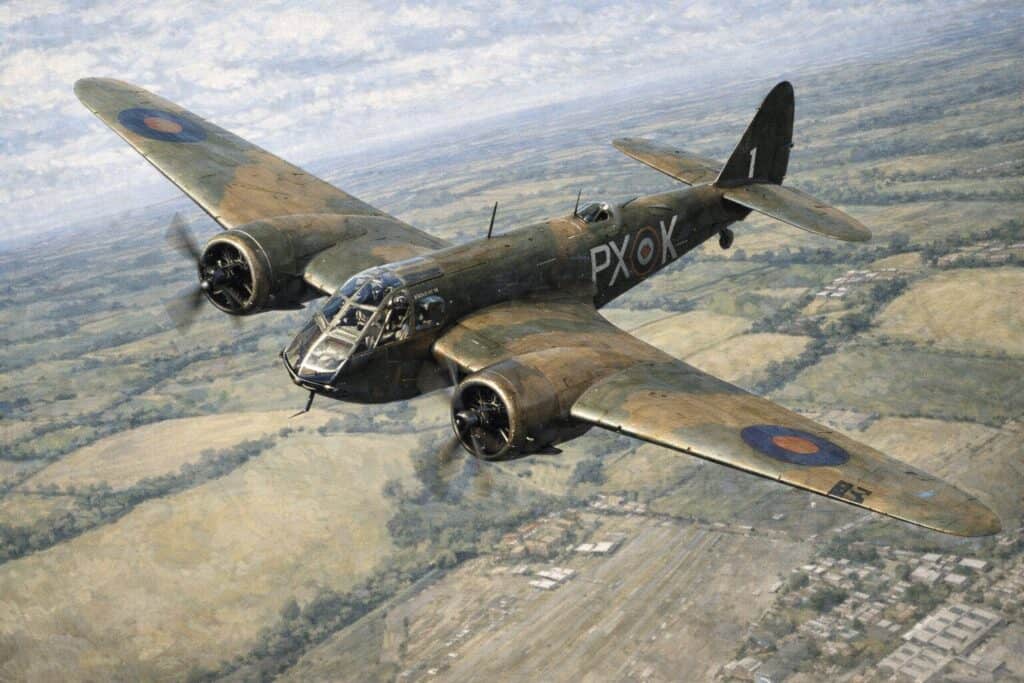
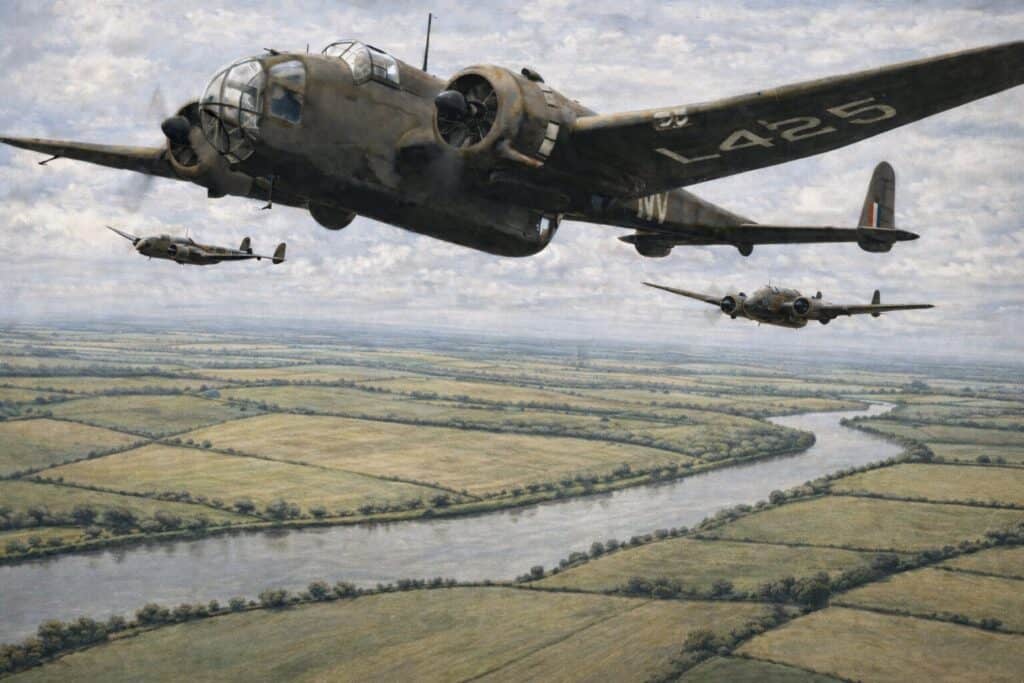
Bomber Command’s expansion in the late 1930s reflected this outlook. Aircraft such as the Armstrong Whitworth Whitley, Handley Page Hampden, and Vickers Wellington were products of a force preparing for long-range offensive work. Training and planning assumed that crews would navigate to enemy targets by day, identify them visually, and strike with enough accuracy to damage key industrial or military objectives. The confidence that bombers could make their way through hostile airspace was never absolute, but it remained strong enough to shape both doctrine and procurement.
This was the intellectual and operational world in which Bomber Command entered the war in September 1939. It had modernising aircraft, a strategic mission, and a theory of daylight penetration that had not yet been fully tested against a modern, integrated air-defence system.
The Early War And The Failure Of The Daylight Assumption
The opening phase of the war quickly exposed the gap between doctrine and operational reality. Political caution initially limited the range of targets the British government was willing to attack in Germany itself, and Bomber Command’s earliest operations were often directed against naval and maritime objectives rather than against the full industrial target system envisaged by inter-war theory. Even so, these missions were enough to show how dangerous daylight bombing had become.
German fighter opposition and anti-aircraft defence proved more formidable than many RAF planners had hoped. Bomber formations attacking defended objectives in daylight found that mutual defensive fire did not provide reliable immunity from interception. Modern fighters, guided by an increasingly organised air-defence network, were able to attack from advantageous angles and exploit gaps in bomber coverage. The problem was not simply that bombers could be shot down; it was that they could be shot down at a rate that threatened the sustainability of the whole offensive method.
The losses suffered in early daylight attacks, including those during operations over the North Sea and against heavily defended coastal targets, forced Bomber Command to confront an unwelcome fact. Even if daylight operations offered the best conditions for visual navigation and target recognition, they imposed risks that could not be accepted for a prolonged strategic campaign. Bomber aircraft were expensive to produce, trained crews were even harder to replace, and a doctrine that consumed force faster than it could be regenerated was not strategically viable.
This did not mean that bombing itself was abandoned. Quite the opposite. Britain still needed Bomber Command to play an offensive role. But if daylight raids could not be sustained at acceptable cost, the RAF had to change how it bombed if it wished to go on bombing at all.
Why Night Operations Became The Practical Solution
Night bombing emerged first as a practical expedient and then as the central method of the RAF’s strategic offensive. The immediate attraction was obvious. Darkness complicated fighter interception. Even before dedicated German night-fighter defences became fully effective, night operations reduced one of the greatest dangers that daylight crews had faced. In strategic terms, the move to night flying was a way to preserve offensive capability while reducing losses.
That advantage came at a price. Night bombing made navigation and target identification much more difficult. Crews could no longer rely on visual landmarks in the same way. Blackout measures obscured urban and industrial areas. Weather, cloud and darkness increased navigational error. Many bombers reached the approximate vicinity of a target without being able to identify it with certainty. Bombing results became more diffuse than pre-war precision assumptions had allowed for.
Yet Bomber Command accepted that trade-off because the alternative was worse. A bombing force destroyed in daylight would deliver no sustained pressure at all. A bombing force operating by night, even with reduced accuracy, could still strike repeatedly and remain in being. In wartime strategy, survival of the force was itself an operational necessity.
The move towards night operations during 1940 and 1941 was therefore not simply a matter of preference; it was a recognition that the original daylight model had failed under modern conditions. The RAF had to preserve aircraft and crews, maintain a visible offensive against Germany, and buy time for the further development of methods that might make night bombing more effective. In that sense, night operations were both a compromise and the foundation of a new strategy.
Navigation, Technology, And The Making Of The Night Offensive
If night bombing was to become more than a blunt expedient, Bomber Command needed better ways of finding targets and concentrating attacks. The technical and organisational transformation that followed was one of the most important developments in the history of the RAF’s bombing war.
Early night operations relied heavily on dead reckoning and limited visual reference. Over long distances, small navigational errors accumulate into major positional uncertainty. The consequences became unmistakably clear in operational analysis. The Butt Report of 1941, drawing on photographic evidence from sorties, showed that only a minority of aircraft attacking Germany were getting their bombs close to their intended targets. However uncomfortable, that conclusion forced the RAF to face the real condition of its bombing accuracy.
The response was not to give up, but to systematise improvement. Radio navigation aids such as Gee gave navigators far better positional awareness over parts of Western Europe. Oboe allowed selected aircraft to be guided to targets with much greater precision. H2S radar improved ground mapping in darkness and cloud, giving crews a better chance of identifying urban and industrial areas below. These systems did not produce effortless precision, but they progressively reduced the uncertainty that had dogged the early night war.
Organisation changed alongside technology. The creation of the Pathfinder Force in 1942 was especially important. Rather than expecting the whole bomber stream to solve the problem of locating a target independently, Bomber Command increasingly relied on specially trained crews to identify and mark it for the main force. This reflected a maturing operational system in which specialised functions were assigned to units best suited to them, rather than assumed to be evenly distributed across the command.
The bomber stream itself also became a decisive tactical innovation. By concentrating aircraft into narrower time and space corridors, Bomber Command complicated the work of German night defences and increased the weight of attack arriving over the target in a shorter period. This was not merely a technical adjustment. It changed the rhythm and concentration of the offensive.
Taken together, these developments transformed night bombing from a defensive expedient into a more coherent strategic method. The RAF could not simply see by night as it had hoped to bomb by day; it had to build an entire technological and operational system that made night warfare practicable.
Organisation, Training, And The Mature Bomber Offensive
Technology alone did not create the night offensive. Bomber Command also had to change itself as an institution. The shift from daylight operations to large-scale night operations altered the demands placed on crews, planners, station staff, and the entire command system supporting the aircraft.
Training was one of the first areas to feel that pressure. Navigators needed far more than competent map reading and dead reckoning. They had to master radio aids, instrument procedures, timing, route discipline, and the practical judgement required when the planned mission and the conditions in the air no longer matched perfectly. Pilots were expected to maintain formation discipline by route and timing rather than by visual proximity, often in darkness and bad weather, and under threat from night fighters or flak. Wireless operators, bomb aimers and flight engineers all operated within a crew system that became more dependent on technical coordination and calm procedure than pre-war assumptions had fully recognised.
Bomber Command’s own staff processes became more systematic as the offensive expanded. Route planning, weather analysis, intelligence assessment, target selection, and post-raid analysis all assumed greater importance. As raid sizes increased, the command could no longer rely on broad strategic intention alone. It had to manage air congestion, the timing of streams, the likely pattern of enemy response, and the ways in which supporting technologies such as Gee, Oboe, Pathfinder marking, and electronic countermeasures could be combined into a coherent whole.
Operational research was especially important in this maturation. Statistical study of losses, route patterns, aiming errors, and bombing results gave Bomber Command a more realistic understanding of what it was actually doing, not merely what it hoped it was doing. This mattered because the night offensive was too large, too costly, and too strategically important to be run on intuition alone. The command increasingly became an organisation in which analysis shaped practice.
This institutional change also helps explain why the offensive could be sustained. The mature bombing campaign was not simply the work of aircraft such as the Vickers Wellington in the earlier phase or the Avro Lancaster in the later phase. It depended on a command capable of learning, reorganising, and standardising increasingly complex operations. In that sense, the night offensive was the product of organisational adaptation as much as of doctrine or machinery.

From Precision Theory To The Area Offensive
As operational experience accumulated, RAF doctrine changed with it. Inter-war bombing theory had placed great emphasis on striking specific industrial objectives. In practice, the navigational and targeting difficulties of the early night war, combined with the scale of the conflict, pushed Bomber Command towards a broader conception of strategic effect.
This shift did not mean that industry ceased to matter. On the contrary, industrial and transport targets remained central to the logic of the bombing campaign. But the means of their attack changed. It became increasingly clear that concentrated attacks against larger industrial cities and urban target systems offered a more realistic way to impose sustained disruption than the pursuit of narrow precision under conditions that did not permit it.
The area offensive that developed under Bomber Command was therefore rooted both in technological limitation and in strategic calculation. Industrial production in modern Germany was not neatly isolated from urban infrastructure, the labour force, housing, transport and utilities. Attacks upon major industrial cities could be defended strategically as attacks upon the wider machinery of war. At the same time, they reflected the fact that night conditions made broader target areas more achievable than single-point objectives.
Leadership and command also mattered here. Under Arthur Harris, Bomber Command pursued a more concentrated and forceful bombing policy, one that emphasised the cumulative effect of repeated attacks on German industrial centres. That approach remains historically contested, especially regarding destruction in urban areas and civilian consequences. Any balanced account must acknowledge that controversy. But it must also recognise the operational logic as Bomber Command understood it: Britain sought a way to apply continuous direct pressure against Germany before Allied armies could return in force to Western Europe, and heavy night bombing appeared to offer that capability.
The arrival of the Avro Lancaster greatly strengthened this method. With its larger bomb load, range, and operational flexibility, it helped make the mature night offensive sustainable on a scale that earlier bombers had struggled to achieve. Raids such as Operation Gomorrah showed how far the offensive had moved from the tentative early-war daylight model. This was no longer a force hoping to identify individual objectives in daylight under hostile skies. It was a command built around concentration, night penetration, marking, technological assistance, and repeated mass attack.
Accuracy, Effect, And The Problem of Strategic Expectations
The move to night bombing also forced Bomber Command to confront a harder question than simple survivability: what did successful bombing actually mean under wartime conditions? Pre-war language about striking key industrial objectives had implied a relatively direct relationship between target selection, accuracy, and strategic effect. The early stages of the war showed that the relationship was much less straightforward.
If night conditions prevented the consistent destruction of narrowly defined targets, then strategy had to be reframed around concentration, repetition, and cumulative pressure rather than around the clean fulfilment of a single raid plan. That did not remove the importance of accuracy, but it changed how accuracy was judged. Bomber Command increasingly had to think in terms of damage to wider industrial areas, disruption of urban infrastructure, strain on transport, and the diversion of German defensive resources.
This mattered because expectations shaped doctrine. A force that continued to imagine itself as a daylight precision instrument would constantly judge itself against results that the operational environment no longer allowed it to deliver. A force that accepted the real conditions of the bombing war could organise itself around more achievable forms of pressure, even as it continued to improve navigation and target marking. In that sense, the evolution of RAF bombing strategy was also an evolution in strategic honesty. Bomber Command had to align its theory of bombing with the war it was actually fighting, not the one earlier planners had imagined.
The Wider Strategic Consequences Of The Shift
The transition from daylight raids to the night offensive shaped far more than Bomber Command’s own procedures. It changed the place of RAF bombing within the wider Allied war effort and within the history of strategic air power itself.
First, it ensured that Britain retained a continuous offensive instrument during the years when other means of direct attack on Germany were limited. The night offensive allowed the RAF to strike deep into occupied Europe and Germany, even when daylight bombing had proved too costly and before a continental return was possible. In political and military terms, that mattered.
Second, the move to night bombing drove technological innovation at scale. Navigation aids, target-marking systems, electronic warfare measures, and new methods of operational analysis all developed in response to the practical demands of the bombing war. These were not marginal improvements; they became central to the system by which the RAF fought.
Third, the RAF’s adaptation helped shape the broader Allied bombing campaign. When the United States Army Air Forces pursued daylight bombing on a large scale, the result was not a simple duplication of British effort but an increasingly complementary pattern. American daylight attacks and RAF night attacks together created a round-the-clock strategic pressure that imposed heavy demands on German industry, transport, and air defence. The RAF’s earlier shift to night operations had already created one half of that wider Allied pattern.
Finally, the transformation exposed both the possibilities and the limits of strategic bombing. The RAF learned that bombing could be sustained only through adaptation, and that claims made in the inter-war years about daylight precision and bomber self-protection had been too optimistic. It also learned that strategic air power, even when it could not deliver the precise results once imagined, could still exert cumulative pressure through scale, persistence, and technical refinement.
The night offensive was therefore not a sign of doctrinal failure alone. It was also evidence of institutional resilience. Bomber Command did not simply persist with a broken model; it changed its methods, technology, and assumptions in order to continue fighting.
Conclusion
RAF bombing strategy evolved because war forced it to evolve. The daylight assumptions with which Bomber Command entered the conflict proved too costly against modern fighter defence and coordinated air warning. Yet Britain still required an offensive air campaign, and night operations offered the means by which that campaign could survive.
What followed was a transformation in doctrine, practice, and technology. Night bombing began as a practical response to loss rates. Still, it became a far more sophisticated system built on radio navigation, radar, target marking, operational research, concentrated attack, and an organisational structure capable of learning from failure. In the process, the RAF moved away from the inter-war idea of daylight precision penetration and towards a night offensive designed to apply sustained pressure on an industrial scale.
That transition shaped the whole later history of Bomber Command. It also revealed something broader about modern air warfare: doctrine could not remain theoretical once it encountered an enemy capable of contesting the air in depth. The RAF’s bombing war was transformed not by preference, but by adaptation. From the failure of daylight confidence emerged the night offensive that would define Britain’s strategic bombing campaign for the rest of the war.