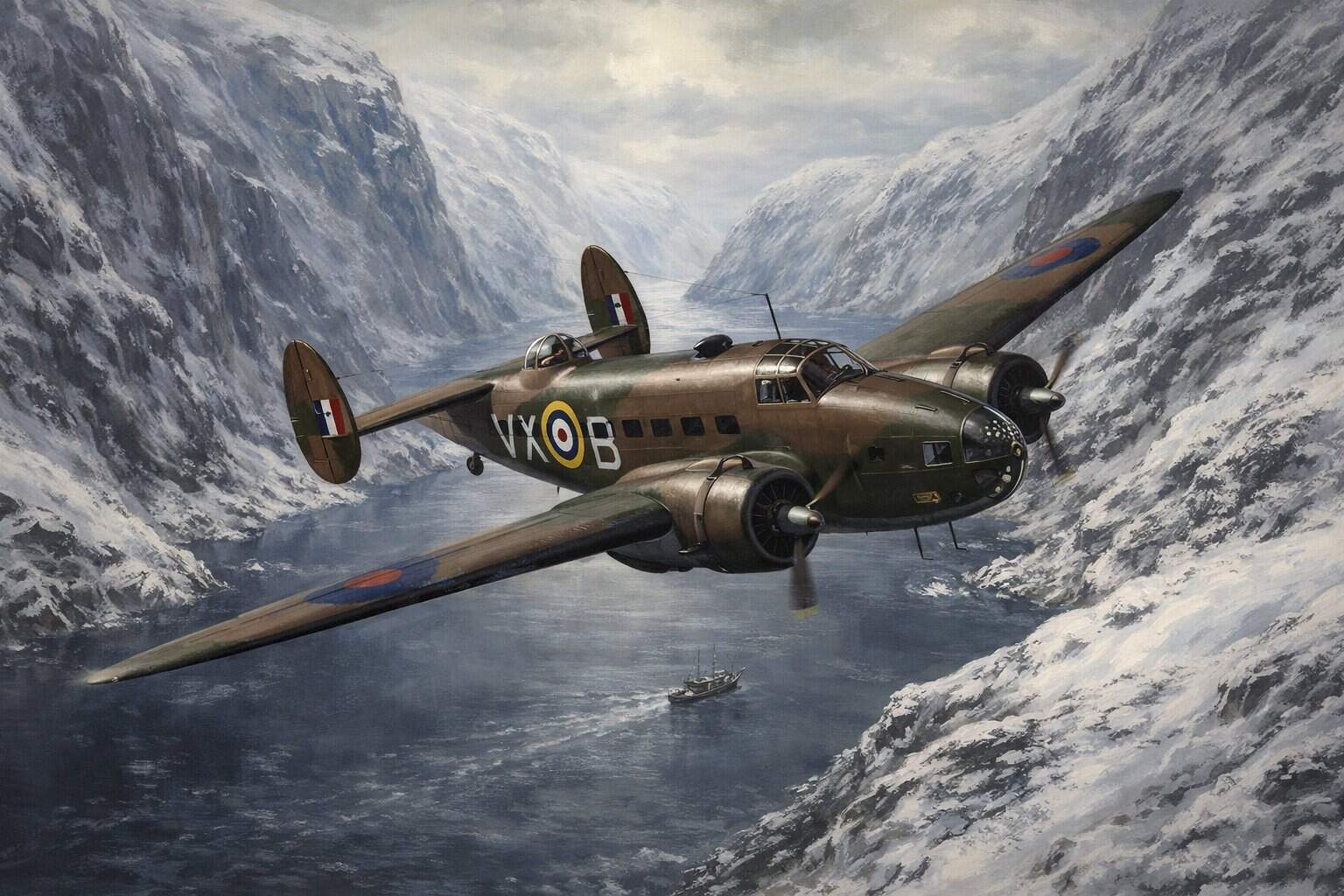
On 14 February 1940, during the early months of the Second World War, an RAF Coastal Command aircraft made a discovery that would soon lead to a dramatic naval confrontation in Norwegian waters. While conducting a patrol along the Norwegian coast, a Lockheed Hudson reconnaissance aircraft located the German auxiliary vessel Altmark, a ship carrying hundreds of captured Allied merchant sailors.
The sighting provided crucial intelligence that enabled the Royal Navy to intercept the vessel, resulting in the well-known Altmark Incident later that day.
This episode occurred during the period often described as the “Phoney War,” when large-scale land operations in Western Europe had yet to begin, but naval and air activity continued across the North Sea and surrounding waters.
The Strategic Background
The German ship Altmark was closely associated with the activities of the German pocket battleship Admiral Graf Spee, which had conducted a commerce-raiding campaign in the South Atlantic during 1939. Merchant vessels captured by the raider had their crews transferred to Altmark, which served as both a prison ship and a supply vessel.
Following the destruction of Graf Spee in December 1939 after the Battle of the River Plate, the Altmark attempted to return to Germany carrying nearly three hundred British merchant seamen who had been taken prisoner during the raider’s operations.
The vessel chose a route through Norwegian territorial waters, hoping that Norway’s neutrality would prevent interception by British naval forces. As the ship moved northward along the Norwegian coast, British intelligence and patrol aircraft searched for signs of its passage.
The Coastal Command Patrol
On 14 February 1940, a Lockheed Hudson aircraft from RAF Coastal Command sighted the Altmark while conducting a routine reconnaissance patrol. The Hudson was a modern maritime patrol aircraft that had entered RAF service shortly before the war and was particularly well suited to long-range reconnaissance over the sea.
Flying along the Norwegian coastline, the crew observed a suspicious vessel matching the description of the German ship. The aircraft maintained visual contact long enough to confirm the identification and report its position.
This sighting was of immediate operational importance. Coastal Command aircraft regularly provided intelligence to the Royal Navy, and the information from the Hudson patrol was quickly relayed to British naval forces operating in the area.
The report confirmed that Altmark was still moving through Norwegian waters and provided the approximate location needed for interception.
Royal Navy Intervention
Armed with the intelligence from the RAF patrol, the Royal Navy dispatched forces to intercept the German vessel. Later on the same day, the British destroyer HMS Cossack entered the Norwegian fjord where Altmark had taken refuge.
In a bold nighttime action, British sailors boarded the German ship and freed the captured merchant seamen. The prisoners were released after several months in captivity and famously greeted their rescuers with the words, “The Navy’s here.”
The boarding operation resulted in the deaths of several German sailors during the brief struggle that followed. The British prisoners, however, were successfully evacuated and returned safely to Allied control.
Diplomatic and Strategic Consequences
Although the rescue was widely celebrated in Britain, the incident created significant diplomatic tension. Norway protested the violation of its territorial waters, arguing that the British naval action had breached its neutrality.
The event also highlighted the vulnerability of Norwegian waters to wartime operations by both sides. German leaders took careful note of the situation and concluded that control of Norway’s coastline would be strategically important for the wider war.
Within weeks, these concerns contributed to the planning of Germany’s invasion of Norway in April 1940, which dramatically expanded the conflict in northern Europe.
Significance in the Air War
The discovery of the Altmark demonstrated the growing importance of maritime reconnaissance aircraft in modern naval warfare. RAF Coastal Command played a vital role in monitoring sea lanes, locating enemy vessels, and providing intelligence that allowed the Royal Navy to act decisively.
Aircraft such as the Lockheed Hudson greatly expanded Britain’s ability to patrol large areas of ocean and coastline, making it far more difficult for enemy ships to move undetected.
Although the Altmark Incident was primarily a naval operation, the initial sighting by Coastal Command aircraft was the key moment that made interception possible. It showed how closely air and naval forces were becoming integrated in the conduct of maritime warfare.
The events of 14 February 1940 illustrate an early example of effective cooperation between the Royal Air Force and the Royal Navy. In the wider history of the war at sea, the Hudson’s discovery of Altmark stands as a reminder that the outcome of naval operations increasingly depended on the eyes of aircraft operating far above the waves.