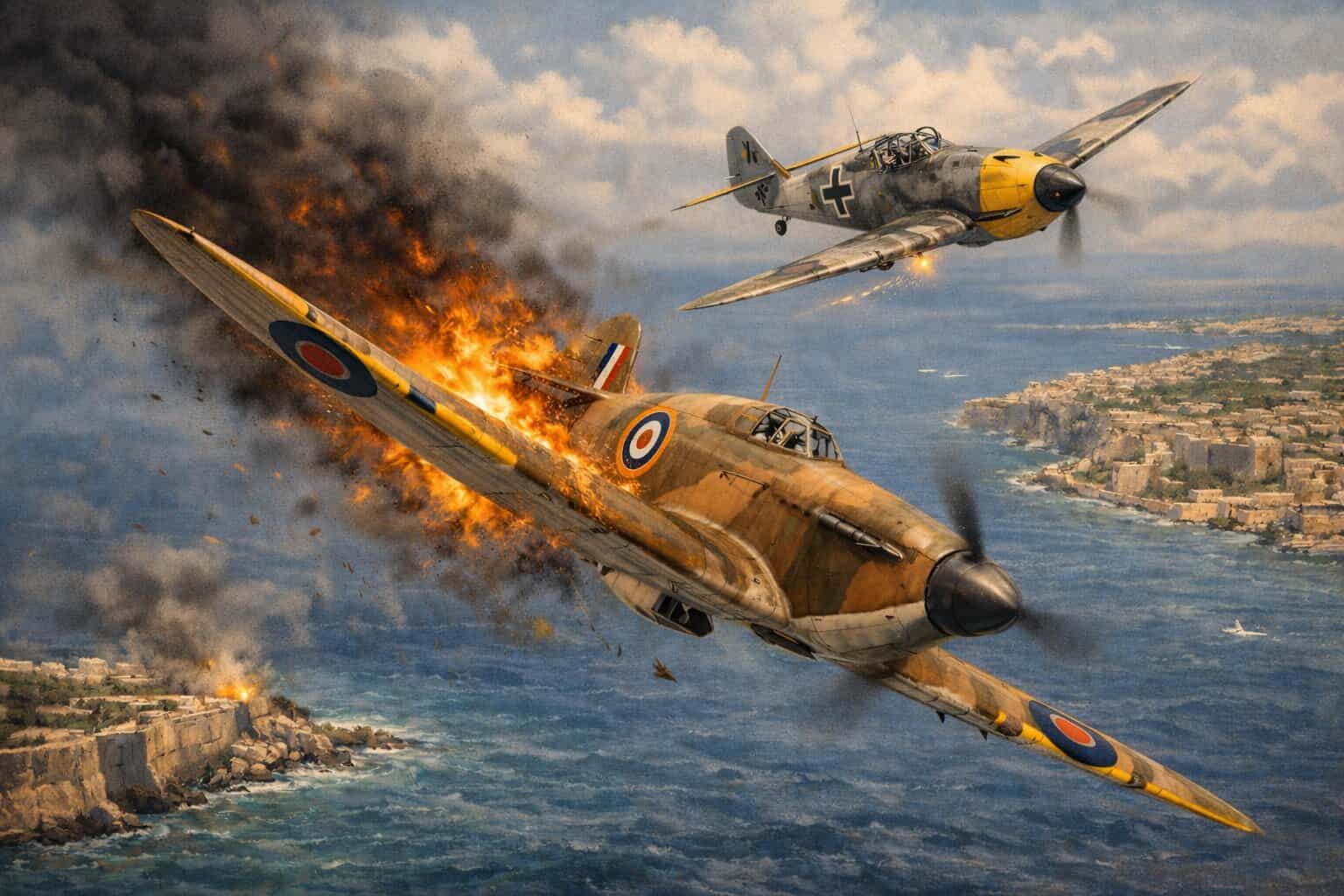
On 25 January 1942, Royal Air Force fighter strength on Malta suffered a serious setback when Luftwaffe Messerschmitt Bf 109s shot down seven Hawker Hurricanes during air combat over the island. The losses represented a substantial proportion of the serviceable fighters then available, at a time when Malta’s air defences were already under sustained and intensifying pressure.
By early 1942, Malta occupied a critical position in the Mediterranean theatre. From its airfields, RAF aircraft attacked Axis shipping routes supplying German and Italian forces in North Africa. The island’s offensive capability, however, depended upon maintaining sufficient fighter cover to defend against repeated air assaults. Throughout January, German and Italian aircraft had mounted frequent raids, targeting airfields, infrastructure, and harbour facilities in an effort to neutralise Malta as an operational base.
Escalation of Axis Air Pressure
The Luftwaffe had reinforced its Mediterranean contingent in late 1941, bringing experienced fighter units equipped with the Bf 109. These aircraft, benefiting from improved performance and combat experience gained on other fronts, posed a significant challenge to the Hurricanes defending the island. Although the Hurricane had proven its effectiveness earlier in the war, by 1942 it faced increasingly capable adversaries.
Axis strategy aimed not only to inflict material damage but to erode Malta’s limited fighter strength. Aircraft and spare parts were difficult to replace due to the island’s isolation and the hazards of convoy resupply. Each loss, therefore, carried disproportionate consequences.
The Engagement of 25 January
On 25 January, Luftwaffe formations approached Malta under fighter escort. RAF Hurricanes were scrambled to intercept. The engagement that followed occurred in contested airspace over or near the island, where the defenders sought to break up bomber formations and challenge the escorting fighters.
In the course of the fighting, seven Hurricanes were shot down by Bf 109s. The losses were significant, both numerically and strategically. Given the limited number of operational aircraft on Malta at that time, the reduction in serviceable fighters was immediately felt. The Luftwaffe, for its part, demonstrated the effectiveness of concentrated fighter operations designed to attrit the island’s defensive capability.
The combat highlighted the tactical difficulties faced by the RAF. Hurricanes were often required to take off under the threat of imminent bombing, climb rapidly to intercept, and engage enemy aircraft at a performance disadvantage and sometimes at a lower altitude. Despite determined resistance, the imbalance in aircraft capability and numbers was evident.
Immediate Consequences
The losses of 25 January intensified the strain on Malta’s air defences. Fewer fighters meant reduced capacity to intercept subsequent raids, increasing the vulnerability of airfields and installations. Maintenance crews worked to repair damaged aircraft and keep remaining Hurricanes serviceable, while commanders sought to conserve strength without conceding control of the skies entirely.
The attrition underscored the urgent need for reinforcement and re-equipment. In the months that followed, efforts were made to deliver more modern fighters to the island. These reinforcements would play a crucial role in restoring Malta’s defensive resilience later in 1942.
Significance in the Mediterranean Air War
The events of 25 January 1942 form part of a broader struggle for air superiority over Malta. Control of the island had direct implications for the North African campaign, as Malta-based aircraft threatened Axis supply convoys crossing the central Mediterranean. Neutralising Malta was therefore a strategic priority for Germany and Italy.
The heavy Hurricane losses on this day illustrate the island’s precarious position in the early months of 1942. Air power was central to both attack and defence, and the balance could shift rapidly depending on the availability of aircraft and pilots’ experience.
In the wider context of the air war, the engagement demonstrates the evolving nature of fighter combat and the importance of technological parity. While Malta would endure further intense bombardment, its eventual recovery and sustained resistance owed much to the lessons learned during such difficult periods.
The combat of 25 January stands as a reminder of the narrow margins upon which Malta’s survival often depended, and of the central role played by RAF fighter crews in maintaining that defence under persistent and hazardous conditions.