Operation Gomorrah was a series of Allied air raids against Hamburg carried out between 24 July and 3 August 1943. For RAF Bomber Command, it marked one of the most destructive applications of area bombing in the Second World War and one of the clearest demonstrations of how far strategic air warfare had developed since the early war years. The operation was conducted jointly with the United States Army Air Forces, but the RAF night attacks formed the central element in the destruction that followed.
Hamburg was selected because of both industrial and operational factors. It was Germany’s second-largest city, a major port and an important centre for shipbuilding, U-boat production and wider war industry. Its location also made it easier to reach than many deeper inland targets. Operation Gomorrah therefore brought together target importance, navigational accessibility and the mature area-bombing doctrine that Bomber Command had developed by 1943.
Strategic Context And Planning
Earlier in the war, RAF night bombing had suffered from poor navigation, limited concentration and doubtful accuracy against individual industrial targets. By 1942 and 1943, Bomber Command had increasingly shifted towards large-scale attacks against urban-industrial areas rather than against single factories in isolation. The intention was to damage industrial output by destroying housing, utilities, transport, and the wider urban environment on which war production depended.
Hamburg was particularly suited to this method. Its scale, industrial importance and port facilities made it a legitimate major objective within Bomber Command’s strategic framework. At the same time, its geography favoured navigation and concentration more readily than some inland targets.
Operation Gomorrah was therefore not an isolated raid but part of a broader strategic bombing policy in which large-scale urban attack had become an accepted method of RAF operations against Germany.
Tactics, Bomb Loads and Window
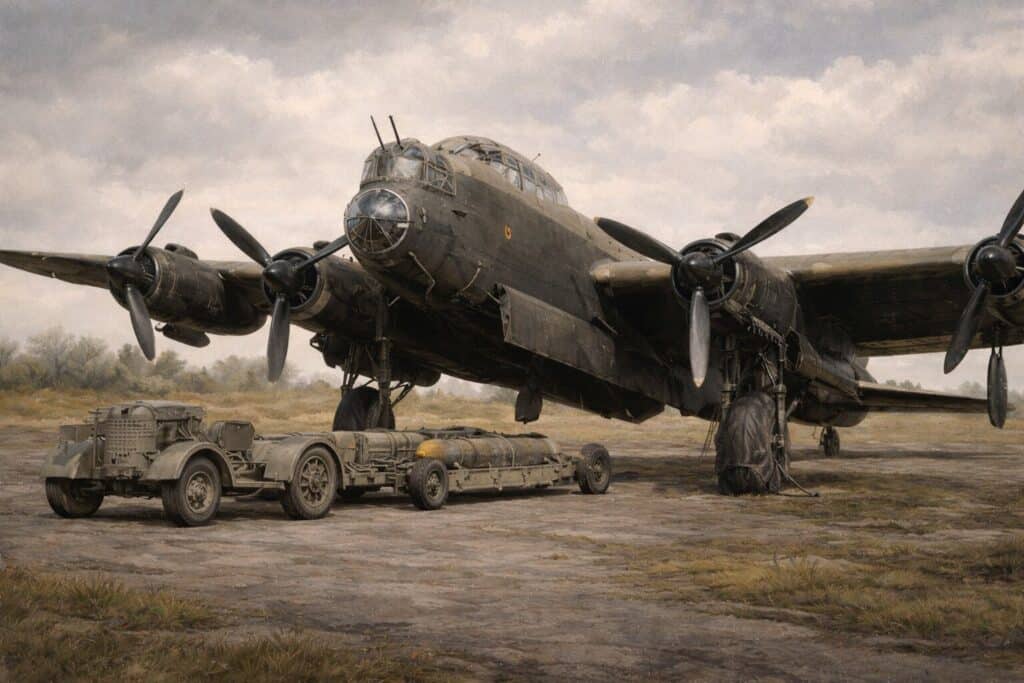
The RAF attack plan depended upon a deliberate mixture of high-explosive and incendiary weapons. High explosives were intended to break roofs, doors, windows and water mains, exposing buildings and weakening the firefighting system. Incendiaries were then expected to ignite numerous fires in the damaged urban fabric. The aim was not simply destruction by blast alone, but a level of combined damage that overwhelmed the city’s firefighting and recovery capacity.
Operation Gomorrah also introduced a major technical innovation in combat use: Window. This radar countermeasure consisted of strips of aluminium foil cut to interfere with German radar. Its release by bomber aircraft complicated the work of German night-fighter control and reduced the effectiveness of elements of the defensive radar network.
The concentration of the bomber stream was central to the operation’s method. If bombers could reach the target with lower losses and remain more tightly grouped, the physical effect on the city was likely to be more severe. Window had tactical importance beyond its immediate technical novelty.
Execution Of The Raids
Operation Gomorrah involved a sequence of RAF night raids and USAAF daylight attacks between 24 July and 3 August 1943. The opening RAF attack on the night of 24–25 July introduced Window operationally and demonstrated that the method could significantly disrupt German night defence.
The most devastating attack came on the night of 27–28 July, when RAF Bomber Command struck densely built-up districts under weather conditions that helped create a firestorm. Later raids caused further damage, though not all achieved the same level of concentration or effect.
The operation developed not as a single isolated blow, but as a concentrated sequence of attacks intended to maintain pressure on the city’s industrial and civic structure over several days.
Results, Destruction and Losses
The night of 27–28 July produced the most destructive effects. Fires merged over a wide area, and the resulting firestorm caused enormous destruction to buildings, infrastructure and the civilian population. In terms of physical and human consequences, it was one of the most severe air attacks carried out against a European city during the war.
Industrial facilities, housing, transport links and utilities were all heavily affected. The number of dead ran into many tens of thousands, while very large numbers of civilians were displaced. The scale of destruction went well beyond the normal cumulative effect of ordinary night raids and made Hamburg a defining example of area bombing at full intensity.
The operation also imposed strain on German air defence and home-front resources, requiring the diversion of labour, repair effort and further measures for urban protection.
Historical Significance
Operation Gomorrah is significant because it demonstrated the mature wartime form of Bomber Command’s area-bombing doctrine. It brought together navigational improvement, heavy bomber concentration, mixed bomb loads and electronic countermeasures in a way that produced destruction on a scale not previously seen in Europe.
It is also central to later debate about the conduct and consequences of strategic bombing. In RAF operational history, Gomorrah stands as an example of what Bomber Command could achieve materially against a large urban target once its methods, aircraft and supporting systems had reached a higher level of effectiveness. In moral and historical discussion, it remains one of the operations most frequently examined in relation to the bombing of cities.
Conclusion
Operation Gomorrah was the RAF and USAAF air offensive against Hamburg in the summer of 1943, and for Bomber Command it represented one of the clearest demonstrations of concentrated area bombing in the Second World War. The use of mixed bomb loads and the operational introduction of Window contributed to an attack sequence that culminated in enormous destruction and loss of life.
Its importance lies both in the scale of its physical impact and in how it illustrates the development of RAF strategic bombing by mid-war. For that reason, it remains one of the defining operations in the history of Bomber Command and in the wider study of strategic air warfare.