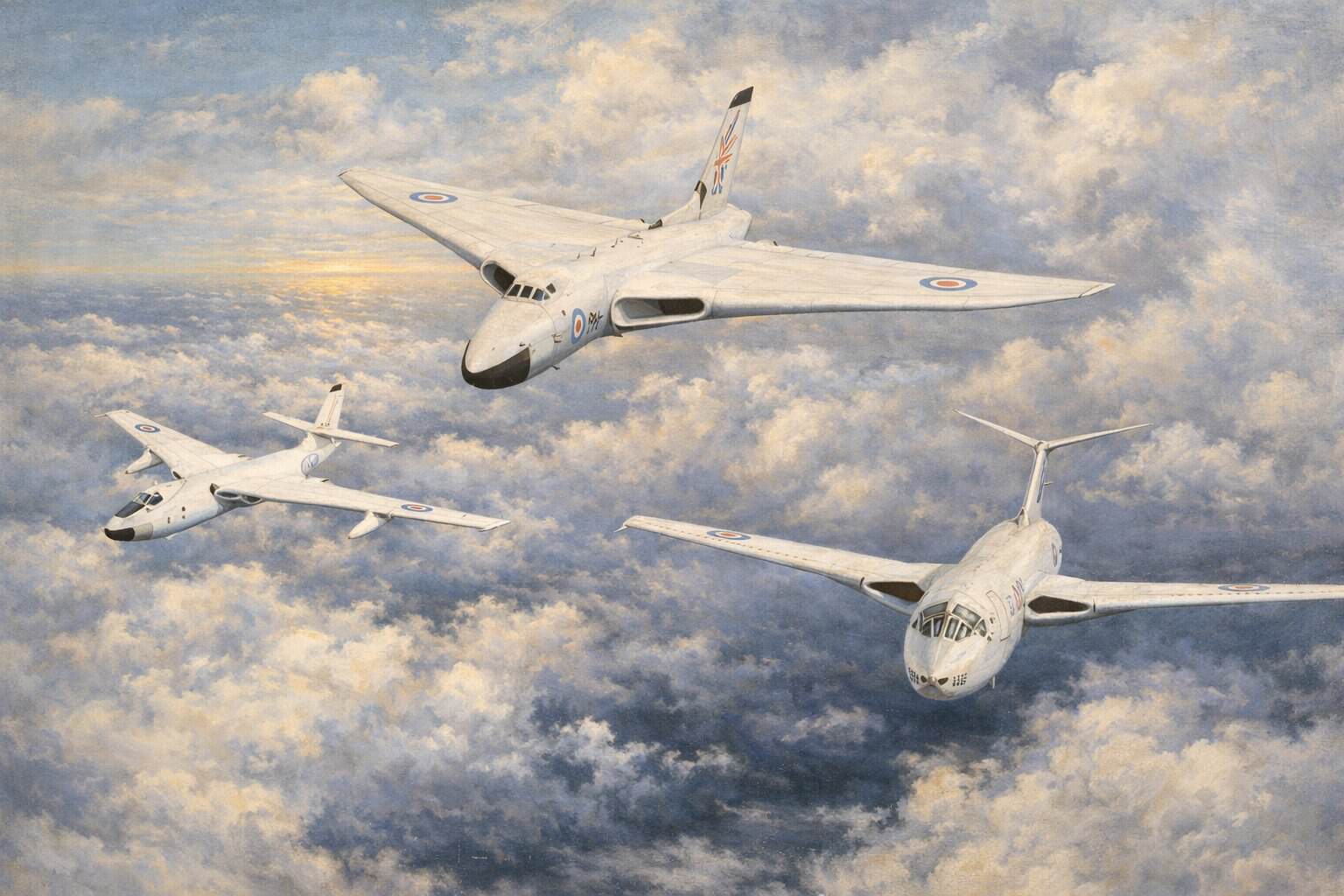
The V-Force stood at the centre of Britain’s early nuclear deterrent because it gave the Royal Air Force a strategic role unlike anything it had held before. In the decade after the Second World War, British defence policy was shaped by the realities of economic weakness, Cold War confrontation, and the arrival of nuclear weapons as the dominant language of great-power strategy. Britain could no longer hope to match Soviet conventional strength in Europe by numbers alone. A bomber force able to carry nuclear weapons deep into hostile territory appeared to offer something of immense value: a means of preserving strategic influence while contributing to the wider Western deterrent posture.
The significance of the V-Force lay in more than its dramatic aircraft. The Vickers Valiant, Avro Vulcan and Handley Page Victor formed part of a wider system that joined technology, operational readiness, doctrine, and national policy. These aircraft were expected to deliver Britain’s nuclear weapons, but their real function was deterrent rather than routine warfighting. They existed to convince any potential adversary that aggression against Britain or the alliance would carry an unacceptable cost. In that sense, the V-Force was a product of the early Cold War’s central strategic belief: that peace might be preserved through the credible threat of overwhelming retaliation.
Yet bomber deterrence was never static. It depended on assumptions about speed, altitude, range, radar, interception and survivability that changed rapidly during the 1950s and 1960s. The history of the V-Force is therefore not simply the story of three aircraft types. It is the story of how Britain adapted wartime faith in strategic air power to the nuclear age, and of how new technologies and new strategic logic later overtook that adaptation.
Why Britain Chose A Bomber Deterrent
Britain’s pursuit of a bomber-based nuclear deterrent emerged from both strategic necessity and political calculation. The immediate post-war world was marked by shrinking resources, global commitments that Britain could no longer sustain on pre-war terms, and the rapid breakdown of relations with the Soviet Union. The creation of NATO in 1949 placed Britain within a collective defence system, but alliance membership did not remove national anxieties about dependence. British policymakers wanted the security that came from close alignment with the United States, yet many also believed that complete reliance on American nuclear protection would reduce Britain’s strategic freedom of action and diminish its international standing.
Nuclear weapons seemed to offer an answer. They promised a means of exerting strategic weight that conventional forces alone could no longer guarantee. Once Britain became a nuclear power in its own right, the question became one of delivery. In the late 1940s and early 1950s, long-range bombers were the only practical instrument available for carrying atomic weapons to distant targets. Ballistic missiles were not yet an operational answer. If Britain wanted a functioning independent deterrent, it needed a bomber force capable of reaching strategic objectives from bases in the United Kingdom.
This decision also reflected the institutional legacy of the Second World War. Bomber Command had demonstrated the scale at which long-range air operations could be organised and sustained. That experience did not simply disappear in 1945. It shaped post-war thinking about strategic air power, even though the weapon to be delivered was now fundamentally different. Wartime bombing had been cumulative, conventional, and industrial in scale. Nuclear strategy, by contrast, rested on the idea that a relatively small number of aircraft might deliver effects far beyond those of any conventional campaign. But the intellectual bridge between the two was clear enough: long-range bombers still appeared to offer the most direct way of striking at the enemy state.
In this setting, the RAF became the service most immediately responsible for turning British nuclear ambition into an operational reality. The deterrent began not as an abstract theory of statecraft, but as a practical requirement for aircraft, crews, bases, planning systems, and weapons delivery methods.
The Three V-Bombers And The Shape Of The Force
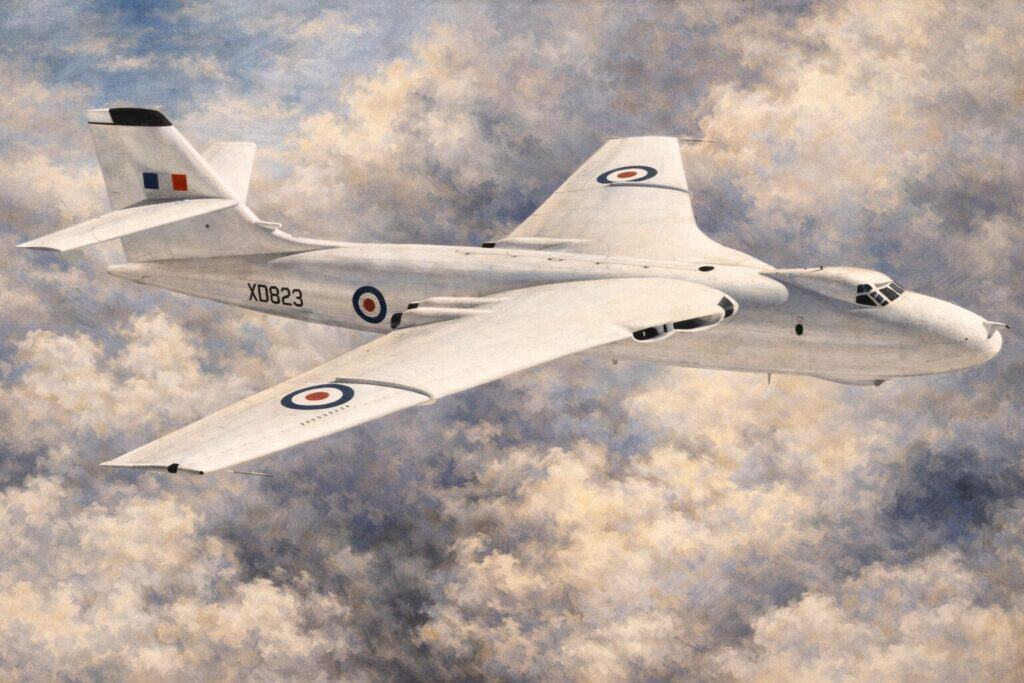
The force that emerged was not built around a single aircraft, but around three distinct designs. The Vickers Valiant, the Avro Vulcan, and the Handley Page Victor together formed what became known as the V-Force. All three were conceived within the assumptions of the early nuclear age: that altitude and speed would help bombers survive long enough to reach their targets, and that strategic effect depended upon range, payload, and readiness.
The Valiant entered service first, giving the RAF its earliest practical jet-powered nuclear delivery platform. It was the most straightforward of the three designs and served an important transitional role. In strategic terms, the Valiant mattered because it allowed Britain to field an operational nuclear bomber force quickly while the more advanced aircraft were still approaching service. It also helped establish the procedures, training patterns, and command culture of the new deterrent era.
The Vulcan became the best-known symbol of the V-Force. Its delta wing gave it a highly distinctive appearance, but the real importance of the aircraft lay in its performance and adaptability. Designed for high-altitude penetration, it embodied the belief that advanced aerodynamic design could keep pace with the demands of nuclear delivery. The Victor, with its crescent wing and equally ambitious design philosophy, represented another route towards the same end: a strategic bomber capable of carrying Britain’s nuclear weapons over long range and at high performance.
The existence of three types gave the RAF a measure of resilience and flexibility. It reduced dependence on a single design and reflected a period in British aviation when the country was still willing to commit major industrial effort to strategic bomber development. Yet the value of the V-Force was never simply technical. The three bombers had to be integrated into a functioning deterrent structure. Aircraft without readiness, crews without doctrine, and bases without dispersal arrangements would not have created a credible strategic force. The V-Force became important because these aircraft were embedded in a command system designed to keep them operationally available on short notice.
Readiness, Dispersal And The Deterrent Posture
A bomber force intended for nuclear deterrence had to do something very different from a wartime offensive bomber command. Its central purpose was to remain ready without being used. That required a distinctive operational posture. Aircraft needed to be maintained at high levels of serviceability. Crews had to be trained not merely to fly long-range strike missions, but to do so under conditions of extreme urgency. Bases needed to support rapid launch, weapon handling, and command transmission. The credibility of the deterrent depended not only on aircraft performance but on the confidence that Britain could actually get its bombers into the air in a crisis.
Readiness became a defining characteristic of the V-Force. Bomber squadrons were organised around alert procedures intended to reduce the time between warning and take-off. This was not just a technical matter. It was a strategic signal. A force that could not respond rapidly enough would struggle to deter anyone, because it might be destroyed before it could act. Operational alert routines, crew duty systems, and communications procedures all reflected this reality.
Dispersal planning was equally important. Fixed bomber bases were obvious targets. If the V-Force remained concentrated at a small number of stations, it risked destruction in a pre-emptive attack. The RAF therefore developed systems by which aircraft could be dispersed across a wider network of airfields during periods of tension. This did not eliminate vulnerability, but it improved survivability and complicated any adversary’s planning. It also reinforced the basic principle that deterrence depended on the enemy believing the force would survive long enough to retaliate.
Targeting doctrine sat alongside readiness and dispersal. The V-Force was integrated into strategic planning that identified key military, industrial, and command targets within the Soviet sphere. In practice, such planning was part of the wider Western alliance framework, yet Britain still retained a national political interest in preserving an independent voice in deterrence. The RAF operated at the meeting point of military planning and national strategy. The bombers were real aircraft on real stations, but their strategic meaning was inseparable from the political idea of an independent British deterrent.

The Problem Of Air Defence And The End Of The High-Altitude Assumption
The original operational logic of the V-Force depended heavily on the belief that high altitude and speed would provide sufficient protection against enemy air defences. That assumption did not survive unchanged for long. During the 1950s, radar systems improved rapidly, interceptor aircraft became more capable, and surface-to-air missiles transformed the defensive environment. What had looked viable in early Cold War planning increasingly appeared vulnerable.
This was one of the central strategic problems of the V-Force. A deterrent based on bombers remained credible only so long as those bombers could plausibly reach their targets. If Soviet air defence systems became too effective, then the entire logic of bomber penetration was weakened. British planners responded in several ways. One was the development of electronic countermeasures to interfere with enemy detection and tracking. Another was the search for a stand-off capability, most notably through the Blue Steel missile, which allowed bombers to launch a nuclear weapon from a greater distance rather than fly directly over the most heavily defended targets.
Equally important was the move from high-altitude penetration to low-level attack profiles. Flying lower reduced the chance of radar detection at long range and made use of terrain masking, but it imposed different stresses on aircraft and crews. Bombers designed for high-altitude nuclear delivery had to be adapted in both technical and doctrinal terms. Low-level flight required revised navigation, greater crew precision, and acceptance that survivability would depend less on altitude and more on evasion, route discipline, and electronic support.
This transition reveals something fundamental about the V-Force. It was not a static expression of early-1950s confidence. It was a force continually adapting to avoid obsolescence. The RAF was trying to preserve a bomber deterrent in an age when defensive technology was advancing at a remarkable pace. That the V-Force could be modified for new tactics was a strength. That it had to be modified so extensively also showed how fragile the original assumptions had become.
Operation Grapple And The Credibility Of British Nuclear Power
The V-Force cannot be understood only through its posture in Europe. Its wider significance also rested on Britain’s effort to prove and refine its nuclear capability on the world stage. Operation Grapple, the British thermonuclear test series in the Pacific, was central to that process. Although not a wartime operation in the conventional sense, it demonstrated how closely the bomber force, weapons development, and strategic policy had become linked.
These tests mattered because deterrence depended upon credibility. Britain needed not just aircraft and doctrine, but a proven thermonuclear capability that could sustain its claim to strategic independence and great-power status. The RAF’s role in supporting this effort reflected the service’s central place within British nuclear policy. The V-Force was part of the system through which Britain translated scientific achievement into operational deterrent effect.
Operation Grapple also reinforced the global reach implied by the V-bombers themselves. The deterrent was based in Britain, but its logic was international. It touched alliance politics, imperial basing arrangements, scientific development, and the wider diplomatic theatre of the Cold War. The V-Force was therefore never just an RAF story in narrow service terms. It sat at the intersection of national strategy, alliance obligations, and international prestige.
That broader political significance helps explain why the V-Force retained its importance even as its operational vulnerability increased. Its value lay partly in what it could do, but also in what it represented: Britain’s claim to remain a nuclear power with an independent strategic role.

From Bomber Deterrent to Polaris
By the 1960s, however, the bomber-based deterrent was under growing strain. Improvements in Soviet radar and missile systems, continuing doubts about bomber survivability, and the rapid advance of ballistic missile technology all pushed British defence planning towards a different answer. The eventual transfer of the primary nuclear deterrent to the Royal Navy’s Polaris submarines was not merely an equipment change. It marked a decisive shift in the structure of British strategy.
Submarine-launched ballistic missiles offered obvious advantages. They were harder to locate and destroy, less dependent on fixed bases, and capable of delivering weapons far more quickly than bombers could. For deterrence, that mattered enormously. A submarine-based system promised greater survivability and therefore greater credibility.
This did not render the V-Force meaningless. For a crucial period, it had provided the operational core of Britain’s nuclear posture. Even during the transition to Polaris, the V-bombers continued to serve as the principal strategic force until the submarine system was fully established. The bombers also found new roles. Most notably, the Victor became highly important as an aerial refuelling aircraft, demonstrating that the end of its nuclear strike role did not mean the end of its usefulness to the RAF.
The shift to Polaris nonetheless changed the RAF’s place in British deterrence. The service moved away from its position at the centre of the national nuclear strike force and towards other Cold War functions, including conventional support, air defence, and broader alliance tasks. In strategic terms, the V-Force era had ended. But its legacy remained substantial because it represented the formative period in which Britain translated the idea of an independent nuclear deterrent into practical military form.
Bomber Command Culture In The Nuclear Age
The V-Force also marked a cultural transition within the RAF. Bomber Command in the nuclear era inherited some of the organisational seriousness of wartime strategic bombing, but its purpose was fundamentally different. Crews were no longer preparing for a long conventional bombing campaign measured in repeated raids and cumulative destruction. They were training for a strategic mission whose success depended on immediate readiness and whose actual execution would signal a failure of deterrence on the gravest possible scale.
That altered the meaning of professionalism inside the force. Readiness drills, route planning, electronic warfare preparation, and the discipline of constant alert all became part of everyday service life. The bomber crew was expected to master highly technical aircraft while also understanding that its role sat at the highest level of national policy. This gave the V-Force a distinct place in RAF culture: part elite flying force, part strategic instrument held in reserve.
It also reinforced the gap between public image and operational reality. To outside observers, the V-bombers could appear primarily as symbols of British engineering or Cold War prestige. Inside the RAF, they were part of a system built around procedures, timing, survivability and the disciplined management of extraordinary destructive power. That culture of strategic seriousness forms an important part of the V-Force story, because it shows how deeply nuclear deterrence reshaped not only aircraft roles but the everyday purpose of RAF bomber service.
The RAF, NATO, And Britain’s Claim To Strategic Independence
The V-Force also mattered because it sat at the intersection of national policy and alliance strategy. Britain did not develop its deterrent in isolation from the wider Western system. NATO planning increasingly treated nuclear weapons as central to the defence of Europe, and British strategic bombers formed part of that larger calculation. Yet British governments were also determined that the country should retain a measure of independent authority over its own nuclear forces. The V-Force had a dual character: it contributed to collective deterrence while also embodying a specifically British claim to strategic status.
This political dimension should not be underestimated. In the 1950s and 1960s, possession of a functioning nuclear delivery force carried weight not only in military planning but in diplomacy and alliance politics. A Britain able to place its own strategic bombers on alert and to integrate them with broader NATO assumptions without surrendering them entirely to foreign control remained a more consequential actor than a Britain dependent solely on American protection. The RAF’s bomber force was therefore part of the country’s international posture as well as its military one.
That dual role imposed both strains and advantages. The force had to be credible enough to matter militarily, yet politically framed to support Britain’s wider strategic relationships. It had to fit into alliance targeting and planning while still serving the domestic claim that Britain possessed an independent deterrent. In practice, this made the V-Force a highly political military instrument. Its readiness, basing and operational doctrine all had consequences that extended beyond the RAF itself.
Seen in that light, the V-Force was not simply a bomber force waiting for a war that never came. It was part of the machinery by which Britain defined its place in the Cold War order. That is one reason its history remains so important. It reveals how RAF air power, alliance strategy and national prestige could become inseparable in the nuclear age.
Conclusion
The V-Force makes better sense when understood as a system rather than a collection of dramatic aircraft. The Valiant, Vulcan, and Victor were the visible elements of Britain’s early nuclear deterrent. Still, their significance came from the way they connected aircraft design, operational readiness, dispersal planning, targeting doctrine, alliance strategy, and national political ambition.
For Britain in the early Cold War, a bomber-based deterrent seemed to offer a workable answer to a difficult strategic problem. It provided a means of sustaining influence, contributing to NATO, and preserving a measure of independence in an age dominated by nuclear power. The RAF found itself carrying responsibilities that were military, political, and symbolic all at once.
The V-Force also reveals the instability of deterrent systems built on changing technology. Its original assumptions about high-altitude penetration were steadily eroded by improvements in air defence, forcing adaptation through stand-off weapons, electronic countermeasures, and low-level tactics. Eventually, the logic of survivability pointed away from bombers and towards ballistic missile submarines.
Even so, the V-Force remains central to RAF history because it marks the moment when British air power became inseparable from national nuclear strategy. It was not simply a continuation of wartime bomber doctrine in peacetime conditions. It was a new form of strategic air power, shaped by deterrence, credibility, and the pressures of the Cold War. In that role, it stood at the heart of Britain’s defence posture during one of the most dangerous periods of the twentieth century.