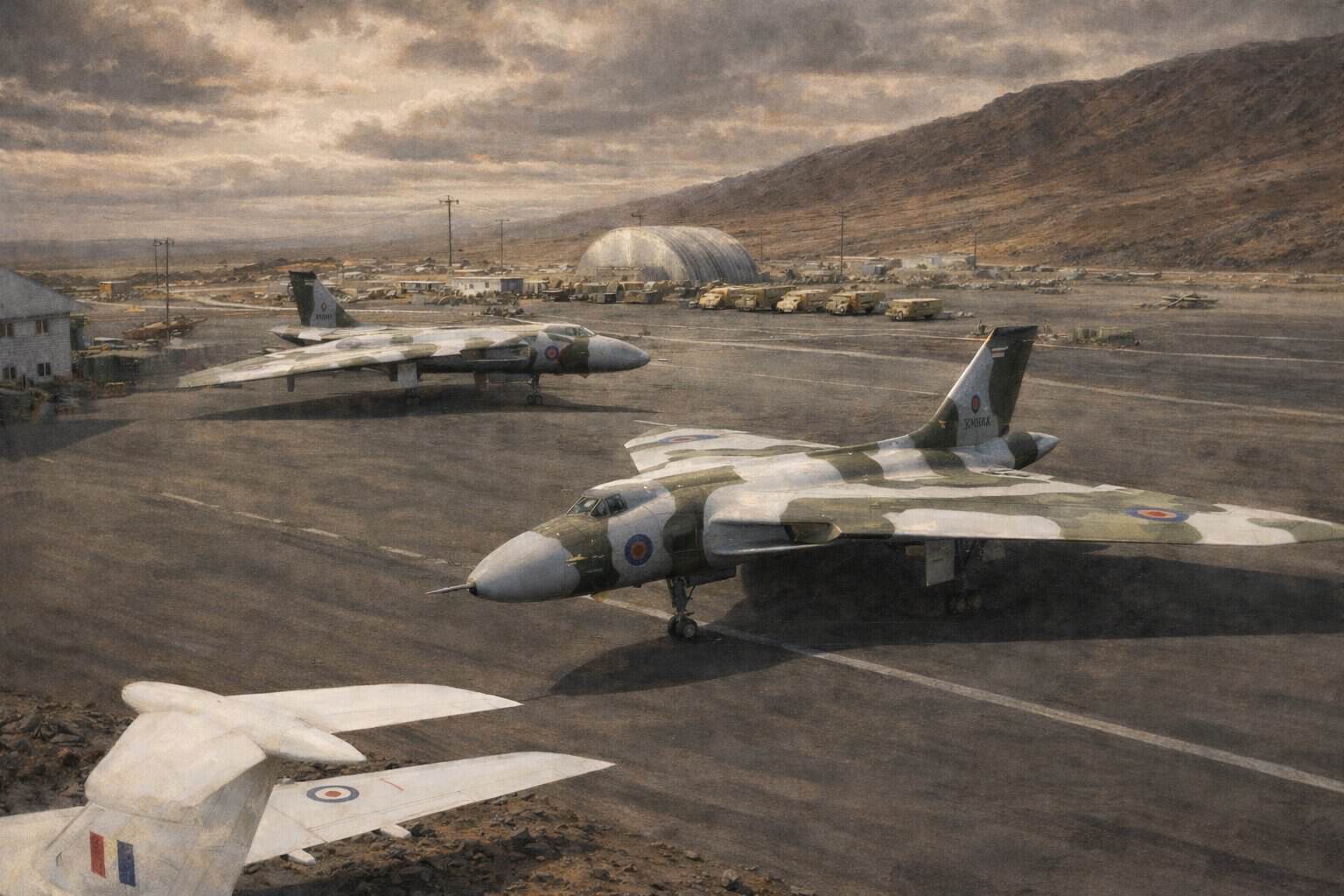
On 29 April 1982, Avro Vulcan bombers from Waddington reached Ascension Island to prepare for long-range attacks during the Falklands campaign as part of Operation Corporate. The move was one of the most striking examples of the Royal Air Force adapting Cold War capability to an unexpected theatre. Designed originally for a strategic nuclear role and later employed in conventional duties, the Vulcan now found itself central to a conflict thousands of miles from home, where range and reach would become decisive operational challenges.
Preparing an extraordinary mission
The deployment to Ascension was significant because it transformed a theoretical possibility into a real offensive option. From Britain itself, the distance to the South Atlantic made direct air action impracticable. Ascension Island offered the necessary staging point, but even from there the missions under consideration were formidable. Aircraft, crews, planners and supporting elements all had to prepare for operations of exceptional length and complexity.
This was not merely a matter of moving bombers from one airfield to another. A deployment of this kind demanded coordination across maintenance, weapons preparation, navigation, communications and tanker support from the Handley Page Victor force. The RAF had to prove that it could assemble an improvised but credible long-range strike capability in very little time. The arrival of the Vulcans at Ascension marked the visible beginning of that effort, which would soon find expression in Operation Black Buck.
Adapting Cold War air power
The wider importance of the event lies in what it says about the RAF in 1982. The service had been structured above all for the defence of Europe and the demands of NATO, yet the Falklands conflict required rapid adaptation to a remote maritime theatre. The Vulcan deployment demonstrated institutional flexibility. Aircraft associated in public memory with the nuclear age were being repurposed for a conventional war whose geography, logistics and political setting were entirely different.
That adaptability mattered strategically. Britain needed to show that Argentine forces on the islands and around them could not assume sanctuary from air attack simply because of distance. Even the preparation of such a capability altered the psychological and military picture. It forced attention onto the possibility of British strikes at a range few would have considered routine.
The road to Black Buck
In hindsight, the deployment to Ascension is inseparable from the Black Buck raids that followed. Yet on 29 April, the outcome was not yet history; it was preparation. That distinction is worth preserving. Famous operations are often remembered as if they emerged fully formed, but in reality, they are built through hurried planning, technical problem-solving and the patient labour of air and ground crews.
For RAF history, this date warrants attention because it marks the moment when intent became deployment. The Vulcans’ arrival did not strike a target itself, but it made later action possible. It showed that the RAF could project heavy aircraft into an austere staging base and ready them for missions at the outer edge of endurance. In the South Atlantic campaign, that was an achievement of organisation as much as of flying, and it remains one of the defining examples of modern RAF reach.