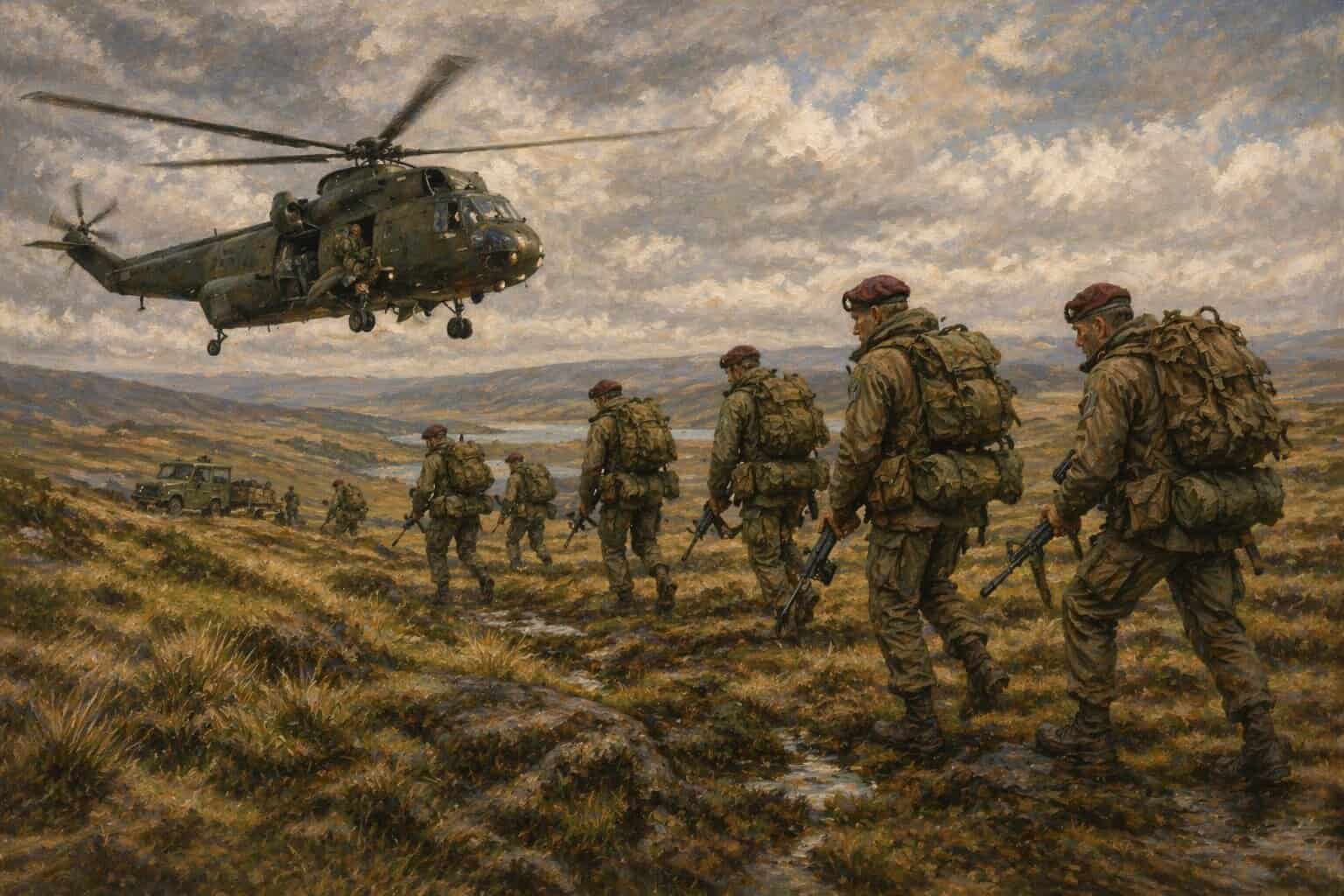
On 2 April 1982, Argentine forces invaded the Falkland Islands, initiating a crisis that rapidly transformed into one of the most demanding British military operations of the post-war era. For the Royal Air Force, the invasion did not immediately produce the familiar image of combat aircraft in action over the South Atlantic.
Instead, it triggered an urgent process of preparation, planning, and long-range support as Britain assembled the naval task force for Operation Corporate, which would sail to recover the islands. The date marked the start of a campaign in which RAF contribution would prove indispensable.
Shock, Distance and Urgency
The seizure of the islands confronted Britain with three immediate realities: the political shock of aggression, the enormous distance involved and the narrow time available for response. The Falklands lay far from the United Kingdom, and any operation to reverse the invasion would require exceptional coordination between the Royal Navy, the Army and the RAF. Nothing about the challenge was routine. Geography alone imposed severe demands on movement, logistics and sustainment.
For the RAF, distance was the central problem. Any British response needed aircraft, crews, stores and equipment to be moved at speed over vast ranges. Even before the shooting war reached its most intense phase, air power was already fundamental because only air transport could compress time sufficiently to support the concentration of force. In that sense, the RAF was engaged from the very beginning, even as public attention focused on the dispatch of the fleet.
Preparing the Task Force
Once the invasion began, Britain began preparing a naval task force, but ships alone could not sustain an operational campaign. They had to be supplied, reinforced and linked to a wider chain of support stretching back to the United Kingdom and beyond.
The RAF’s transport and support elements were therefore central to the national response. Men and matériel had to be flown, staging arrangements improvised, and a global chain of support created. In that sense, the invasion immediately turned the RAF into a key instrument of national response long before its most famous combat actions took place.
Significance
2 April 1982 matters in RAF history because it marks the moment when an enormous long-range joint campaign became unavoidable. The invasion created the operational conditions that would bring RAF transport aircraft, tankers, support elements and later strike assets into one of the most remarkable British military efforts of the post-war period.
The date is therefore best remembered not only as the beginning of the Falklands crisis, but as the starting point of the RAF’s contribution to Operation Corporate. It was the day on which the scale of the challenge became clear, and the service began the work that would make Britain’s response possible across one of the longest lines of operation the RAF had ever supported.