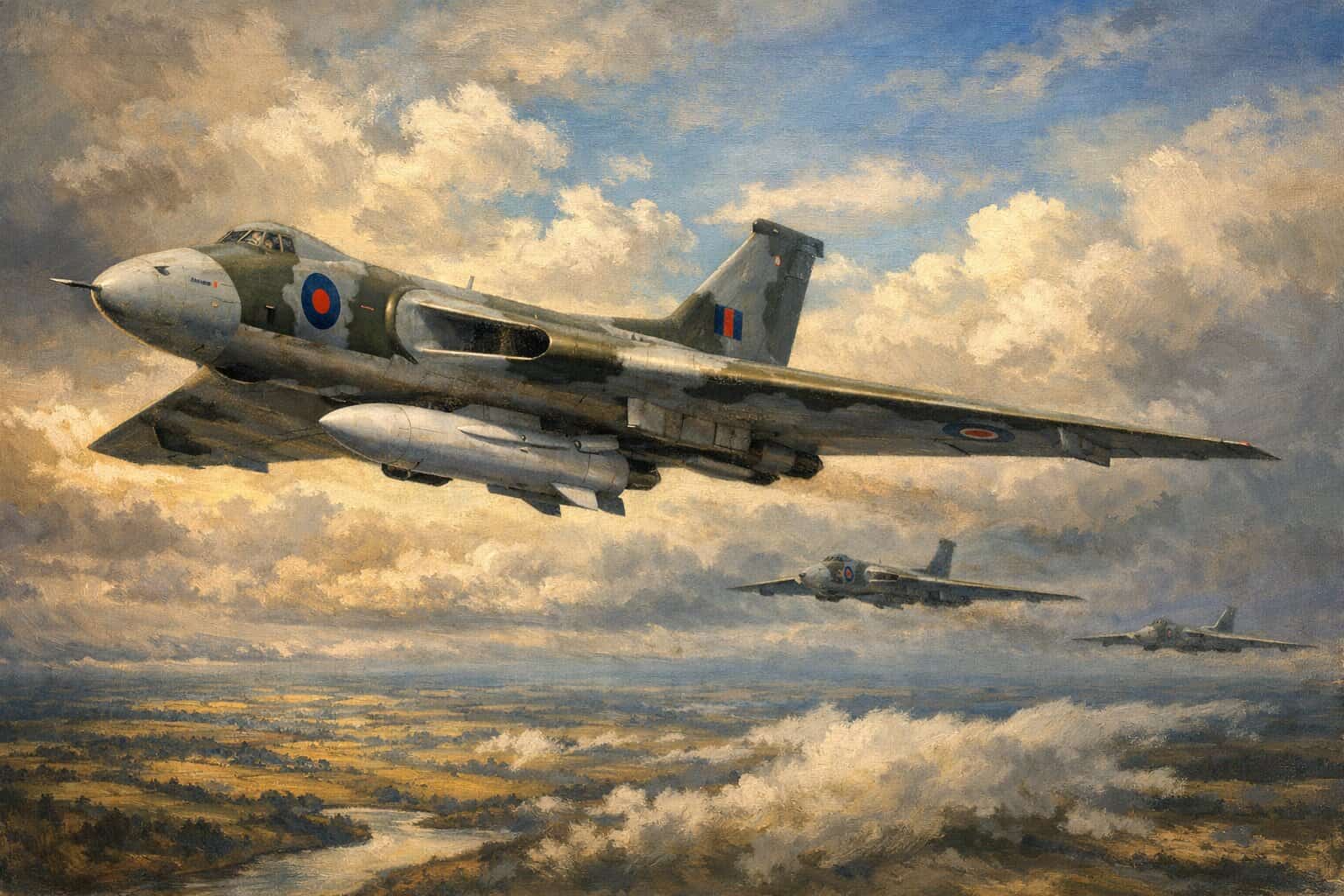
On 1 February 1963, the Royal Air Force reached a significant milestone in the development of Britain’s nuclear deterrent when Avro Vulcan bombers of No. 617 Squadron became the first RAF unit declared operational with the Blue Steel stand-off nuclear missile. The achievement represented a major technological step in Britain’s Cold War strategy, enabling bomber crews to deliver a nuclear weapon from outside the densest layers of Soviet air defence.
By the early 1960s, the RAF’s V-force, comprising the Avro Vulcan, Handley Page Victor, and Vickers Valiant strategic bombers, formed the backbone of the United Kingdom’s nuclear deterrent. However, advances in radar systems, surface-to-air missiles, and interceptor aircraft were steadily increasing the vulnerability of high-flying bombers. The need for a weapon that allowed an aircraft to launch its payload at a safe distance from heavily defended targets became increasingly urgent.
The introduction of the Blue Steel missile was intended to address this problem. Its operational debut with No. 617 Squadron marked the culmination of several years of development, testing, and operational training.
Development of the Blue Steel Weapon
Blue Steel was designed as a supersonic, air-launched stand-off missile capable of carrying a nuclear warhead over a considerable distance after release from its carrier aircraft. The missile’s purpose was to allow the bomber to launch its weapon while still outside the most heavily defended regions surrounding key targets.
The programme emerged during a period when Britain sought to maintain an independent nuclear capability while also integrating with wider NATO deterrence planning. The missile was intended primarily for use by the Vulcan and the Handley Page Victor, the RAF’s two principal strategic bombers after the withdrawal of the Valiant from nuclear duties.
Development proved technically demanding. Blue Steel incorporated advanced guidance systems, a rocket propulsion unit, and complex electronic equipment. Extensive trials were required to ensure reliability and accuracy before the weapon could be entrusted to operational squadrons.
Testing and evaluation took place over several years, involving both ground trials and flight tests with RAF bombers. By the early 1960s, the missile had reached the stage where operational units could begin integrating it into their procedures.
No. 617 Squadron and Operational Readiness
Responsibility for the first operational deployment fell to No. 617 Squadron, a unit with a long and distinguished history within the Royal Air Force. During the Second World War, the squadron had gained fame for specialised precision attacks, and in the post-war era it continued to operate within the RAF’s strategic bomber force.
By the early 1960s, the squadron was equipped with the Avro Vulcan, one of the most advanced bombers in service at the time. The Vulcan’s high altitude performance, speed, and large payload capacity made it a suitable platform for carrying the new missile.
Preparing the squadron for the Blue Steel role required extensive training. Aircrew had to learn new procedures for missile preparation, launch, and navigation, while ground crews were responsible for handling and maintaining a highly complex weapon system. The integration of missile technology into bomber operations represented a significant evolution from the earlier practice of carrying free-fall nuclear bombs.
On 1 February 1963, the RAF formally declared the squadron operational with the Blue Steel missile. From that point forward, Vulcan aircraft assigned to the unit were capable of delivering a nuclear strike using the stand-off weapon.
Strategic Context in the Cold War
The timing of Blue Steel’s operational introduction reflected the changing strategic environment of the early 1960s. The Cold War had entered a period of intense technological competition, with both NATO and the Soviet Union investing heavily in missile systems, air defence networks, and nuclear delivery platforms.
Surface-to-air missile systems were becoming increasingly effective at engaging high-altitude bombers, the very aircraft that had formed the core of Western nuclear deterrence in the previous decade. The ability to launch a weapon from outside the most heavily defended zones became a crucial capability.
Blue Steel extended the effective striking range of RAF bombers and increased their chances of reaching launch points without entering the most dangerous areas of enemy airspace. Although the missile did not remove all risks to the aircraft carrying it, it significantly improved the survivability of the bomber force in the event of a nuclear conflict.
Significance in the Evolution of the RAF Deterrent
The operational introduction of Blue Steel marked an important phase in the evolution of Britain’s strategic deterrent. It demonstrated the RAF’s ability to incorporate increasingly sophisticated weapons into its bomber force and reflected the rapid pace of technological change during the Cold War.
However, the missile also represented a transitional stage. Within a few years, strategic planning would shift toward submarine-launched ballistic missiles as the principal means of delivering the United Kingdom’s nuclear deterrent. Even so, the Blue Steel system remained a key component of RAF strike capability during the mid-1960s.
For historians of military aviation, 1 February 1963 stands as a reminder of the period when the RAF’s V-bombers formed the front line of Britain’s nuclear strategy. The operational debut of Blue Steel illustrated both the ingenuity of British aerospace engineering and the strategic pressures of an era defined by nuclear deterrence and rapid technological innovation.