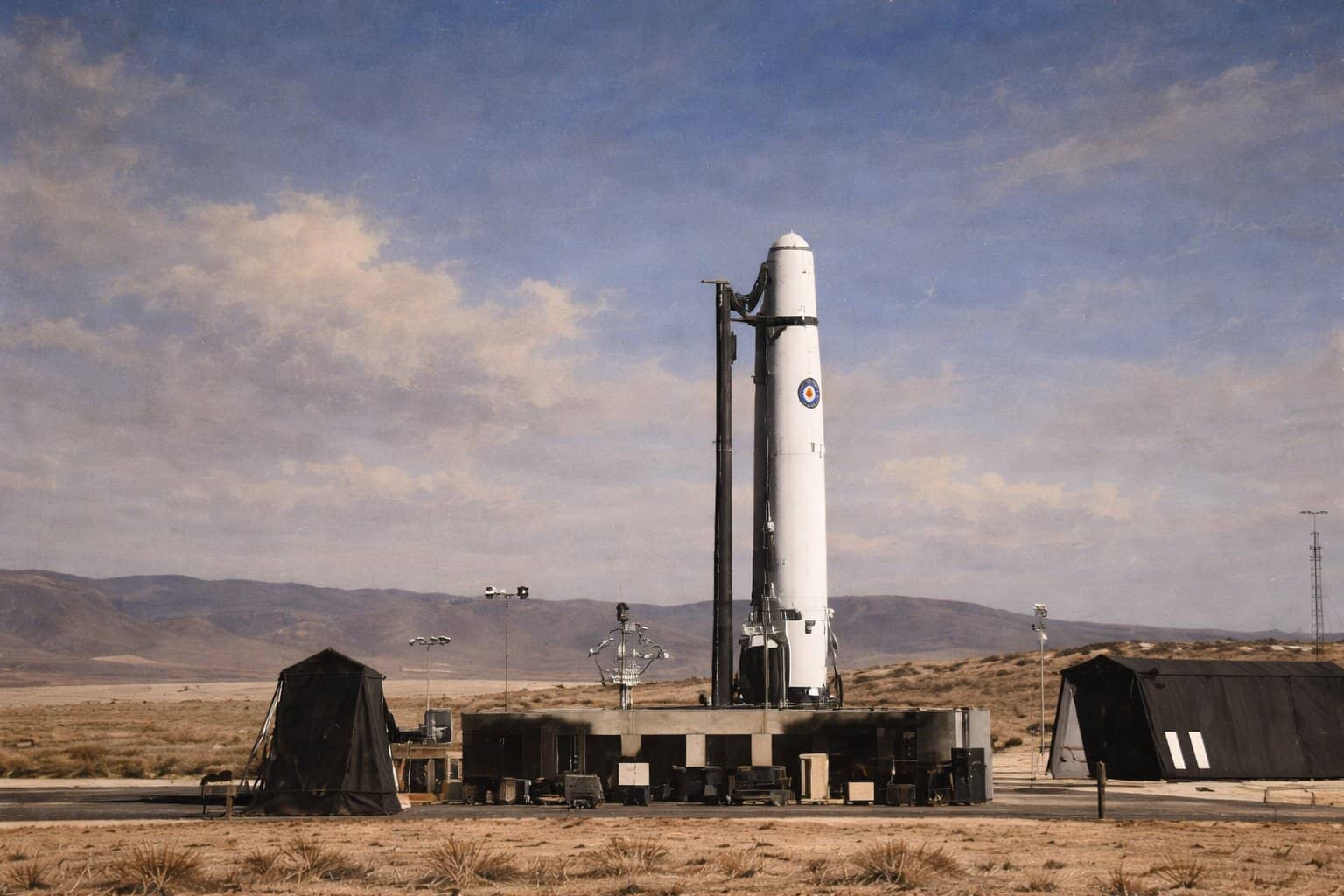
On 16 April 1959, RAF trainees took part in a Thor missile test launch from Vandenberg in the United States, marking a notable moment in Britain’s entry into the nuclear missile age under Project Emily. The event belonged to the Cold War world of deterrence, alliance and technological adaptation. For the RAF, it represented the practical training required to handle a weapons system that was both politically sensitive and operationally demanding. A missile force could not be created by policy alone; it needed crews who could operate it with precision.
The RAF and the missile age
By the late 1950s, the strategic air picture was changing rapidly. The bomber remained central to Britain’s nuclear posture, but guided missiles were becoming an increasingly important part of deterrence thinking. The Thor intermediate-range ballistic missile was one expression of that shift. Although based in Britain under arrangements closely tied to the United States, the system required RAF personnel to master procedures markedly different from those of conventional flying operations. The service was being asked to expand its definition of air power beyond aircraft alone.
Training in the United States mattered greatly. Test launches at Vandenberg were not ceremonial exercises. They were a means of proving that crews could manage preparation, sequencing and execution to the required standard. In the nuclear era, reliability was not merely technical efficiency; it was the foundation of credibility. If deterrence rested upon the enemy believing that a force was real, ready and usable, then every stage of training contributed to that perception.
A symbol of Cold War partnership
The Thor programme also revealed how deeply Anglo-American defence cooperation shaped the RAF during the Cold War. Britain was adapting an American missile system to its own strategic role, and that inevitably involved close operational and technical links. RAF trainees at Vandenberg were working within a transatlantic framework in which technology, doctrine and political calculation were closely connected. The launch of 16 April 1959 can therefore be read not only as a training milestone, but as evidence of the practical reality of alliance.
At the same time, Thor’s place in RAF history was always somewhat transitional. Missile systems promised speed and reach, yet they also raised difficult questions about vulnerability, control and long-term effectiveness. The period in which Thor formed part of Britain’s deterrent was relatively brief. Even so, that should not obscure its significance. For the men trained to operate it, and for the service integrating it into national defence, it marked a serious and demanding chapter in the evolution of strategic power.
Remembering the Vandenberg test launch means recognising an RAF story that unfolded far from traditional flying stations and combat patrols. It was a story of technicians, procedures and geopolitical tension, in which the decisive act was not a sortie but a missile leaving its launcher under the scrutiny of a new nuclear age. On 16 April 1959, the RAF showed it was learning to operate in that world.