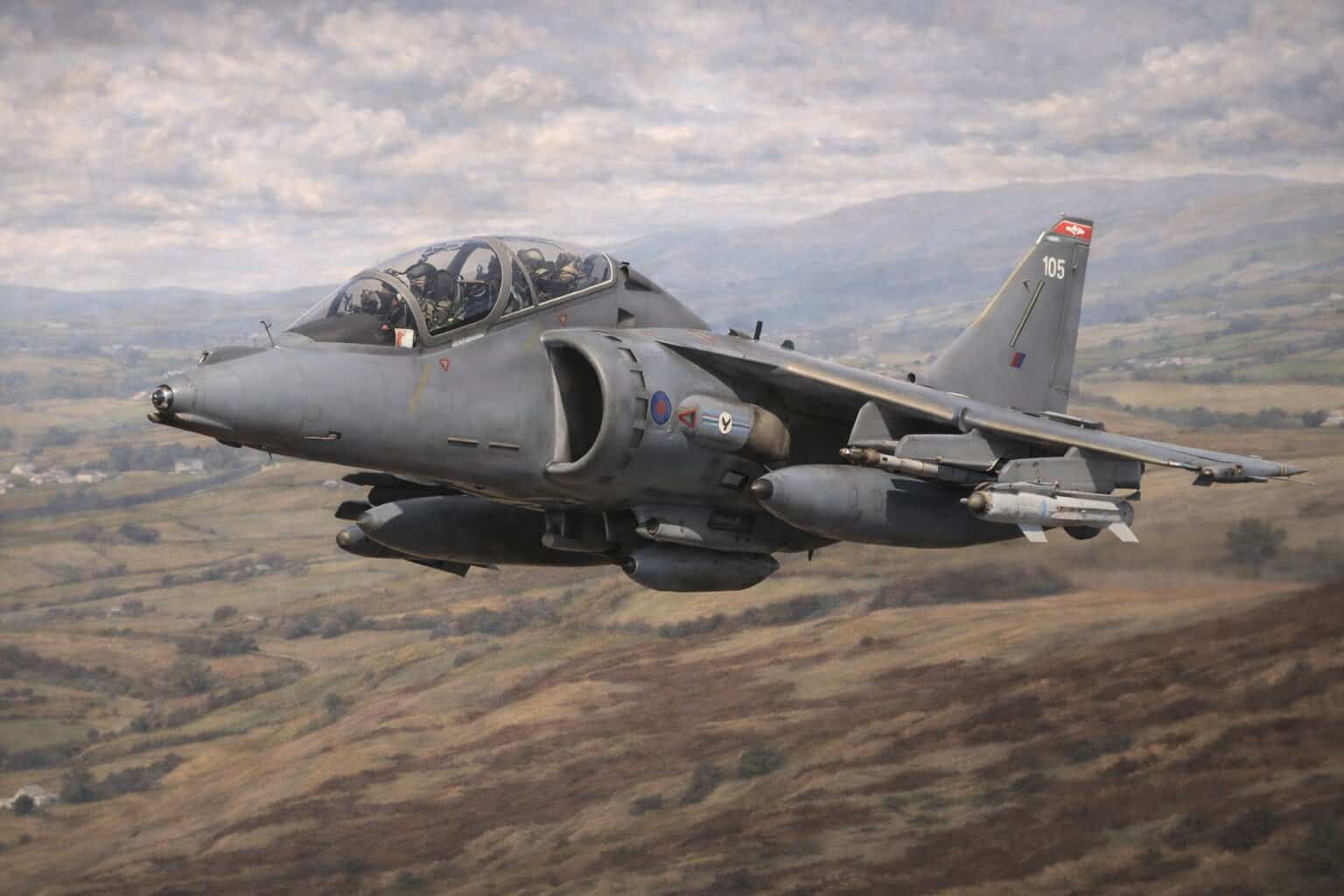
On 30 January 1995, the first McDonnell Douglas/BAe Harrier T10 was delivered to the Royal Air Force, marking an important step in the evolution of Britain’s second-generation Harrier force. The introduction of the T10 provided a modern two-seat training aircraft aligned with the capabilities of the upgraded Harrier GR7, strengthening operational conversion and continuation training within the RAF.
By the mid-1990s, the RAF’s Harrier fleet was undergoing significant modernisation. The Harrier GR7, developed from the Anglo-American AV-8B lineage, introduced improved avionics, enhanced navigation systems, night-attack capability, and compatibility with a broader range of weapons. These advances required a training platform capable of preparing pilots for the more complex systems environment of the updated aircraft.
Background to the Harrier T10
The Harrier T10 was developed as a dedicated two-seat training variant based on the AV-8B airframe. Unlike earlier Harrier trainers, which had been adapted from first-generation designs, the T10 reflected the architecture and cockpit layout of the GR7. This ensured that pilots transitioning to the front-line aircraft encountered minimal differences in instrumentation and systems management.
The aircraft retained the Harrier’s distinctive vertical and short take-off and landing capability, powered by the Rolls-Royce Pegasus engine. While the T10 was not primarily intended for combat, it was fully representative in performance terms, allowing instructors to train pilots in handling characteristics, system operation, and tactical procedures under realistic conditions.
The introduction of the T10 also reflected the continuing cooperation between British Aerospace and McDonnell Douglas, whose partnership had produced the second-generation Harrier family. By 1995, this collaboration had delivered aircraft capable of operating in both RAF and United States Marine Corps service.
Entry into RAF Service
The delivery on 30 January 1995 signified the formal entry of the Harrier T10 into RAF service. The aircraft was assigned to units responsible for Harrier training and operational conversion. Its role included preparing new pilots for front-line assignments and maintaining proficiency among experienced aircrew.
Training on the Harrier demanded mastery of both conventional jet operations and vertical or short take-off techniques. The T10 allowed instructors to supervise closely during complex manoeuvres, including transition between forward flight and hover, deck-landing practice, and operations from austere airstrips.
The aircraft’s avionics suite also supported instruction in navigation, weapons systems management, and night operations. As the RAF increasingly integrated precision-guided munitions and advanced targeting systems into its strike doctrine, the need for comprehensive training platforms became more pronounced.
Operational Context in the Mid-1990s
The mid-1990s were characterised by expeditionary operations and peace-support missions in regions such as the Balkans. The Harrier GR7 was well-suited to these environments, capable of operating from forward locations with limited infrastructure. The introduction of the T10 enhanced the RAF’s ability to generate and sustain trained pilots for such deployments.
Although the T10 itself was not intended for routine operational deployment in combat roles, its contribution to readiness was significant. A modern trainer ensured continuity in skill development and reduced conversion times for pilots entering Harrier squadrons.
Significance in RAF Development
The delivery of the first Harrier T10 on 30 January 1995 represents a notable moment in the RAF’s adaptation to post-Cold War operational demands. It underscored the importance of aligning training capability with front-line aircraft evolution. As avionics, weapons integration, and night-attack roles expanded, so too did the complexity of pilot preparation.
In the wider history of British military aviation, the T10 formed part of the sustained development of the Harrier force, which had been central to RAF doctrine since the 1970s. The aircraft embodied both technological advancement and the enduring emphasis on flexible, expeditionary air power.
The entry into service of the Harrier T10 therefore marked not only the arrival of a new trainer; it also reflected the RAF’s commitment to maintaining operational excellence in a rapidly changing strategic environment.