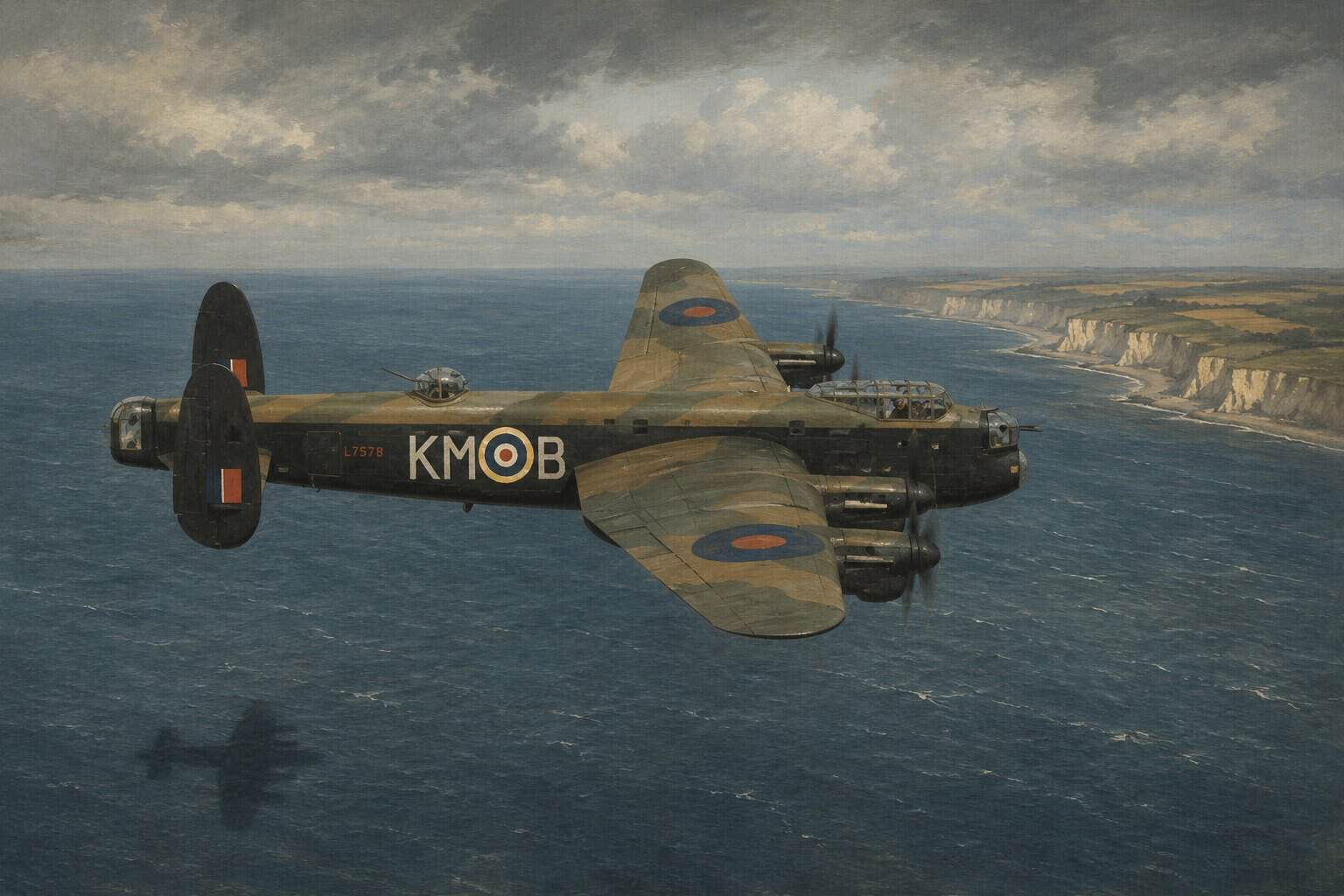
On 11 July 1942, Bomber Command aircraft attacked the shipyards at Danzig in what was then the most distant daylight raid yet attempted by the RAF. The operation was notable not only for its target, an important centre for German naval construction, but also for the scale of the challenge involved. Reaching the Baltic objective and returning safely meant flying an exceptionally long route, through bad weather and deep into hostile airspace.
A demanding daylight operation
By mid-1942, Bomber Command had generally moved towards night bombing for major attacks, in large part because daylight operations against defended targets could be extremely costly. The Danzig raid stood out. It demanded confidence in aircraft performance, navigation and crew endurance, and it placed a premium on the capabilities of the Lancaster, which was beginning to demonstrate its value as Britain’s premier heavy bomber.
Contemporary reporting emphasised the mission's exceptional range, describing a flight of roughly 1,700 miles through violent thunderstorms and thick cloud. Such conditions complicated every stage of the operation. Crews had to navigate over long distances, maintain formation as best they could, identify the target area and then deliver their bombs against a major shipbuilding centre that the enemy had good reason to consider comparatively secure from daylight attack.
Attack on the shipyards
The raid struck the submarine-building and shipyard facilities at Danzig, a target of clear strategic importance. Bomber Command’s intention was not merely symbolic. These yards mattered to Germany’s wider naval war, and attacking them demonstrated that RAF bombers could reach deep into the Baltic approaches. Reports from the operation indicated heavy bombing in the target area, with some crews observing fires after the attack.
Not every aircraft found conditions straightforward, and the nature of such a mission guaranteed difficulty. Long-range daylight operations exposed crews to enemy fighters, anti-aircraft fire, weather dislocation and the ever-present risk that a navigational error could jeopardise the whole flight. Even when bombs were delivered successfully, the route home remained part of the battle.
Why the raid mattered
The significance of 11 July 1942 lay in what it revealed about RAF reach and ambition. Danzig was not a routine target. By attacking it in daylight, Bomber Command signalled that no important German maritime centre could assume safety simply because of distance. The raid also underlined the growing importance of the Lancaster, whose range, load-carrying ability and performance made such demanding operations possible.
At the same time, the mission showed why daylight attacks of this kind remained exceptional. The combination of range, exposure and uncertainty made them hazardous undertakings. Bomber Command would continue to place its main effort at night, where it could better preserve force concentration and reduce vulnerability, even if accuracy remained a constant challenge.
A wider reflection
The Danzig raid belongs to a broader story of RAF adaptation during the Second World War. It reflected an air force still experimenting with reach, timing and method while trying to hit strategically valuable targets across an ever-wider war zone. Some operations became models for future effort; others demonstrated the limits of what could prudently be repeated.
On 11 July 1942, the RAF proved that a distant Baltic target could be struck in daylight by heavy bombers. That alone gave the raid lasting significance. It was a bold, technically demanding operation that combined endurance, navigation and offensive intent in equal measure, and it stands as a telling example of Bomber Command’s willingness to test the outer edge of operational possibility.