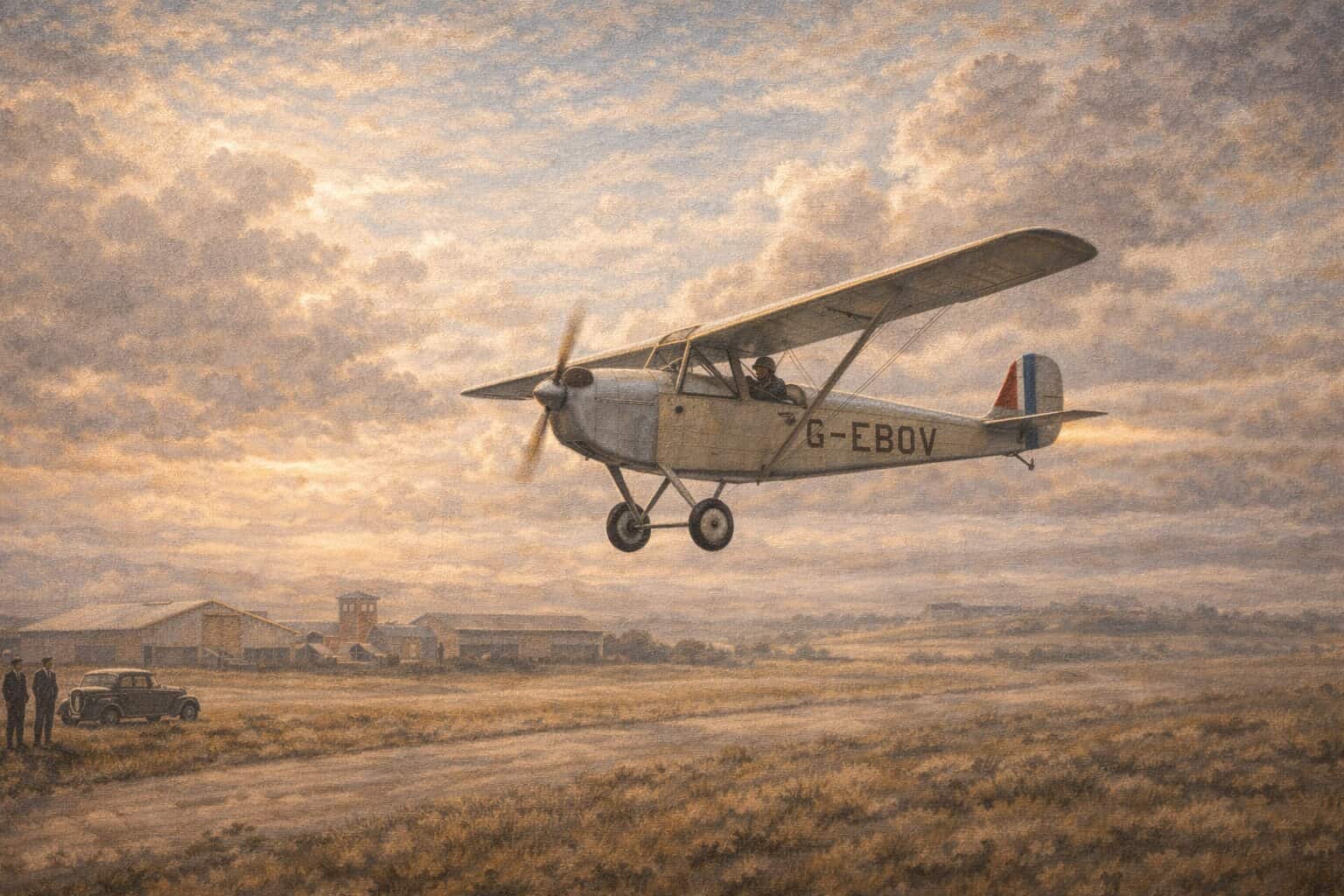
On 7 February 1928, the Australian aviator Bert Hinkler departed from England to begin a remarkable solo flight to Australia, embarking on one of the most ambitious long-distance journeys attempted during the early years of aviation. Flying a small light aircraft across thousands of miles of unfamiliar territory, Hinkler aimed to demonstrate both the growing reliability of modern aircraft and the potential for rapid intercontinental travel by air.
At a time when aviation was still developing rapidly in the years following the First World War, such long-distance flights captured the public imagination. Hinkler’s attempt was particularly notable because he intended to complete the journey alone, navigating across Europe, the Middle East, India, and Southeast Asia before reaching Darwin in northern Australia.
Aviation in the Late 1920s
The late 1920s were a period of intense experimentation and record-setting in aviation. Aircraft technology had advanced significantly during the First World War, and in the decade that followed, aviators around the world sought to prove the capabilities of these machines through long-distance flights and endurance records.
Such flights were not merely publicity stunts. They provided valuable demonstrations of navigation techniques, aircraft reliability, and the feasibility of establishing long-range air routes between distant parts of the world. For nations such as Britain and Australia, separated by vast distances, these developments carried clear strategic and commercial importance.
Bert Hinkler was already well known within aviation circles before his 1928 flight. During the First World War he had served with the Royal Naval Air Service and later the Royal Air Force, gaining valuable flying experience. After the war he became involved in a series of pioneering long-distance flights and aviation experiments that enhanced his reputation as a skilled and determined aviator.
Preparing for the Solo Journey
Hinkler’s attempt to fly from England to Australia required careful preparation. Unlike modern long-distance flights, aviation in the 1920s depended on relatively small aircraft with limited range and minimal navigation equipment. Pilots undertaking such journeys relied heavily on visual navigation, basic maps, and their own judgment.
The route from Britain to Australia presented numerous challenges. Pilots had to cross vast stretches of unfamiliar terrain, including deserts, mountains, and tropical regions where weather conditions could be unpredictable. Airfields along the route were often rudimentary, and in many places, aviation infrastructure was still in its infancy.
Despite these obstacles, Hinkler was confident that a well-planned solo flight could succeed. His aircraft was selected for reliability and efficiency, allowing him to cover long distances between refuelling stops. The journey would involve a series of stages across multiple continents before reaching the northern coast of Australia.
The Flight Begins
On 7 February 1928, Hinkler departed England and began the first leg of the journey. Over the following days, he flew steadily across Europe and into the Middle East, navigating a route that had only recently begun to see occasional long-distance aviation attempts.
Progress depended not only on the aircraft’s performance but also on weather conditions and the availability of suitable landing grounds. Each stage required careful planning, with Hinkler landing to refuel and rest before continuing the journey.
Although long-distance flights were becoming more common during the 1920s, a solo journey of this scale remained highly unusual. The ability of a single pilot to manage navigation, aircraft operation, and logistical planning over such a vast distance demonstrated both personal skill and the growing maturity of aviation technology.
Arrival in Australia
After completing the long series of stages across Europe, the Middle East, and Asia, Hinkler eventually reached Darwin, successfully completing the flight from England to Australia. The achievement was widely celebrated both in Britain and Australia, where the journey was seen as a powerful demonstration of the possibilities of long-distance aviation.
The flight significantly reduced the time required to travel between the two countries compared with traditional sea routes. It also illustrated the growing feasibility of establishing regular air connections across the British Empire, an idea that would gain increasing importance during the following decades.
Hinkler’s achievement earned him international recognition and reinforced his reputation as one of the leading aviators of the era.
Significance in Aviation History
The events of 7 February 1928 marked the beginning of a journey that became one of the most celebrated long-distance flights of the interwar period. Hinkler’s successful solo flight demonstrated the increasing reliability of aircraft and the potential for aviation to transform global travel.
Such pioneering flights played a crucial role in shaping the future of air transport. By proving that long-range routes could be navigated successfully, aviators like Hinkler helped lay the groundwork for the development of international air services in the decades that followed.
For the Royal Air Force and the wider aviation community, these achievements also reflected the lasting influence of wartime aviation experience. Many of the pilots who carried out record-breaking flights during the 1920s had gained their skills during the First World War, applying that knowledge to push the boundaries of peacetime aviation.
In the broader story of early aviation, Bert Hinkler’s departure from England on 7 February 1928 stands as a reminder of an era when individual pilots played a central role in exploring the possibilities of flight and demonstrating how aircraft could connect distant parts of the world.