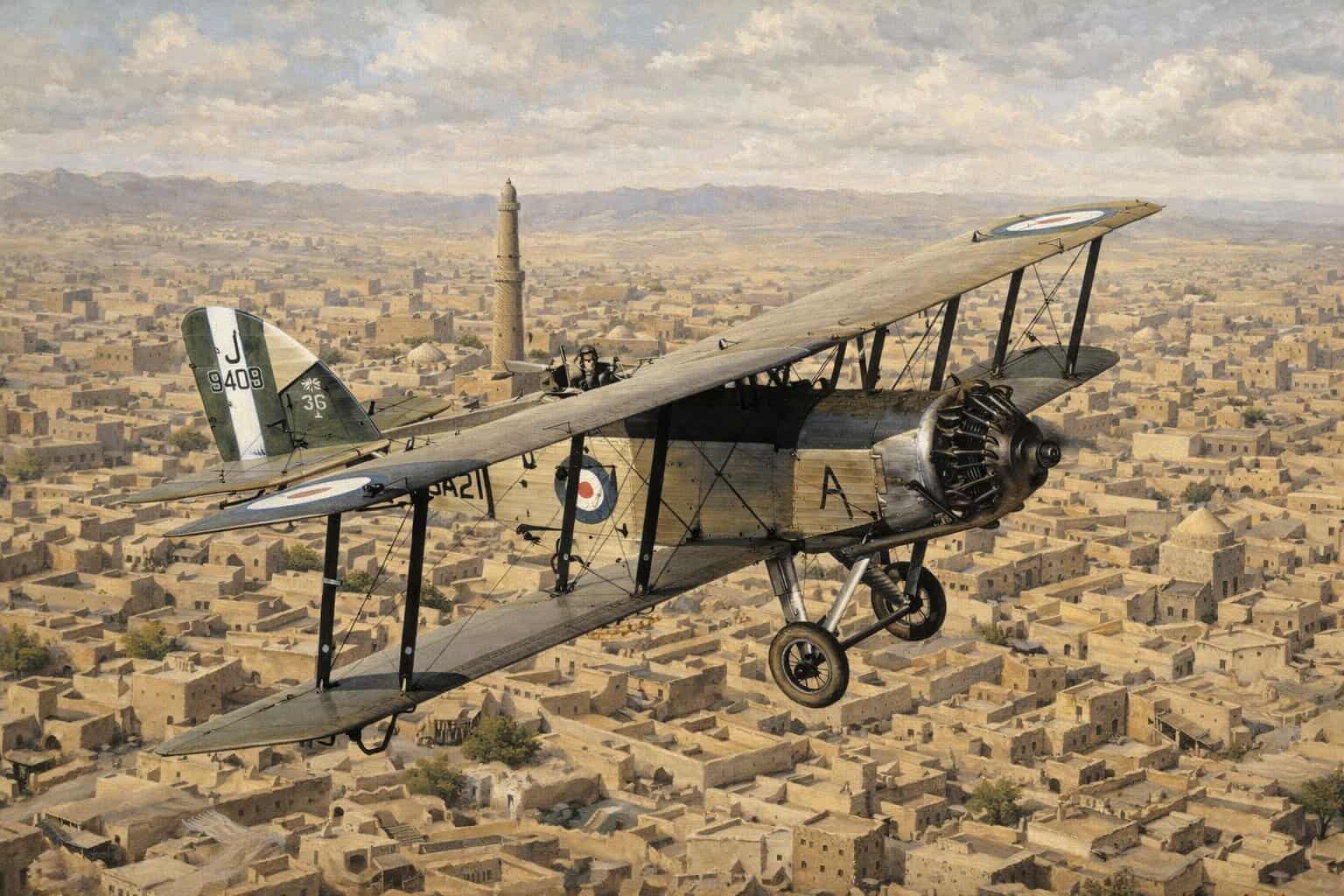
RAF operations near Muan in northern Iraq on 5 and 6 January 1931 saw aircraft of No. 30 Squadron locate and attack a force of rebel Kurdish horsemen. The action on 6 January was the second day of an engagement that had begun the day before, part of a renewed campaign against the Kurdish leader Sheikh Mahmud, in which the Royal Air Force supported the Iraqi government under the policy known as air control.
Mahmud’s forces had been active in the region since September 1930, and by early January the RAF and Iraqi authorities held intelligence that he intended to strike government posts in the area. The fighting near Muan sat within that immediate chronology, and it was followed within days by further rebel action elsewhere in the north.
Sheikh Mahmud and the 1930–31 Campaign
Sheikh Mahmud, properly Mahmud Barzanji, had challenged British and Iraqi authority in Kurdistan repeatedly since the end of the First World War, with earlier revolts in 1919 and 1923. In September 1930 he raised a fresh rebellion, and No. 30 Squadron RAF was committed to supporting Iraqi Army operations against his fighters. In 1931, intelligence on 3 January indicated that Mahmud planned to attack police posts across the Halebja Plain. On 9 January his forces captured the police post at Khurmal, a sign that the rebellion remained active in the days immediately after the Muan action.
No. 30 Squadron had operated the Westland Wapiti in Iraq since 1929, and flew more than 2,200 hours against Mahmud’s forces between October 1930 and May 1931. The scale of that commitment shows how central the squadron was to the government’s response through the winter and spring.
No. 30 Squadron near Muan, 5–6 January
On 6 January, aircraft of No. 30 Squadron continued operations against rebel Kurdish horsemen near Muan, during a two-day action that had begun the previous day. The action formed part of RAF operations against forces associated with Mahmud’s rebellion in northern Iraq, where aircraft supported Iraqi Army operations with reconnaissance and armed intervention. The fighting near Muan continued across the two-day period, with No. 30 Squadron engaged against the rebel horsemen.
The Muan action formed part of a short period of renewed fighting in northern Iraq. Three days later, on 9 January, Mahmud’s forces captured the police post at Khurmal as the rebellion continued to develop. The operations of 5–6 January therefore formed part of a wider sequence of fighting rather than an isolated RAF action.
Air Control in Iraq
The Muan action sat within Britain’s wider use of RAF air control in Iraq during the interwar period. Aircraft were used alongside Iraqi and British ground forces to provide reconnaissance, mobility and, when ordered, armed action across areas that were difficult to police by land alone. Air control relied on aircraft for reconnaissance, for rapid movement of intelligence, and for punitive action against groups that resisted government authority, on the reasoning that this cost less than maintaining large land forces across difficult terrain. The RAF had already carried out extensive operations of this kind in Iraq through the 1920s, including evacuation and support duties in earlier crises, and by 1931 the method was well established.
The approach was debated at the time. Supporters argued that it allowed Britain to police a large and mountainous territory at a fraction of the expense of conventional campaigns. Critics questioned the human cost of bombing operations directed at tribal areas, a debate that shaped RAF and government thinking well beyond Iraq. The wider development of the service across this period, including its role in Iraq, is traced further in Formation and Interwar.
What Followed
The campaign against Mahmud continued for several months after the Muan action. No. 30 Squadron’s Wapitis remained heavily committed, flying operations against his forces through the winter and into spring. Mahmud eventually surrendered in May 1931, following sustained air action against his tribesmen, bringing his final rebellion to a close.
The events of 5 and 6 January near Muan were a small part of that longer campaign, but they illustrate how closely RAF air operations in interwar Iraq were tied to the movements of the forces on the ground. No. 30 Squadron’s operations during the campaign illustrate the direct role assigned to RAF aircraft under the air-control system: locating and attacking rebel forces while supporting the wider effort against Mahmud’s rebellion.