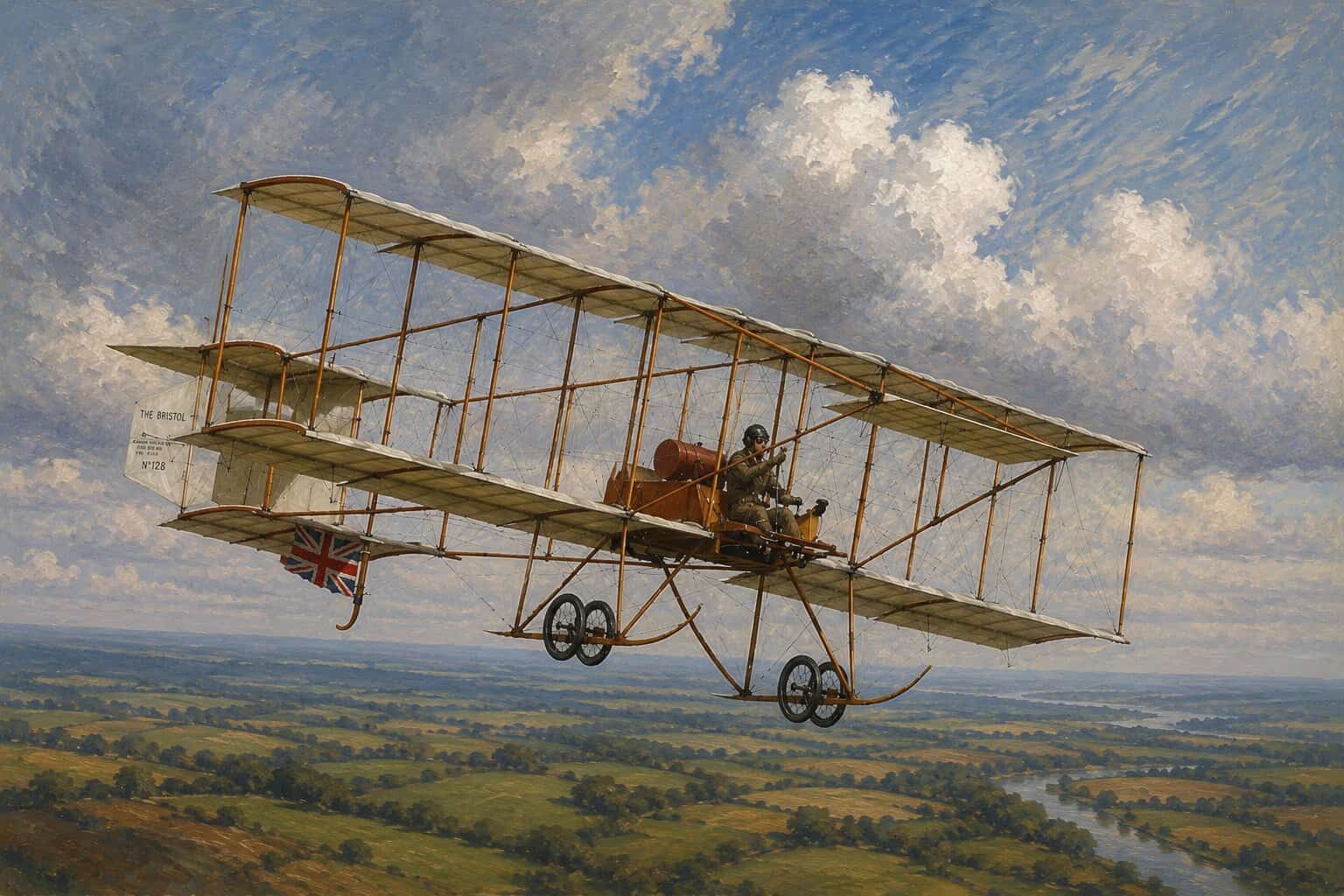
On this day, 18th June 1913, the British government formed the Air Committee to bring greater coordination to the country's growing air interests. The decision belonged to the pioneering era of military aviation, when aircraft were still new, institutions were unsettled, and the relationship between naval and military flying had not yet been clearly defined. Even so, the step mattered. It showed that air power was already becoming too important to be left to improvised arrangements.
Early aviation outgrows existing structures
In the years before the First World War, British aviation developed quickly but unevenly. Aircraft technology was advancing, experiments were multiplying, and both the Admiralty and the War Office recognised that flying might become useful for reconnaissance, communication and eventually combat. Yet usefulness alone did not create effective administration. Different departments pursued their own priorities, and there was as yet no settled system capable of directing air policy across the whole defence structure.
The Air Committee was an attempt to answer that problem. Its purpose was not to create an independent air force overnight, nor to settle every argument about control. Rather, it represented an early acknowledgement that aviation cut across traditional service boundaries. Aircraft could not be treated simply as an appendage of the Army or the Navy without inviting duplication, rivalry and wasted effort.
Coordination before independence
That is what gives the committee historical importance. British air power did not begin with the Royal Air Force in 1918. Before there could be an air ministry or an independent service, there first had to be a growing recognition inside government that aviation required more coherent oversight. The Air Committee was part of that prehistory. It stood at a point where enthusiasm for flying was being translated into administration, policy and practical questions about procurement, roles and command.
Its creation tells us something essential about how military institutions adapt. New technologies rarely arrive with perfectly fitted structures already waiting for them. Instead, governments improvise, review and reorganise. Committees are seldom glamorous, but they often reveal the moment when an innovation has become too consequential to ignore. In that sense, the Air Committee was evidence that British aviation had moved beyond novelty.
What the committee could and could not do
The committee did not solve every problem. Early British aviation remained marked by institutional friction, uncertain priorities and the normal difficulties of managing a fast-changing technology. But that should not obscure the significance of the step itself. Coordination, however imperfect, was preferable to fragmentation. Bringing together naval and military air questions in a single forum was an acknowledgement that they were strategically linked.
For the future RAF, that mattered. The eventual emergence of a unified British air administration depended on earlier efforts to think across service boundaries. The Air Committee helped prepare the intellectual and bureaucratic ground on which later reforms would stand, even if its own lifespan and powers were limited.
Why the moment deserves notice
This episode is a reminder that the history of air power is not made only in combat. It is also made in offices, committees and policy debates where governments decide how new capabilities should be organised and controlled. Without such groundwork, operational success becomes harder to sustain.
The formation of the Air Committee belongs in the larger story of how Britain learned to take aviation seriously. It marked an early stage in the long movement from scattered experimentation to national air policy. Long before the RAF became an independent service, the need for coordinated thinking about air power was already being felt, and the Air Committee was one of the first formal signs of that change.