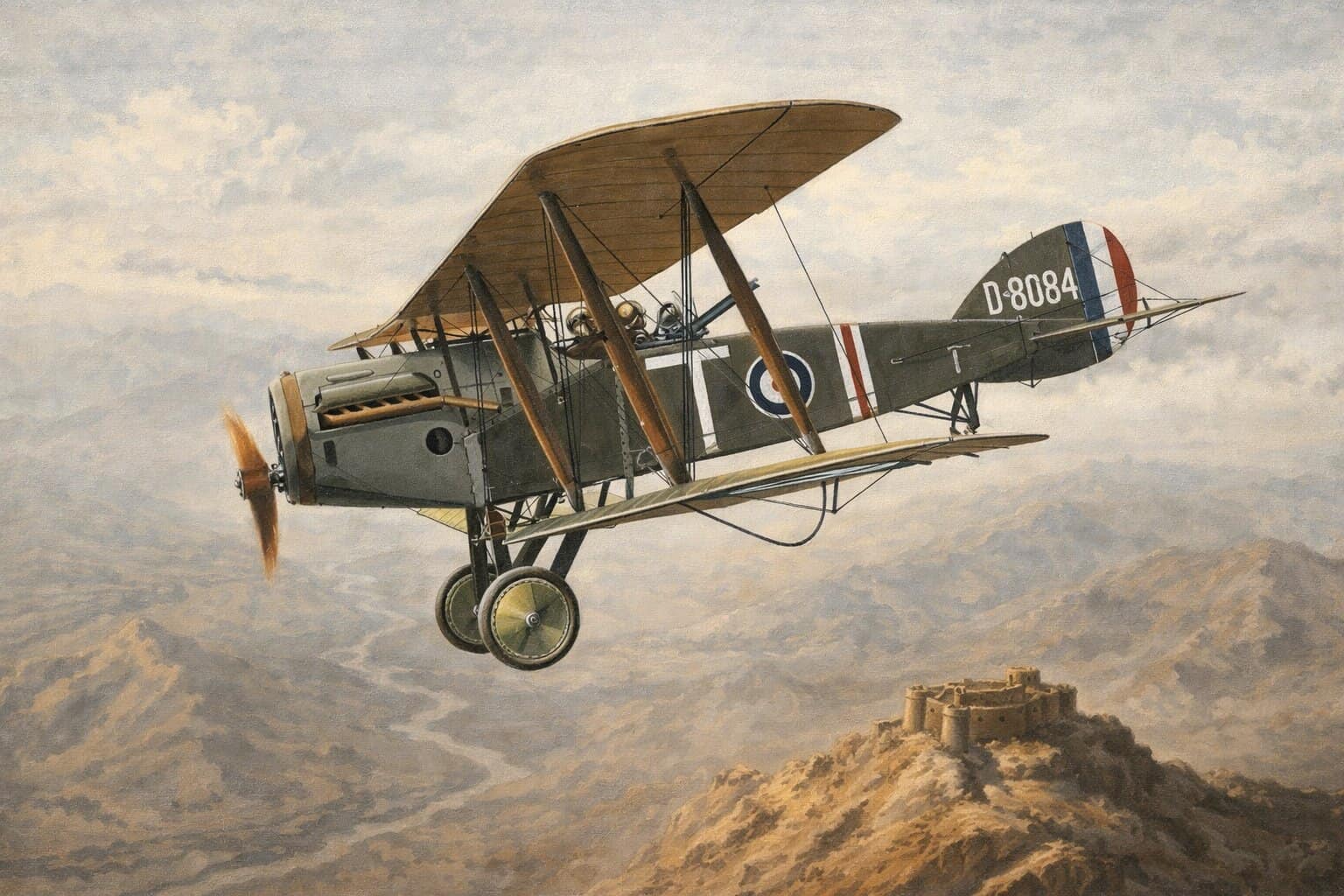
Pink’s War was the RAF campaign conducted in South Waziristan in 1925 against Mahsud tribesmen on the North-West Frontier of British India. Directed by Wing Commander Richard Pink, it became one of the clearest inter-war examples of air control in practice: an attempt to use aircraft, rather than a large ground expedition, to impose pressure, disrupt resistance and compel a settlement.
The operation is usually described as the RAF’s first campaign carried out independently of the British Army and the Royal Navy. For that reason alone, it holds an important place in RAF institutional history. Yet its importance lay not only in novelty. Pink’s War also exposed the strengths and limits of coercive air power in a frontier environment where political control, local resistance and imperial economy were closely linked.
Background
The North-West Frontier had long posed difficulties for the authorities in British India. Mountainous terrain, limited communications and the persistence of tribal resistance made the region expensive and difficult to control. During the interwar years, advocates of air control argued that aircraft could reduce the need for major ground operations by quickly punishing resistance, reaching remote areas, and applying pressure at lower cost.
In South Waziristan, operations against Mahsud tribesmen had continued through 1924. By the end of that year, some resistance had been subdued, but elements of the Mahsud community, including the Abdur Rahman Khel, were still active. The RAF became the principal instrument chosen to enforce compliance. The campaign that followed was shaped by frontier politics as much as by purely military calculation.
The Campaign
Pink’s War opened in March 1925 under the command of Richard Pink, whose force drew on No. 2 (India) Wing. Aircraft used in the operation included Bristol F.2B fighters of 5 Squadron and de Havilland DH.9A aircraft from 27 Squadron and 60 Squadron. Before bombing began, warning leaflets were dropped over the target area, reflecting the established imperial practice of presenting air action as coercion intended to force submission rather than as unrestricted destruction.
Operations then turned to sustained attacks on tribal strongholds, settlements and lines of movement in the Mahsud area. Sorties were flown by day and at night in order to maintain pressure and disrupt normal life as well as armed resistance. The aim was not to seize and hold ground but to make continued opposition increasingly costly while avoiding a larger conventional campaign in difficult country.
This method of war depended on persistence. Aircraft could strike quickly and repeatedly, but they could not by themselves occupy territory or impose a political solution. The campaign was therefore designed to compel rather than to conquer. In that respect, it represented the logic of inter-war air control in one of its purest forms.
Results and Losses
After just over fifty days of operations, Mahsud leaders sought peace, and the campaign came to an end on 1 May 1925. In immediate operational terms, the RAF had achieved its objective. British losses were light, with two British fatalities reported and one aircraft lost during the campaign. Precise Mahsud casualties remain uncertain, a reminder of the uneven and often imperfect record left by frontier warfare.
The short-term result appeared to vindicate the use of air action as an economical instrument of imperial control. Pink’s War was limited in duration, required relatively modest forces and avoided the scale of ground commitment that would otherwise have been needed in Waziristan. Even so, the campaign did not resolve the deeper political realities of the frontier. It demonstrated coercive reach rather than durable settlement.
Significance
For the RAF, Pink’s War carried significance beyond its local setting. It offered a practical demonstration of what senior airmen believed an independent air force could do when given responsibility for an operation. In an era when the Service still had to justify its institutional autonomy, that mattered. The campaign entered RAF history not simply as a frontier action, but as evidence used in wider debates about the value of air power and the case for an independent service.
It also remains unusual in RAF memory because it was named after an RAF officer. That distinction reflected the degree to which the operation was associated with Richard Pink’s command, but it also underlined the Service’s desire to mark the campaign as a specifically RAF achievement.
Wider Context
Pink’s War belonged to a wider pattern of imperial air policing in the inter-war years. Similar arguments about cost, mobility and rapid coercion shaped RAF employment elsewhere, notably in Iraq. In each case, aircraft promised governments a means of extending influence across difficult terrain without the expense of large permanent ground forces.
Yet the campaign also illustrates why air control must be treated with caution in historical judgment. Aircraft could punish, intimidate and disrupt, but they could not remove the political causes of unrest. On the North-West Frontier, as in other imperial settings, tactical success did not amount to permanent stability. Pink’s War stands as both a notable RAF operational milestone and a revealing example of the limits built into inter-war coercive air strategy.