
In the popular British memory of 1940, the RAF is most often seen through the summer skies over southern England. The months immediately before that struggle are less comfortable and, for that reason, often less clearly remembered. In France and the Low Countries, the Service faced a campaign for which neither its aircraft nor its doctrine were fully suited. It was drawn into an accelerating continental defeat, asked to support an army in retreat, to strike a fast-moving armoured enemy at short notice, and to do so while preserving the strength needed to defend Britain itself.
The result was not a simple story of failure. RAF squadrons fought with courage and persistence, and the campaign exposed just how demanding modern air warfare had become. Yet the Fall of France did lay bare dangerous weaknesses: vulnerable light bombers, confused command relationships, inadequate communications, and the severe cost of trying to satisfy every allied demand at once. The campaign mattered because it forced the RAF to abandon comforting assumptions and to concentrate on what would be decisive in the next battle.
The RAF Commitment In France
When Britain committed itself to the defence of France, RAF plans reflected the strategic and political assumptions of the late 1930s. The British Expeditionary Force would return to the Continent, and RAF units would support it as part of a wider Allied front expected to settle into a hard but manageable war. The memory of 1918 still lingered, but so did the hope that air power might offer reach and disruption beyond the trench warfare of the previous generation.
The RAF presence in France took shape in two broad elements. The Air Component existed primarily to support the British Expeditionary Force. It included fighter squadrons equipped mainly with Hawker Hurricanes, as well as army co-operation aircraft such as the Westland Lysander. Alongside it stood the Advanced Air Striking Force, intended to conduct bombing operations from bases in France. In theory, this gave Britain a means of striking at German communications and military targets on the western front while still supporting land operations. In practice, it created a force structure divided between direct battlefield support and an offensive role that looked more coherent on paper than it would prove in action.
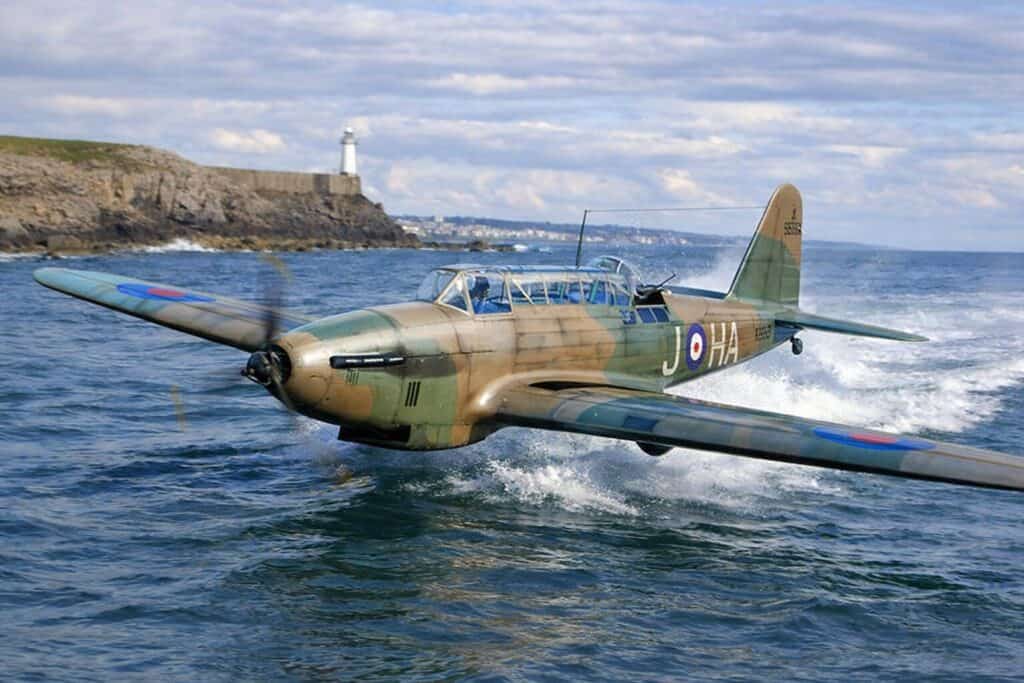
This deployment carried deeper problems. British rearmament was incomplete, and several RAF aircraft in front-line service were already vulnerable to modern fighter opposition and concentrated anti-aircraft fire. The Fairey Battle, although modern in appearance when conceived, was slow, lightly defended and ill-suited to daylight attack against well-protected targets. The Bristol Blenheim was more versatile, but it too was operating in a rapidly hardening combat environment. Even before the German offensive began, there were reasons to doubt whether these aircraft could perform the tasks expected of them at an acceptable cost.
There was a further uncertainty in the very idea of offensive action from France. British political leaders wanted Germany to feel pressure, but fears of uncontrolled escalation and civilian casualties had already constrained the use of the bomber force. That left the AASF in an awkward position. It existed to strike, yet the strategic purpose of those strikes was never as settled as wartime memory sometimes suggests. Once the campaign became mobile and urgent, the force was pulled away from the more deliberate offensive logic of the so-called phoney war and thrust into immediate battlefield tasks for which its training, equipment and assumptions had only partly prepared it. A bomber force created in one strategic mood was suddenly fighting in another.
The command picture also contained tensions. The needs of the British Expeditionary Force, the expectations of the French high command, and the wider strategic priorities of the Air Ministry did not always align. Dowding, looking ahead to the likely struggle over Britain itself, remained deeply conscious that fighter squadrons lost in France could not easily be replaced. Others, confronted by immediate allied need on the Continent, pressed for greater commitment. Once the German offensive opened in May 1940, those competing priorities would become impossible to reconcile cleanly.
Sedan And The Destruction Of The AASF
The German attack in the west quickly overturned the assumptions behind the Allied position. Speed, concentration and close coordination between air and land forces gave the Luftwaffe and the Wehrmacht a tempo that the Allies struggled to match. Nowhere did the RAF’s predicament become clearer than in the desperate attempts to strike the German crossings around Sedan and the Meuse.
The Advanced Air Striking Force was tasked with attacking targets of immediate operational importance under exceptionally unfavourable conditions. The need was plain enough. German armour pushing through the Ardennes threatened to rupture the front and unhinge the entire Allied defence. Bridges, columns, and crossing points had to be hit quickly if the advance was to be slowed. Yet urgency did not alter the balance of risk. RAF light bombers were sent by day against heavily defended targets in airspace where German fighters were active and anti-aircraft fire was intense. The cost was appalling.
The Fairey Battle became the most tragic symbol of that moment. Crews pressed home low-level and medium-level attacks in circumstances that gave them little real chance of survival. Losses were so severe that the aircraft’s reputation never recovered. The issue was not courage, which was abundant, but the mismatch between mission and machine. The RAF had entered a campaign in which obsolete or near-obsolescent assumptions were punished with brutal speed. Bombing a defended crossing in daylight demanded speed, protection, escort and tactical methods that these units could not reliably bring together.
The destruction suffered by the AASF was more than a matter of aircraft wastage. It weakened Britain’s ability to influence events in France at the very moment when the Allied line was beginning to break. It also demonstrated that air operations could not be improvised successfully merely by issuing urgent orders from above. Good intelligence, clear target selection, escort arrangements, communications, and an understanding of enemy air strength all mattered. Without them, brave effort translated into grave loss without commensurate operational effect.
It is important, too, not to read the outcome as proof that bombing never mattered in fast-moving land warfare. The real lesson was harder and more specific. Battlefield bombing could matter greatly, but only when aircraft, intelligence and command arrangements were fitted to the task. The Luftwaffe showed what concentrated tactical air support could achieve when integrated into a broader operational design. The RAF in France, by contrast, often tried to use light bomber units as emergency instruments for crisis management. That distinction was central. The problem was not air power in support of land operations as such; it was a British force structure and method that had not yet caught up with the tempo and concentration of the war it had entered.
The Sedan battle became one of the defining RAF experiences of the campaign. It exposed not only the vulnerability of certain aircraft types, but also the danger of asking small, finite air forces to solve problems created by larger failures in alliance planning and operational doctrine. By the middle of May, the RAF was no longer trying to shape a manageable campaign. It was trying to contain the disaster.
Fighters Over A Collapsing Front
If the bomber effort over the Meuse revealed the weakness of the AASF, the fighter battle over France showed both the quality of RAF personnel and the limits of what they could achieve amid a fast-moving continental collapse. Hurricane squadrons of the Air Component and reinforcements sent from Britain entered a struggle that was tactically demanding and strategically unrewarding. They flew patrols, escorts and interceptions over a front that shifted faster than air command systems could always follow.
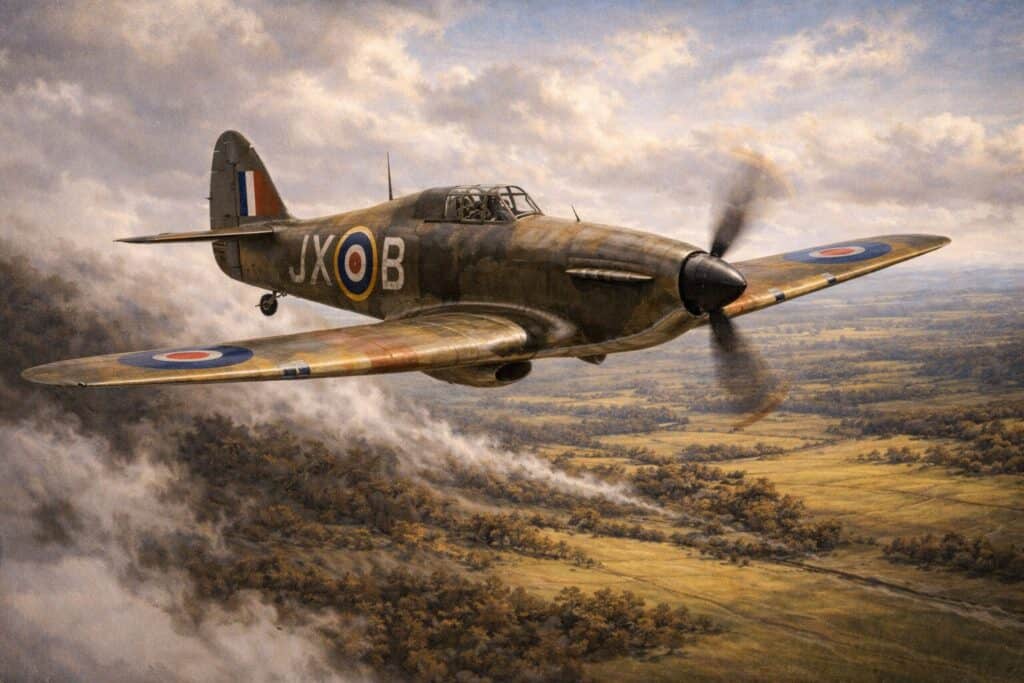
RAF fighter pilots proved that the Hurricane was a formidable combat aircraft in the hands of determined squadrons. Against German bombers, it could be highly effective, and against fighters it remained competitive when handled intelligently. But local success in the air did not settle the deeper problem. The Luftwaffe was operating in support of a coherent ground offensive, while RAF fighters were being pulled between immediate battlefield needs, bomber escort, and the longer-term necessity of preserving strength for home defence. There was no single decisive concentration of purpose.
The Air Component also depended upon an army co-operation system that struggled under intense pressure. Lysander crews undertook hazardous reconnaissance and liaison work. Yet, the very nature of that role exposed them to heavy danger once German air superiority grew and the ground battle became fluid. Communications between air and land formations remained slower and less responsive than modern combined operations required. Requests for support, changes on the front line, and the identification of worthwhile targets often failed to keep pace with events. In those circumstances, aircraft could arrive too late, too thinly escorted, or against objectives already overtaken by the battle.
Reinforcement decisions deepened the strain. Fighter squadrons were sent from Britain in response to the worsening battle, but each reinforcement was a temporary relief purchased at long-term cost. Pilots entered combat from unfamiliar bases, maintenance staffs worked in unstable conditions, and the operational picture altered before fresh units could fully settle. There was no easy point at which Britain could say enough had been done for France, yet neither was there a point at which further sacrifice promised a realistic restoration of the allied position. RAF fighter operations unfolded within an insoluble dilemma: they remained necessary, but they no longer offered a path back to control.
There was another strategic difficulty. Every request from France for more fighter squadrons carried consequences for Britain. Dowding’s instinctive caution has sometimes been portrayed as parochial or defensive in the narrow sense, but the campaign itself vindicated much of his concern. Fighter Command was not a reservoir without limit. To feed it steadily into France risked exhausting the very shield Britain would soon need. The tension between continental obligation and national survival ran through every RAF decision in May 1940.
The air fighting over France became a campaign of attrition without strategic leverage. RAF squadrons could blunt, disrupt and occasionally punish, but they could not by themselves reverse a land defeat that was already widening. Their performance helped protect retreating forces and contest the air where possible, yet the operational framework in which they fought was collapsing around them.
Retreat To The Channel And Beyond
Once the German breakthrough split the Allied position, the RAF’s task changed again. What had begun as support for an allied field campaign increasingly became the protection of retreat, evacuation and reorganisation. Airfields were threatened, ground crews had to move in haste, and squadrons found themselves operating under conditions of constant disruption. The campaign’s geography contracted toward the Channel ports, but its pressure did not ease.
During the retreat to Dunkirk and the wider evacuation effort, the RAF had to balance what could be seen from the coast with what was being fought farther inland and overhead. British public memory long tended to imagine RAF absence because fewer aircraft were visible from the beaches than expected. In reality, air fighting was being conducted where interception was most useful rather than where it was most dramatic to those waiting to be lifted off the shore. This was not only a tactical decision but an operational necessity. Fighters had to engage incoming raids before they reached the evacuation area, and do so while husbanding aircraft, pilots, and fuel with far greater care than popular myth allowed.
Dunkirk also underlined a point that would shape later debate about the RAF’s wartime reputation. Air power was often judged by what exhausted soldiers or civilians could directly witness, yet effective air defence frequently depended upon fighting beyond their field of view. The campaign opened one of the persistent gaps between operational reality and public perception. RAF commanders were concerned with timing, altitude, interception lines and the preservation of scarce squadrons. Men on the beaches understandably judged by whether they could see friendly fighters overhead at the most desperate moments. Both perspectives were real, but they were not the same.
The retreat also illustrated how difficult sustained close support remained. Even where the RAF wished to strike advancing German columns or protect exposed troops, it faced the same obstacles that had already proved so damaging: uncertain targeting, enemy fighter cover, heavy anti-aircraft fire and the relentless pace of the ground advance. Yet withdrawal did not mean passivity. RAF units continued to fly in support of the army, to cover evacuation routes, and to maintain some degree of pressure on the enemy where opportunity allowed.
For many airmen and ground personnel, the campaign ended in improvised departure. Aircraft were flown back if serviceable; equipment was abandoned if necessary; bases were evacuated under pressure; support staffs crossed the Channel by whatever means were available. The organisational strain was severe, but not all of it was waste. The very act of pulling squadrons, personnel and surviving aircraft back into Britain preserved a core from which the next phase of the war could be fought.
After Dunkirk, the crisis in France was not yet over. RAF units continued operations during the final stages of the French campaign, and Britain remained engaged while political collapse unfolded around its ally. But the character of the effort had changed irreversibly. The question was no longer how to stabilise the front. It was how to limit the damage, extract what could be saved, and prepare for a war now centred on Britain’s own survival.
What France Taught The RAF
The Fall of France forced the RAF into a reckoning that peacetime theory and partial rearmament had postponed. It demonstrated first that aircraft unsuited to heavily defended daylight operations could not be kept in front-line use merely because they existed in significant numbers. The Battle’s losses were a warning written in unmistakable terms. If the RAF was to survive and remain effective, aircraft type, mission profile and enemy defences had to be matched far more honestly.
The campaign also showed that command arrangements mattered as much as aircraft performance. British air power in France operated within overlapping political and military expectations that were difficult even in a stable situation and deeply damaging in a crisis. Requests from allies, demands from the army, and the strategic calculations of the Air Ministry all pressed on a comparatively small force. The result was not simply friction; it was a recurring risk that air units would be committed piecemeal to tasks whose urgency was obvious but whose military effect was doubtful.
Another lesson concerned the relationship between air superiority and every other air role. Reconnaissance, army co-operation, battlefield attack, evacuation cover and bomber operations all became harder as German control of the air increased in key sectors. The RAF did not learn in France that air superiority was the only thing that mattered, but it did learn how quickly other functions became costly and compromised when control of the sky could not be secured or at least strongly contested.
France also sharpened the distinction between what the RAF hoped to do and what it could sustain. Pre-war theory had left space for offensive ambition, battlefield support, army co-operation and home defence to coexist within the same broad force. The campaign showed that in a major crisis, priorities had to be ranked, not merely listed. A service that tried to do everything with inadequate means risked doing nothing decisively enough. This was one of the reasons the defence of Britain would later be pursued with far clearer concentration than the defence of France had been.
Just as important was the campaign’s exposure of communications weakness. The interwar belief that air power could move at a speed beyond that of ground warfare remained partly true, yet modern battle required rapid information as well as rapid aircraft. Delays in reporting, identifying and transmitting target information reduced the effectiveness of offensive sorties and limited the usefulness of tactical support. Air-ground co-operation would remain a major problem for the RAF, but France showed how urgent the problem had become.
There was a moral lesson too, though not in the sentimental sense. The campaign proved that courage could not compensate for structural weakness. RAF crews in France did what could reasonably be asked of them and often more. Their losses were therefore not merely unfortunate; they were a direct measure of flawed assumptions carried into battle. Serious institutions learn from such evidence, or they perish. In that respect, the defeat in France was harsh but clarifying.

From Continental Defeat To Home Defence
The most important consequence of the campaign lay in what followed. Britain emerged from the Fall of France militarily weakened and strategically isolated, but the RAF that fought the Battle of Britain did not do so unchanged. The experience of May and June 1940 had stripped away dangerous illusions. Fighter strength had to be preserved. Air defence had to be organised as a national system rather than treated as a reserve to be spent freely overseas. Tactical bravery had to serve a coherent operational design.
This did not mean that every lesson was absorbed instantly or perfectly. The RAF would continue to debate offensive doctrine, fighter allocation and the right relationship between support of the army and wider strategic priorities. Yet the central fact remained: the loss of France concentrated British attention upon the defence of the United Kingdom, and that concentration favoured the part of the RAF best positioned to make a decisive difference. Dowding’s insistence on conserving Fighter Command now looked less like caution and more like strategic discipline.
The campaign also highlighted the strengths Britain still possessed. Hurricanes had proved sturdy and effective. Fighter pilots and squadron commanders had gained combat experience under difficult conditions. Ground organisation, when rooted in a home system rather than an improvised expeditionary framework, could be far more resilient. Britain could not undo the defeat in France, but it could turn surviving experience into a more focused defence.
There was a continuity between the two campaigns, though not a comfortable one. The Battle of Britain did not arise from a vacuum. The losses, arguments and operational shocks of France shaped it. The RAF entered the summer of 1940 with painful fresh knowledge of what modern air war demanded and what it punished. In that sense, the Fall of France was both a defeat and a preparation. It narrowed Britain’s options, but it also clarified the one task that now overrode all others.
Conclusion
The RAF’s campaign in France in 1940 was a struggle fought under flawed assumptions, mounting pressure and shrinking room for manoeuvre. It revealed the limits of vulnerable bombers, the strain placed on fighter squadrons pulled between alliance duty and national defence, and the difficulty of supporting a collapsing land front from the air. None of that diminished the courage shown by the squadrons involved. It did, however, expose the hard terms on which modern air power had to operate.
That is why the campaign deserves more than a passing glance before the better-known battle that followed. In France, the RAF lost men, aircraft and illusions, but it gained something equally important: a sharper understanding of what had to be defended, what could no longer be attempted in the same way, and why survival in the summer of 1940 would depend on discipline as much as gallantry.