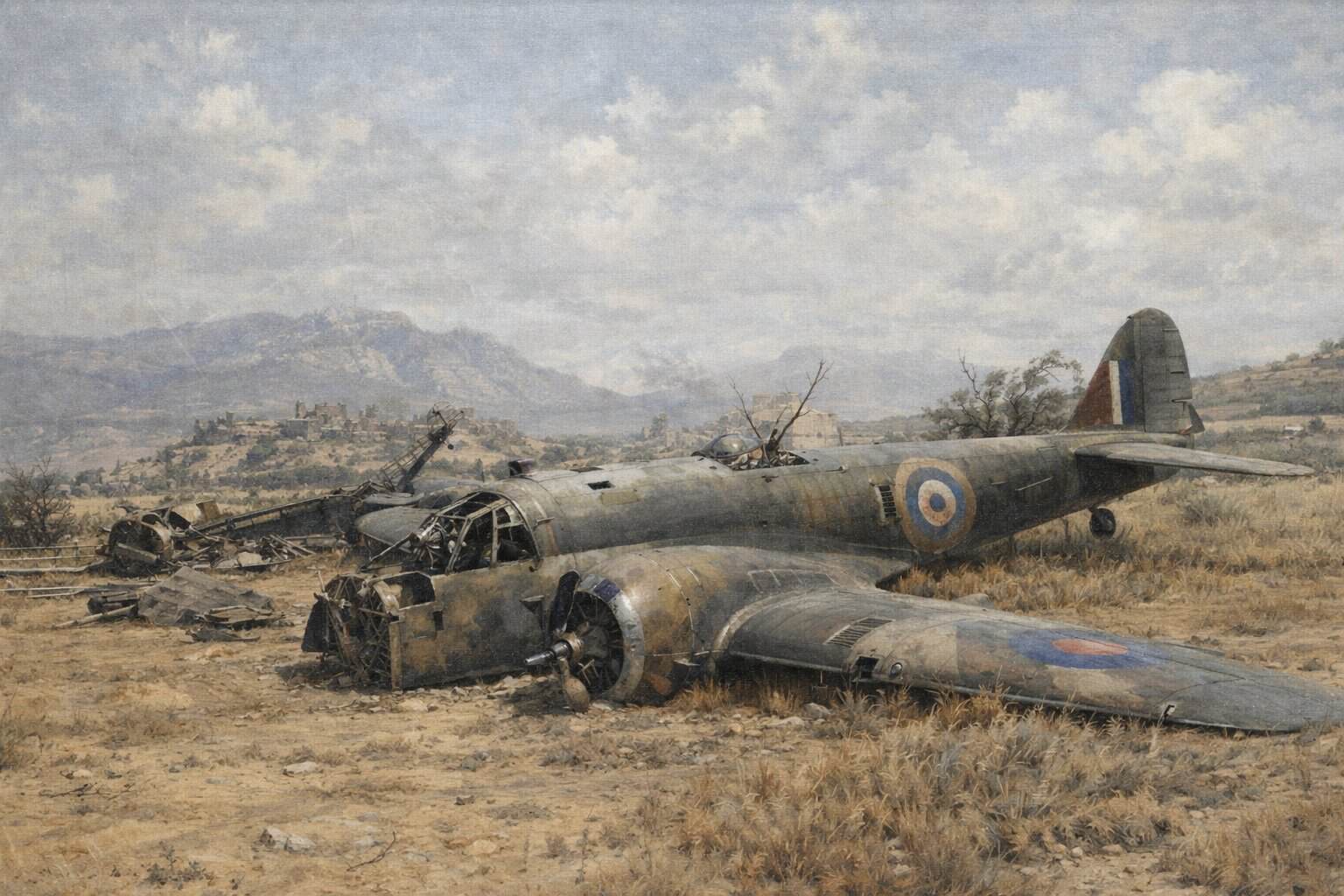
RAF in the Battle for Crete was shaped by exhaustion, shortage and the rapid loss of air superiority. In May 1941, the island became the scene of a decisive contest in which German control of the air steadily weakened the British and Commonwealth defence, limited the RAF’s freedom of action and helped make withdrawal unavoidable. Crete offered a severe lesson in the operational consequences of fighting without adequate air cover.
Background
The battle for Crete followed directly from the collapse of the Allied position in mainland Greece. The earlier campaign had already worn down RAF units, and the move to Crete did not offer the conditions needed for rapid recovery. Aircraft availability was limited, maintenance was difficult, and the island’s airfields were exposed to sustained attack. Even before the main German assault began, the RAF faced the problem of defending an important position with too few serviceable aircraft and too little freedom to build a durable defensive system.
This weakness mattered because Crete lay across key lines of communication in the eastern Mediterranean. Its airfields and harbours gave it clear operational value, but they could only be held if the defenders could contest the air above the island and the surrounding sea. The Luftwaffe entered the campaign with the advantage of proximity, concentration and established momentum. The RAF, by contrast, was operating at the end of a strained chain of retreat and reinforcement.
The Battle for Crete
When the German airborne assault opened, the battle quickly showed how far air superiority shaped events on the ground. Constant air attack disrupted movement, communications and supply, while also placing pressure on the island’s airfields and administrative system. The RAF could still fight, but it could not impose itself on the battle in a sustained way. Its resources were too limited to blunt the wider German effort or to shield ground forces from repeated attack.
The struggle for Maleme airfield became especially important. Once the Germans were able to strengthen their hold and bring in further men and materiel, the balance shifted more sharply against the defenders. That development was not simply a local tactical reverse. It reflected the broader fact that German aircraft could strike repeatedly, shape the tempo of operations and support the airborne assault at decisive points, while the RAF lacked the strength to deny that freedom.
The consequences extended beyond the immediate battlefield. German air power also made reinforcement and supply far more hazardous. Ships approaching Crete came under intense attack, and the wider effort to support the island or extract troops from it had to be conducted under constant threat from above. In that sense, the battle was decided not only by the fighting on land, but by the inability of British forces to challenge German control of the air across the theatre immediately surrounding Crete.
Withdrawal and Loss
As the position deteriorated, withdrawal became the only practical course. The evacuation that followed was carried out under severe pressure, and it confirmed the same underlying lesson that had marked the battle from the start: without sufficient air cover, even disciplined resistance and determined sea movement became progressively more costly. The RAF’s reduced local presence limited what it could do to protect the retreat, while the Luftwaffe remained able to attack ports, shipping and troop concentrations.
Crete was lost through a combination of tactical pressure and wider operational imbalance. German airborne forces achieved surprise and momentum, but those advantages were magnified by command of the air. The defenders could not move, reinforce or withdraw on equal terms. The result was not merely the loss of an island position, but a clear demonstration that local courage and hard fighting could not compensate for sustained enemy air superiority.
Significance
For the RAF, the battle for Crete became one of the clearest early-war warnings about the cost of entering a campaign without the means to contest the air effectively. It illustrated that air power was not a supporting detail to be considered after the main fighting began. It was central to whether a defence could be organised, maintained and, if necessary, disengaged in good order.
The campaign also reinforced the importance of depth in air organisation: secure airfields, resilient logistics, sufficient reserves and the ability to rotate or replace losses. Where those conditions were absent, even a strategically important position could become untenable with striking speed. In RAF terms, Crete was a lesson in the relationship between air superiority and every other aspect of joint warfare.
Wider Context
The battle belonged to a difficult period in 1941 when the RAF was stretched across several theatres and still recovering from earlier losses in the Mediterranean and Balkans. In that wider setting, Crete showed how quickly German air power could exploit weakness at the edge of British capability. It also helped confirm a principle that would shape later campaigns: amphibious movement, reinforcement and withdrawal all depended on credible air protection.
Crete did not settle the wider Mediterranean war, but it showed with unusual clarity how an air decision could drive a campaign's outcome. The island’s loss was not simply the consequence of an airborne landing. It was the product of a battle in which the RAF and its allies were unable to prevent the enemy from controlling the air, and in which that control dictated the course of events from the opening attacks to the final withdrawal.