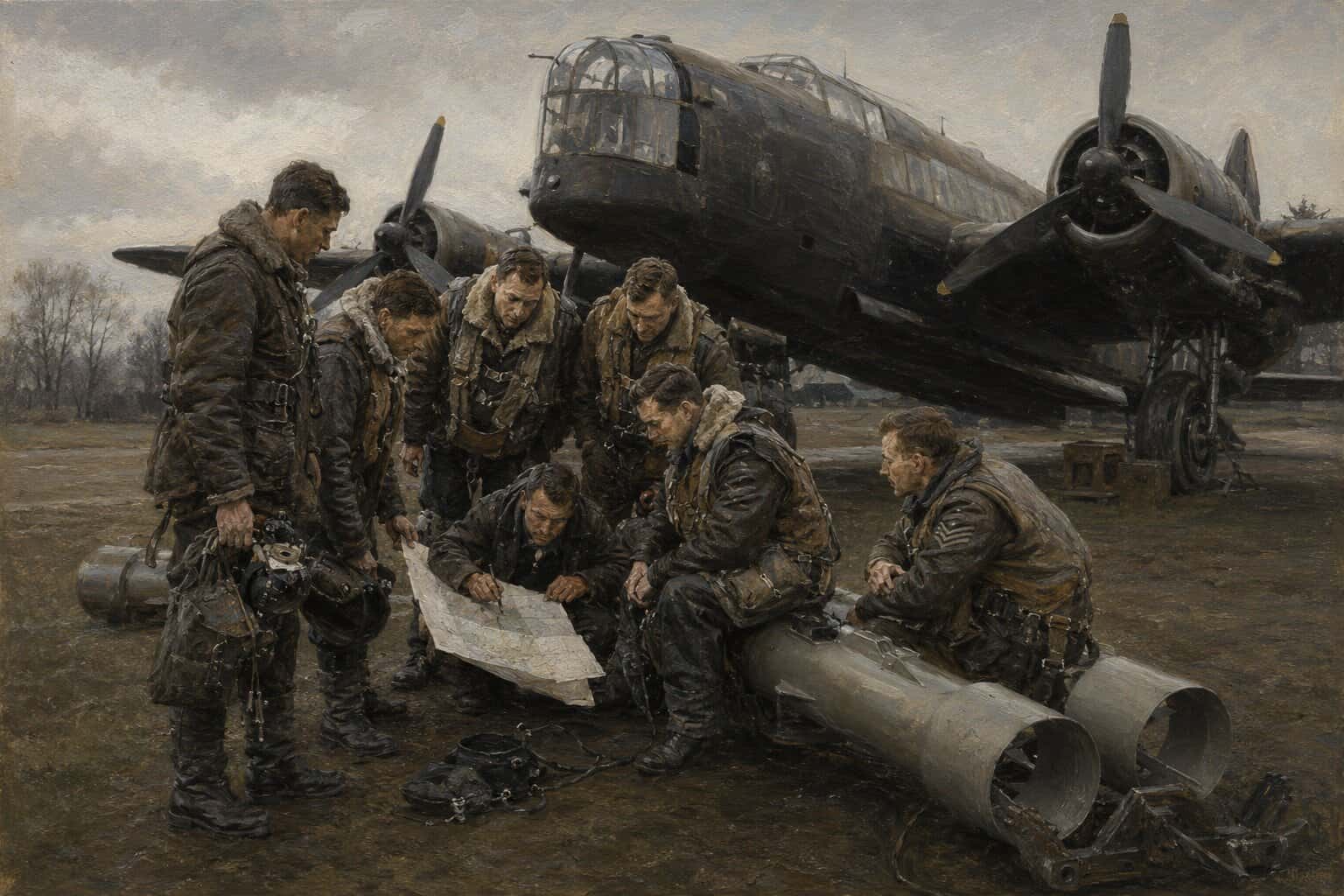
The wartime Royal Air Force is often remembered through squadrons, campaigns, and aircraft, but none could have functioned for long without a system capable of producing trained aircrew in vast numbers. Every operation consumed skill as well as fuel. Pilots had to master increasingly complex aircraft; navigators had to work accurately by night and over long distances; wireless operators, air gunners, bomb aimers and flight engineers had to fit into crews that could survive operational conditions only because training had already made discipline close to instinctive. Britain entered the Second World War with valuable flying experience but nothing like the scale a long industrial air war would demand.
What emerged between 1939 and 1945 was a vast wartime pipeline running from selection boards and ground instruction through elementary flying, specialist schools, operational training and conversion to combat aircraft. It stretched across Britain and deep into the wider Commonwealth, and it shaped what kinds of operations the RAF could sustain, how quickly commands could recover from loss, and how far Britain could turn air power into a global instrument of war. A companion long read, RAF Aircrew Training WWII: From Recruit to Front Line, follows one recruit’s personal route through that pipeline. This article instead sets out the system itself: the institutions, the overseas schemes and the pressures that produced RAF aircrew on an industrial scale.
Why Britain Needed a Mass Training System
The RAF of the late 1930s was not built for the scale of conflict that arrived in 1939. It was a professional service with established training institutions, a strong belief in technical standards, and a growing sense that modern war would place air power at the centre of national survival. Even so, its peacetime structure remained comparatively small. Existing training establishments could produce competent officers and airmen, but they had not been designed to sustain the attrition of a major European war while the service also expanded across the Middle East, the Mediterranean, the Atlantic and Asia.
Rearmament in the second half of the 1930s forced the problem into view. New aircraft were entering service, squadrons were expanding, and the strategic importance of air defence and bombing was rising in British planning. That expansion exposed a contradiction: aircraft production could be accelerated through industrial effort and Treasury spending, but trained aircrew could not be produced at the same speed. Flying demanded time, instructors, airfields, fuel, spare parts and a grading system capable of separating the merely enthusiastic from those who could cope with the physical and mental demands of military aviation.
The pre-war RAF already had elements on which a larger system could be built. Cranwell, reserve arrangements, auxiliary structures and specialist schools gave the service a professional training culture, while civilian flying clubs and air-mindedness schemes widened the social base from which potential pilots were drawn. These measures were only a starting point. Once war became likely, the service had to think less in terms of producing polished peacetime officers and more in terms of moving large numbers of men through a sequence that preserved standards without paralysing expansion.
Expansion also created a competing demand for the very men the RAF most needed at the front. An experienced pilot posted to an instructional role strengthened the training system, but he was also a pilot no longer available to a squadron. Balancing that quantity against quality, and deciding how many capable men the training machine itself should absorb rather than release to operations, would define the whole history of wartime aircrew training.
The RAF Volunteer Reserve, established in 1936, played a significant part in preparing for this expansion. It offered weekend and evening flying instruction to civilian volunteers years before war was declared, building a reservoir of partially trained men who could be absorbed quickly into full-time service once war began. Alongside short-service commissions and the established reserve schemes, the Volunteer Reserve widened the social and geographical base of RAF recruitment well beyond the officer-dominated culture of the pre-war regular service, a shift that became decisive once wartime mobilisation demanded recruits by the tens of thousands rather than the hundreds.

Selection and Initial Training
Every aircrew candidate passed through selection before touching an aircraft. Medical fitness, aptitude, educational ability and psychological steadiness all mattered, because aircrew roles were highly specialised. Not every promising recruit was suited to flying, and not every pilot candidate had the temperament or mathematical ability required for navigation or wireless work. Selection boards graded candidates and directed them towards the trade that best matched their abilities, a process that shaped the whole pipeline as much as any classroom instruction did.
Recruits who passed selection moved into reception and ground training, where drill, discipline, service procedure and basic academic instruction in subjects such as mathematics, meteorology and signals prepared them for flying training proper. This stage was rarely glamorous, but it filtered out men who would struggle with the discipline and routine that operational service required, before the RAF committed scarce aircraft and instructor time to them.
The trade a man was streamed into at this point was rarely his own choice alone. Aptitude scores, aircrew requirements at the time and the availability of places on a given course all played a part, and a candidate who hoped to become a pilot might instead be directed towards navigation, wireless work or air gunnery if the system judged him better suited, or simply more urgently needed, elsewhere. That flexibility was essential to a pipeline that had to match output to demand across several different trades at once, rather than simply produce as many pilots as possible.
Selection itself became more systematic as the war went on. Aircrew Selection Boards assessed candidates against a common set of criteria, while Initial Training Wings extended the reception stage into several weeks of drill, physical training, service law, elementary mathematics, basic navigation and aircraft recognition. The intention was to ensure that every recruit reaching a flying school had already absorbed the discipline and academic groundwork that flying training itself had no time to teach from scratch, and to reduce the number of would-be aircrew who washed out only after consuming scarce flying hours.
Elementary and Service Flying Training
Pilot candidates who completed initial training moved on to an Elementary Flying Training School, universally known as an EFTS, where they learned the fundamentals of take-off, landing, turns, forced-landing procedure and basic aircraft handling. Machines such as the Tiger Moth became symbols of this stage, not because they were glamorous but because they were forgiving enough to teach the first habits of military flying. Only after an EFTS course could the system judge who had the steadiness and capacity to continue.
Those who progressed moved to a Service Flying Training School, or SFTS, where the demands increased sharply. Trainees flew more powerful aircraft and learned instrument flying, formation work, navigation, night flying and gunnery according to their intended role. For men destined for multi-engine work, trainers such as the Airspeed Oxford and Avro Anson bridged the gap between elementary handling and operational aircraft. Synthetic instruction supplemented the hours available in the air: the Link Trainer, a ground-based flight simulator, let trainees rehearse instrument flying procedures without the cost and risk of putting an aircraft into the air for the purpose. The move from EFTS to SFTS was where the RAF began to separate future fighter pilots from those bound for bombers, coastal aircraft or transport types, since each demanded a different balance of skills.
Successful completion of an SFTS course was marked by a final flying and ground examination that tested navigation, instrument flying, forced-landing procedure and service knowledge together, rather than any single skill in isolation. Instructors graded each trainee not only on technical competence but on judgement under pressure, since a pilot who flew well in calm conditions might still falter when weather, mechanical trouble or fatigue removed his margin for error. Those who failed at this late stage, after months of training, were among the most difficult cases the system had to manage, since the RAF had invested heavily in them without being able to pass them onward to an operational squadron. Successful trainees at this stage were awarded their pilot’s flying badge, or wings, marking formal qualification in their trade.
Other Aircrew Trades
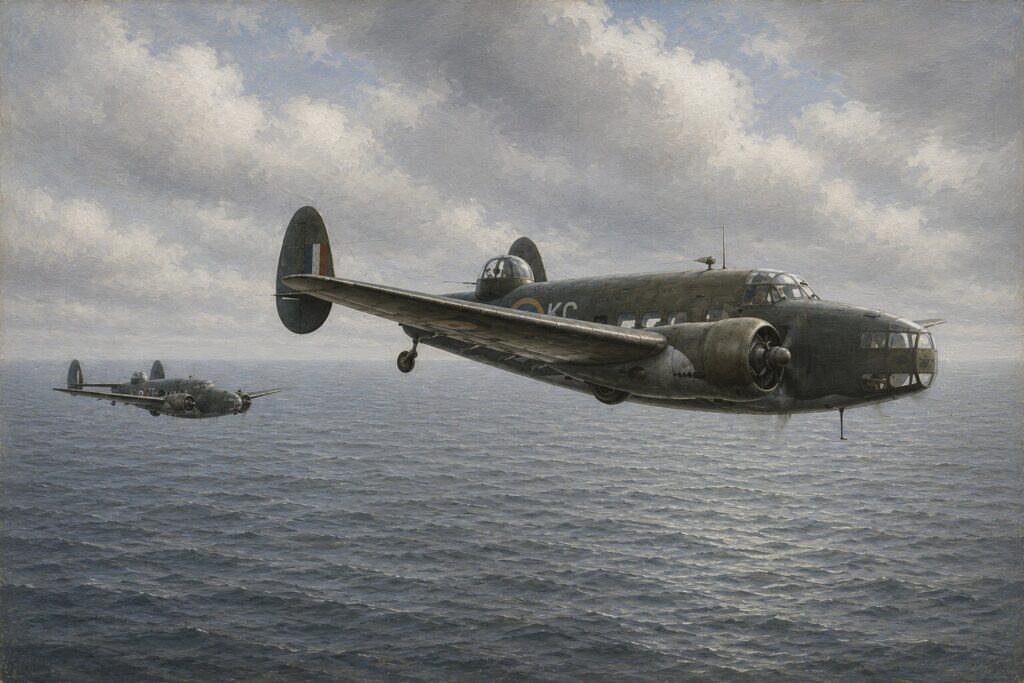
Pilots were never the whole of the system. Observers, and later navigators, trained in dead reckoning, chart work, meteorology and, as the war progressed, in the growing range of radio and radar aids that supplemented visual navigation. Their work demanded sustained concentration over long distances and often in darkness, where a single miscalculation could put an entire crew off course or over the wrong target.
Wireless operators trained in Morse code, radio procedure and equipment maintenance. In the early war years, many bomber crews combined the wireless and gunnery roles into a single trade, commonly styled the wireless operator/air gunner, before later specialisation separated the two functions more clearly. Air gunners passed through dedicated gunnery schools, where they learned turret operation, aircraft recognition and deflection shooting, skills that had to become reflexive under the stress of a night interception.
Bomb aimers, trained from the same observer stream that produced navigators, learned bomb-sighting, map reading and target identification. Early in the war navigation and bomb aiming were combined within the observer trade, but during the war this broad role was progressively divided into more specialised navigator and air bomber categories, reflecting the increasingly distinct skills demanded by each task. As four-engine bombers such as the Handley Page Halifax, Short Stirling and Avro Lancaster entered service, the RAF added flight engineers to their crews, a trade trained specifically in engine management, fuel systems and the mechanical demands of larger aircraft that a pilot alone could no longer monitor in the air. Together, these specialist streams turned a bomber or flying boat crew into a trained team, each member responsible for a function the others depended on.
Training for these trades was never static. As bombing and navigation technology grew more sophisticated, particularly as radio and radar aids became more widespread as the war progressed, navigator and bomb aimer courses absorbed increasingly technical instruction that would have been unrecognisable to the observers of 1939. Gunnery training likewise evolved from basic turret familiarisation towards more realistic simulated attack exercises, reflecting hard-won lessons about the tactics used by night fighters over Germany. The RAF’s aircrew trades were reshaped repeatedly by the demands of the campaigns each trade was meant to support, rather than remaining fixed categories handed down at the start of the war.
The Empire Air Training Scheme and the Commonwealth System
One of the most striking features of RAF wartime training was that it quickly outgrew Britain itself. The geography of the United Kingdom imposed obvious limits. Airfields were crowded, weather was unreliable, enemy action threatened the home base, and operational demands competed with training for aircraft and instructors. If Britain was to sustain a large air force over several years, part of the answer had to be found overseas.
That answer took shape through the Empire Air Training Scheme, known in Canada as the British Commonwealth Air Training Plan. Agreed soon after the outbreak of war, it turned imperial connection into military capacity. Canada became central because it offered space, relative security from enemy attack, extensive flying areas and the industrial means to support large schools. Australia and New Zealand ran their own training organisations within the same scheme, while South Africa contributed through the Joint Air Training Scheme, and Southern Rhodesia hosted the Rhodesia Air Training Group. Further capacity came from the United States, where RAF pilots trained at United States Army Air Corps stations under the Arnold Scheme, alongside separate civilian-run British Flying Training Schools that operated under contract.
The scheme created a distributed training network for an air war that could no longer be run on domestic British foundations alone. Men might be recruited in one part of the Commonwealth, begin training in another, and then travel onward to Britain or a theatre command for operational conversion. That movement required common syllabuses, administrative cooperation, shared standards and a constant traffic of records, instructors and aircraft. Training overseas also carried a strategic advantage in distance, since it reduced pressure on British airfields, kept a large part of the training effort away from direct enemy attack, and made use of climates and open flying space unavailable in heavily congested southern England.
The system was not frictionless. Standardisation across several countries was a continuing task, aircraft availability differed between schools, and local needs and national identities remained even as the war demanded cooperation. Men trained overseas still had to be integrated into British commands, acclimatised to theatre conditions and, in some cases, brought up to speed on aircraft very different from those they had trained on. Even so, the wartime aircrew pipeline would have been far weaker without this global dimension. The RAF’s ability to remain in the field through prolonged attrition owed much to the skies of Canada, the training schools of southern Africa and the wider Commonwealth and Allied network that grew during the war.
By the time the scheme reached full production, it was supplying a substantial share of the aircrew serving with RAF and Commonwealth squadrons, easing a bottleneck that domestic training alone could never have resolved. Its scale also left a lasting diplomatic legacy, embedding wartime cooperation between Britain and the Dominions into a shared institutional memory that outlasted the war itself.
Operational Training Units and Conversion to Combat Aircraft
By the middle years of the war, Operational Training Units, or OTUs, had become one of the most important links in the chain. They formed the bridge between school instruction and combat service, giving crews their first sustained experience of the aircraft types and tactics they would use operationally. For bomber crews in particular, the OTU stage was where individual specialists became a working crew. Pilots, navigators, wireless operators, bomb aimers and gunners were commonly left to form themselves into crews through a largely informal process of mutual selection, choosing to fly together on the strength of a shared confidence that could matter as much as any posting order.
As bomber types grew heavier, a further stage was added. Crews destined for four-engine aircraft such as the Halifax, Stirling and Lancaster passed through Heavy Conversion Units, where they added a flight engineer and adapted to the size, weight and handling of a much larger aircraft before joining an operational squadron. Fighter Command’s requirements ran on a different track. A single-seat fighter pilot needed rapid aircraft handling, gunnery, radio discipline and the ability to function within a tightly controlled air-defence system, so conversion there centred on type-specific handling and tactics rather than crew formation, with dedicated conversion units introduced as newer, faster fighter types entered service and pilots had to be brought up to speed on them before joining a squadron. Coastal and transport aircrew followed parallel arrangements suited to long-range navigation, maritime search or airborne operations. In every case, the RAF used the OTU and conversion stage to ensure that the first genuinely operational sortie was not also a crew’s first real test of working together.
These training differences reflected genuinely different kinds of war. Fighter Command needed pilots who could react in seconds, hold formation, communicate over radio and make split-second decisions under direct enemy fire, so its operational training concentrated on type conversion, gunnery and tactical formation flying rather than on building multi-man crews. Bomber Command’s demands ran the other way: navigation, target-finding and defensive gunnery all depended on a crew functioning as a single unit across many hours in darkness, which made the informal crewing-up process at OTU as important as anything taught in a classroom. Coastal Command trained its crews for a different rhythm again, one measured in long, monotonous patrol hours over open water where navigation accuracy and constant vigilance counted for more than split-second reflexes, and where the enemy was as likely to be found through patient search as through direct engagement. Later in the war, as transport and airborne operations expanded, aircrew also had to master formation flying in large numbers, glider towing and the precise timing that airborne assault and resupply demanded. That variety in operational demand meant the OTU and conversion stage, more than any earlier point in the pipeline, was where the RAF finally matched a trained man to the particular kind of war his command actually fought.

Training Risk and Standards
Training systems are often described in administrative language, but they were held together by people and equipment under real strain. Instructors were among the most important and least visible figures in the wartime air effort. Some were experienced aircrew withdrawn from operations, temporarily or permanently; others were men who showed the steadiness and judgement required to teach rather than to go directly to a squadron. Their work demanded patience and nerve, since they had to pass on standard methods without breaking a trainee’s confidence, and judge when a weakness was curable and when it was dangerous.
Many of the RAF’s instructors served what was informally known as a rest tour, screened from operations for a period after completing a first tour of operational duty, so that their hard-earned experience could be passed on to newcomers before they returned, if required, for a further spell on operations. That arrangement helped keep training realistic without permanently removing experienced men from the front line, though it also meant that trainees were sometimes taught by men who were themselves worn down by the strain of a full operational tour.
Aircraft posed a constant difficulty of their own. Training machines had to be numerous, maintainable and suited to a specific stage of instruction, and they were rarely the most modern types in RAF service. A training aircraft flown repeatedly by inexperienced hands was part of a demanding system, and maintenance staff had to keep heavily used fleets serviceable, since breakdowns or shortages could disrupt the flow of students moving from one stage to the next.
Accidents were an unavoidable part of wartime flying training. They were less visible in public memory than operational losses, but they formed a grim background to the production of aircrew. Elementary flying could punish panic or overconfidence; advanced training added instrument pressure, navigation error, night operations and the handling of more powerful aircraft. Men were killed or injured before ever seeing combat, and others were withdrawn from flying duties and redirected into different trades. That reality sharpened a continuous argument over tempo: how quickly a recruit could be moved forward, how much failure the system could absorb, and how far standards could bend before they ceased to be standards at all. Following the heavy early-war losses suffered by Fighter and Bomber Command, training authorities revised syllabuses where they could, lengthening courses and adding specialist instruction to address the weaknesses that operational experience had exposed, without ever fully resolving the underlying tension between output and standard.
Behind the administrative language stood a human cost that training statistics rarely captured. Recruits were uprooted from civilian life and placed into a sequence of tests and postings that could stretch across continents, and a man might pass one course only to fail the next or be re-categorised into a different trade. The RAF drew on a far wider pool than its pre-war service had known, taking in university men, clerks, labourers, school-leavers and volunteers from across the Commonwealth, and it had to absorb that uneven mix of backgrounds and turn it towards common standards under pressure.
Scale and Legacy
By 1944 and 1945, the aircrew training system had become one of the most mature organisational achievements of the wartime RAF. It remained imperfect, with bottlenecks, mismatches between supply and demand and a recurring difficulty in aligning output with changing operational plans, but the contrast with the small pre-war service was unmistakable. Britain and the Commonwealth had built a training structure capable of sustaining fighter defence, the strategic bombing offensive, maritime warfare, tactical air support and long-distance air transport at the same time.
Its importance lay not only in scale but in the way it linked doctrine, organisation and operations. A command could propose an air campaign only if trained aircrew were available to carry it out; an aircraft type could be introduced effectively only if instructors, syllabuses and conversion arrangements kept pace with it; and heavy losses could be absorbed only if the training pipeline remained intact. In that sense, the aircrew training system was one of the mechanisms by which strategy was translated into operational reality, even though it rarely appeared in the headlines that combat operations generated.
It also shaped the RAF’s post-war inheritance. The service that emerged in 1945 had learned that modern air power required a permanent training architecture rather than an improvised wartime arrangement, and that operational capability depended on reserves of instructional knowledge, specialist schools and a habit of planning beyond the front line. That lesson carried into the peacetime RAF, which retained dedicated flying and technical training organisations even as the vast wartime system contracted and was reorganised for a much smaller force. Commonwealth cooperation in training had shown, too, that British air power at its wartime peak was sustained by a network far wider than Britain alone.
The Battle of Britain, the bomber offensive, maritime patrols and airborne operations all rested in part on that less visible foundation: before squadrons could fight, men had to be selected, taught, graded and prepared in very large numbers, across a system that stretched from English elementary schools to the training fields of Canada, southern Africa and beyond.