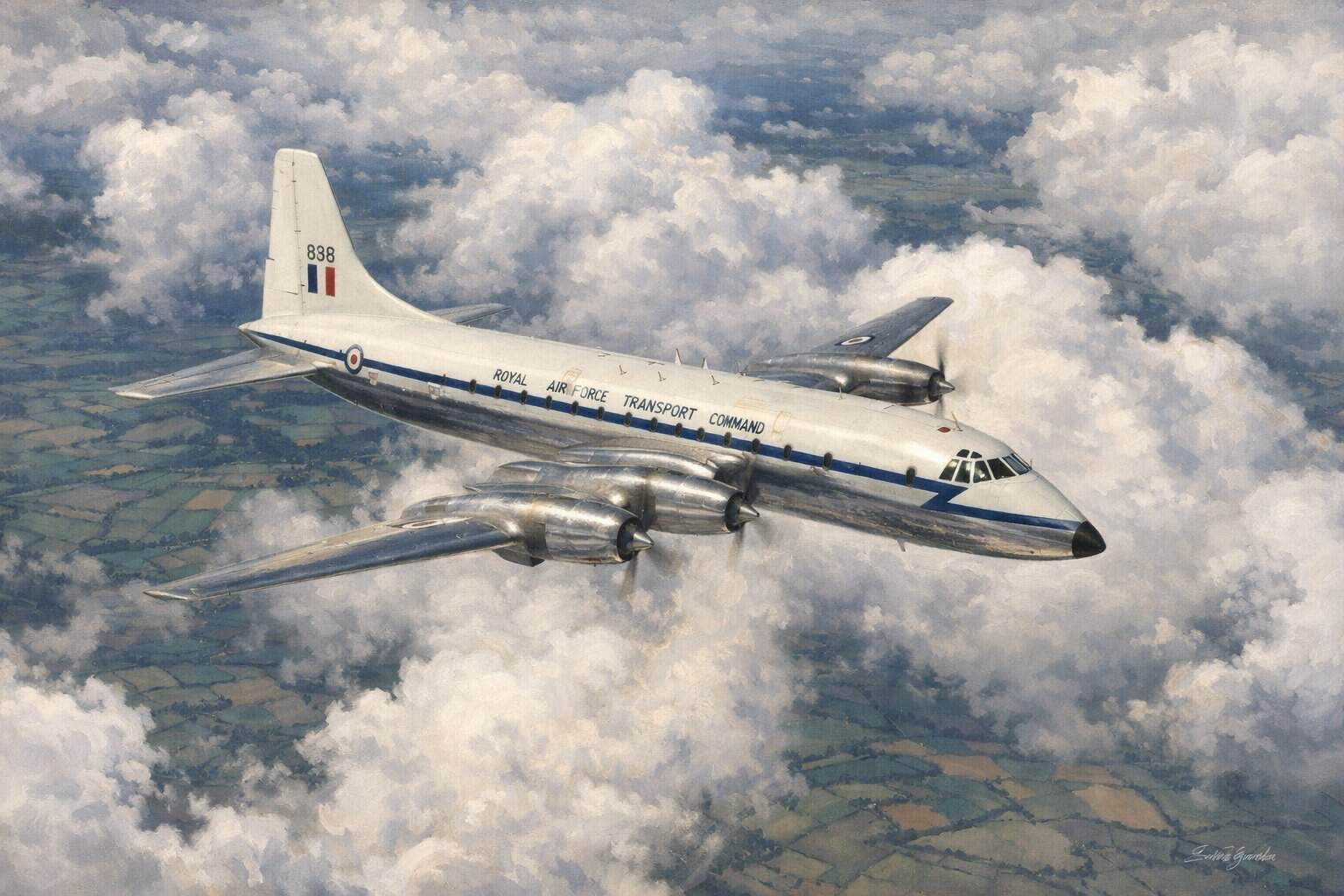
RAF Transport Command, known formally as Royal Air Force Transport Command, gave the RAF a permanent organisation dedicated to moving personnel, equipment, mail, medical cases and urgent stores across long distances. Formed during the Second World War and expanded through its closing stages, it turned air transport from a supporting activity into a standing arm of British air power, carrying the RAF’s reach from the Atlantic ferry routes to the airfields of the Far East.
The command’s record was built on continuity rather than a single campaign. It linked Britain with distant theatres during the war, supported operations where sea movement was slow or vulnerable, and carried those lessons directly into the early Cold War. By the 1950s and 1960s, its aircraft were sustaining overseas garrisons, responding to crises and maintaining the logistics of a shrinking but still global British defence commitment.
Formation from Ferry Command
RAF Transport Command was established on 25 March 1943, bringing the RAF’s separate transport and ferrying functions together under a single command for the first time. The existing RAF Ferry Command, responsible since 1941 for flying newly built aircraft across the North Atlantic to Britain, was absorbed into the new organisation and continued its Atlantic ferrying role as No. 45 Group. Air Chief Marshal Sir Frederick Bowhill, who had led Ferry Command throughout its existence, became the first Air Officer Commanding-in-Chief of Transport Command.
The new command was deliberately broader than its predecessor. Where Ferry Command had focused on delivering aircraft from factory to front line, Transport Command was structured as a worldwide organisation covering transport services, aircraft delivery and ferrying, route organisation and operational transport support. The reorganisation was significant enough to be marked as the day RAF Transport Command was created to unify wartime airlift, giving the RAF a single authority over long-distance air movement at a point in the war when operations were expanding well beyond north-west Europe.
Wartime Global Airlift
Transport flying had existed before 1943, but the scale of global war gave it far greater weight. Aircraft and crews were needed to move replacement personnel, specialist staff and high-priority cargo quickly between theatres. Air transport offered speed and flexibility that sea lift could not match, even though it could never approach sea lift in volume.
The command built and sustained a network of staging routes that reached from Gibraltar and Malta, across North Africa and the Middle East, to India and the Far East, running alongside the North Atlantic corridor it had inherited from Ferry Command. That network let aircraft, personnel and freight move between theatres far more quickly than convoys or troopships, even where individual aircraft carried only modest loads.
The Burma theatre showed this most clearly. Operations in difficult terrain, often far from developed infrastructure, depended on aircraft that could deliver supplies to forward airstrips, drop stores to isolated forces and evacuate casualties by air. In these conditions, RAF transport aircraft were part of the means by which ground operations could continue at all.
As the war ended, Transport Command’s tasks widened again. Repatriation of personnel, the movement of former prisoners of war and the redistribution of units across a shrinking wartime establishment required a large and disciplined air transport effort. The emergency lift of the war years fed directly into the post-war demand for organised global air transport.
The Berlin Airlift and Post-war Commitments
In the post-war years, RAF Transport Command shifted from urgent wartime support to the sustained work of imperial communications, reinforcement and crisis response. Troops needed to reach overseas stations, equipment had to reach distant commands, and administrative links had to be maintained with bases often far from major ports or dependable shipping routes. Air mobility became a standing requirement of defence policy rather than an occasional expedient.
The command’s largest post-war test came with the Berlin Airlift of 1948 to 1949, when RAF transport aircraft joined the effort to supply the blockaded city by air. The Handley Page Hastings, a four-engined transport that had entered RAF service that same year, faced one of its earliest major tests during the airlift, alongside the wider post-war transport force it was joining. The Hastings went on to serve as one of the RAF’s primary transport types for the next decade and a half.
Strategic and Tactical Fleets
By around 1960, RAF Transport Command operated a mixed fleet built up through years of gradual adaptation. Strategic transport duties were carried out by aircraft including the Hastings, the Bristol Britannia and the de Havilland Comet, each representing a different stage of post-war design. The propeller-driven Hastings had carried the command through the immediate post-war years; the Britannia turboprop and the jet-powered Comet added speed and improved the long-range movement of passengers and urgent freight.
RAF tactical airlift called for different qualities. The Blackburn Beverley and the Armstrong Whitworth Argosy were valued for their cargo-handling arrangements and their ability to operate into more austere airstrips. The Beverley addressed the need to carry bulky loads, while the Argosy served freight and paratroop tasks.
Rotary-wing transport added a further layer of mobility. The Bristol Belvedere, Westland Whirlwind and Westland Wessex extended air transport into places where runways were absent or impractical, giving the command a short-range lift capability alongside its fixed-wing fleet.
1960s Modernisation
Re-equipment in the 1960s exposed the tension between operational need and industrial policy. The RAF needed aircraft with range, useful payload, acceptable cruising speed and the ability to work from limited infrastructure. A British solution was explored in the Armstrong Whitworth AW.681, a short take-off tactical transport, but the project did not survive the defence cuts of the mid-1960s.
Transport Command instead adopted the Lockheed C-130 Hercules, a proven aircraft that met the RAF’s practical requirements for tactical airlift. The Short Belfast filled a narrower heavy-lift role, while the Vickers VC10 became the command’s principal long-range jet transport, prized for its performance from hot-and-high airfields where other aircraft struggled.
End of Transport Command and Legacy
RAF Transport Command was renamed RAF Air Support Command on 1 August 1967, a change that reflected its widening role in supporting RAF and British military operations worldwide. Air Support Command’s existence was brief. No. 38 Group transferred to Strike Command on 1 July 1972. On 1 September, Air Support Command and Strike Command were merged, with the remaining Air Support Command assets forming the new No. 46 Group within Strike Command.
RAF Transport Command’s history forms a central chapter in RAF airlift history, and it shows that air power depended on more than combat aircraft. Its aircraft made possible the rapid movement of people, equipment and specialist support across great distances, first in war and then across two decades of post-war commitments. The balance it struck between strategic lift, tactical transport and rotary-wing support shaped the structure that Strike Command inherited in 1972, leaving successor commands with the capabilities and organisational experience on which later RAF global air mobility was built.