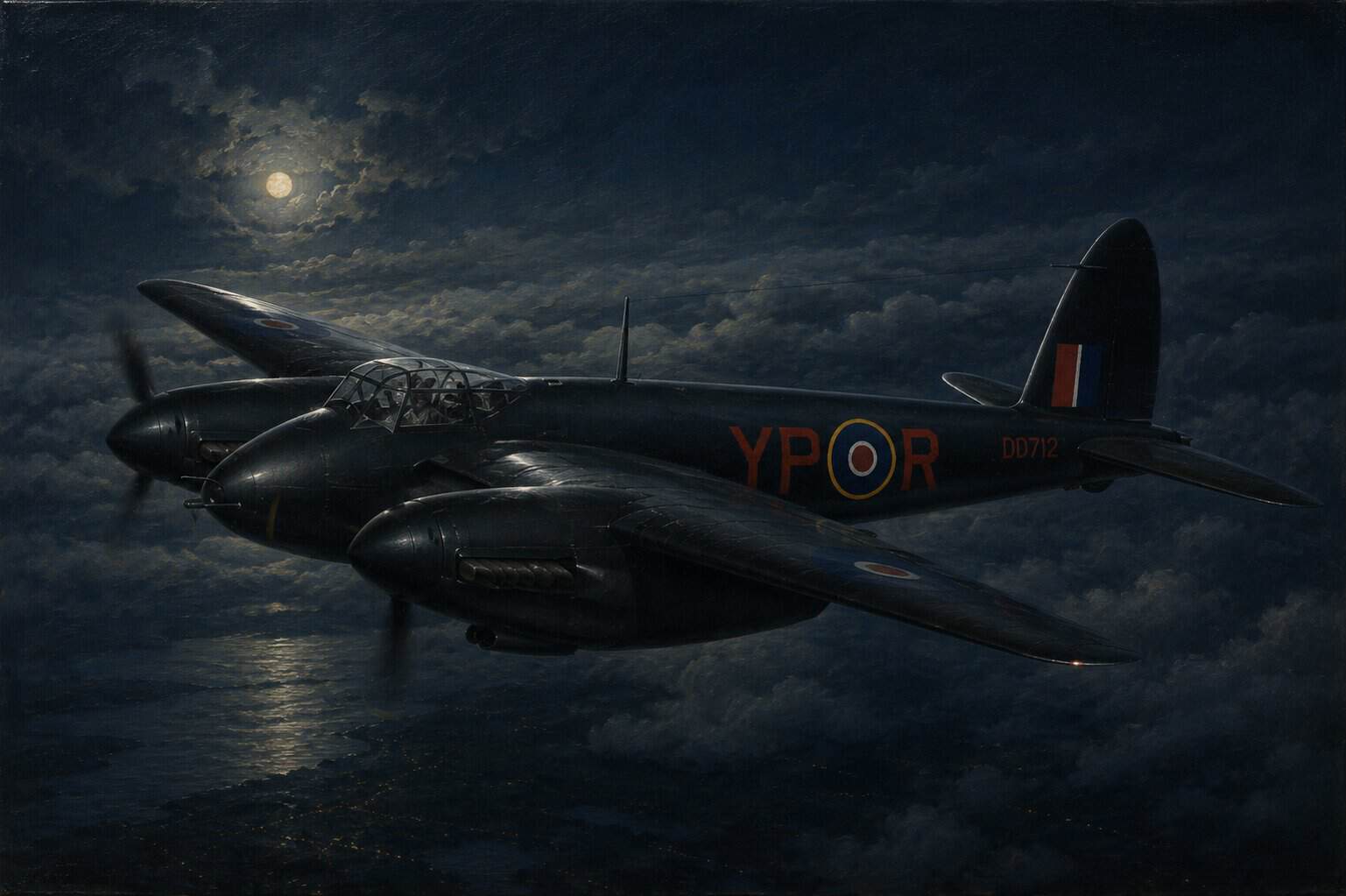
The history of RAF night fighting and radar was a story of rapid adaptation rather than instant technical mastery. In the early years of the Second World War, the RAF had to learn to detect, track, and defeat air attacks after dark, when visual warning and ordinary fighter methods were no longer enough. What emerged was not a single invention but an increasingly integrated air-defence system in which radar, controllers, searchlights, anti-aircraft guns and specialist crews worked together.
Background
Before the war, British air defence had already begun to benefit from the radar network that became known as Chain Home. That system offered early warning of approaching aircraft and gave Fighter Command a stronger basis for directing its resources. Yet the first generation of warning and control arrangements was most effective in daylight and against raids that could be followed with greater visual certainty. Darkness introduced a different problem. Knowing that hostile aircraft were approaching was not the same as being able to bring a fighter into position to find and destroy them.
The Luftwaffe’s turn to sustained night bombing during the Blitz exposed that gap. Britain could detect raids approaching the coast, but interception after dark remained difficult. Pilots had to rely on fragmentary guidance, limited visibility and the hope of making visual contact in poor conditions. Searchlights and anti-aircraft fire formed part of the defensive belt, but they could not, by themselves, provide a consistently effective answer. The RAF therefore had to develop a night-defence system that treated warning, tracking and interception as parts of the same operational problem.
Building A Night Defence System
That effort depended on organisation as much as on technology. Radar information had to be filtered, interpreted, and quickly passed to the command structure. Ground controllers then needed to direct fighters towards the likely path of incoming bombers with greater precision than had previously been possible. This brought night defence firmly into the wider evolution of Fighter Command’s control system. The principles associated with Hugh Dowding’s command framework remained important, but they had to be refined for conditions in which the target could not be easily seen and in which timing, altitude, and direction mattered even more.
As the system improved, ground-controlled interception became a central element of night defence. Radar stations, operations rooms and fighter sectors increasingly formed a chain that could narrow the search area for an attacking crew. The process remained demanding and imperfect, but it was far more effective than leaving a pilot to hunt almost blindly in the dark. The RAF’s growing mastery rested on disciplined procedure, better communications and a clearer understanding of how technical warning could be converted into operational action.
Specialised Night Fighters
Aircraft and equipment also had to change. Early war fighters designed chiefly for daylight combat were not always well suited to the endurance, stability and onboard equipment required for night interception. The Bristol Beaufighter became one of the RAF’s principal answers to that problem. Its range, firepower and capacity to carry airborne interception radar made it valuable in the developing night battle. Later, the de Havilland Mosquito brought even greater speed and versatility, becoming one of the most effective night fighters in RAF service.
Airborne radar was especially important because it shifted part of the search problem from the ground to the fighter itself. Ground control could guide an aircraft towards a target area, but the final stage of interception still required a means of locating the bomber in darkness or cloud. Radar carried in the night fighter helped close that gap. It did not remove the skill required of a pilot and a radar operator, nor did it guarantee success in every engagement. Still, it greatly improved the RAF’s ability to translate warning into contact.
Significance
By the middle years of the war, the RAF possessed a far more coherent night-defence capability than it had held during the early Blitz. The change was significant not because the problem disappeared, but because Britain’s air-defence system became progressively more capable of contesting the night sky. That mattered for the direct protection of cities, ports and industrial centres, and it also mattered institutionally. The RAF had shown that effective air defence required the integration of command systems, electronic detection, specialised aircraft and trained crews rather than dependence on any single arm.
In wider air-war terms, the development of radar-guided night fighting demonstrated one of the defining features of the conflict: the close relationship between operational pressure and technical innovation. British air defence after dark was strengthened not by a single breakthrough, but by the gradual linking of early warning, command and control, airborne equipment, and suitable aircraft. The result was a more mature and resilient system, one that illustrated how the RAF learned to fight a modern air battle in both darkness and daylight.