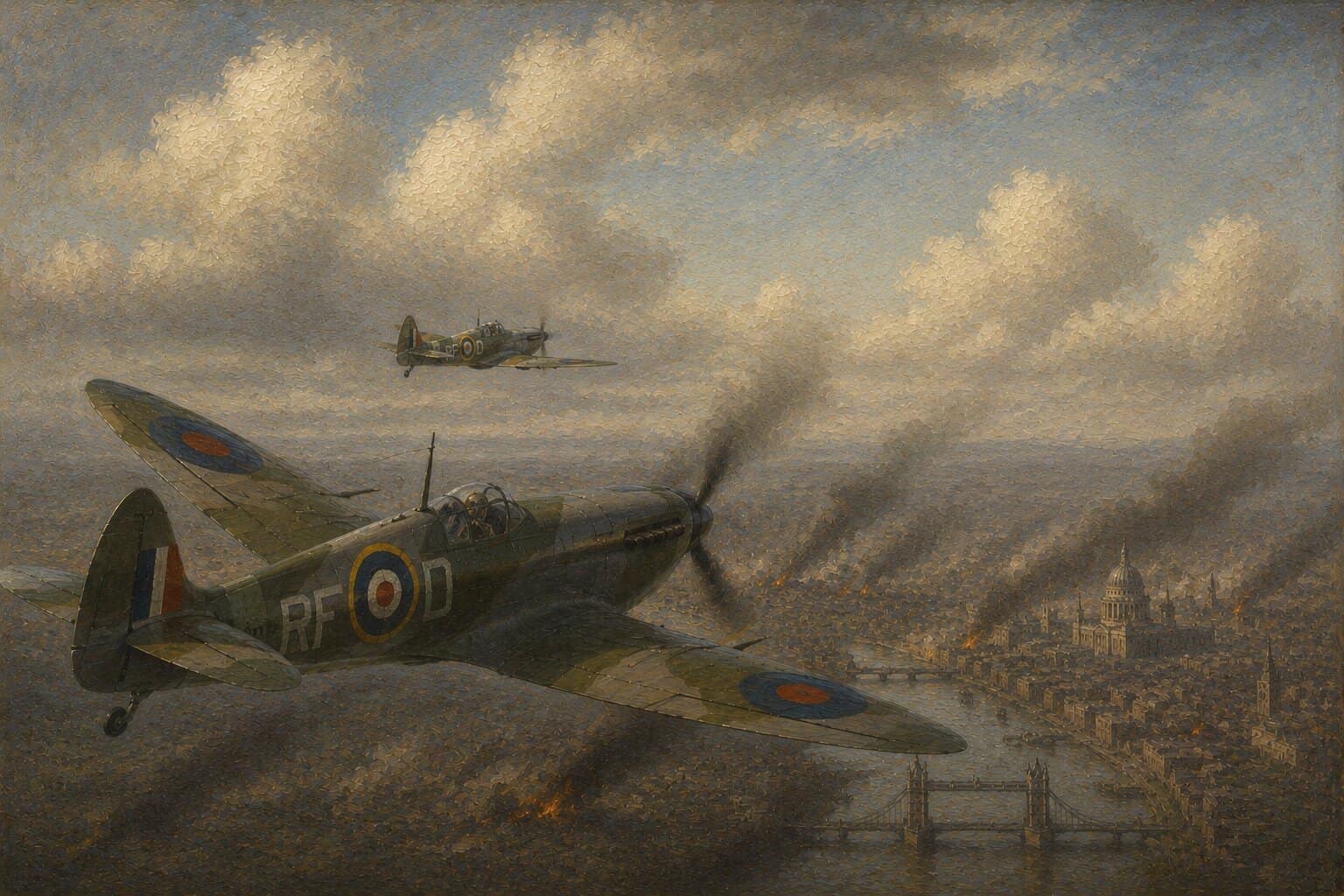
On 27 September 1940, the Luftwaffe mounted heavy raids against London and the South-East, with diversionary attacks on Bristol, in one of the major air actions of the Battle of Britain. The scale of the fighting and the losses inflicted made the day one of the most costly of the campaign for Germany. Yet the result was not a simple British triumph. Fighter Command also suffered heavily, underlining the relentless strain of late-September operations at the height of the battle.
The Battle In Its London Phase
By the final week of September 1940, the Battle of Britain had entered a different phase from the earlier attacks on coastal convoys and airfields. The Luftwaffe had shifted its main weight towards London, seeking both material damage and a decisive weakening of British resistance. Raids on the capital were now central to German strategy, but they did not reduce the intensity of the air fighting. Instead, they drew large formations into repeated daylight combat, often resulting in severe losses.
The raids of 27 September formed part of that pattern. London and the South-East remained the principal targets, while Bristol faced diversionary attacks intended to complicate British defensive responses. Such operations forced Fighter Command to react across a wide area while still concentrating sufficient force where the main assault developed. The burden on command, control and exhausted squadrons was therefore considerable.
A Costly Day For The Luftwaffe
What made the day especially notable was the level of German loss. In one of the battle’s most punishing exchanges, the Luftwaffe lost a substantial number of aircraft and, with them, trained crews and experienced leadership that could not easily be replaced. The deaths of several senior, seasoned commanders heightened the significance of the setback. In an air campaign where the quality of personnel was as important as the number of machines, such losses carried consequences beyond a single day’s operations.
These setbacks mattered because the Luftwaffe was trying to sustain pressure while proving that it could dominate British skies over the capital. Heavy losses weakened that effort. They also demonstrated that, even during the London raids, British fighter defences remained capable of mounting determined and damaging opposition. Tactical success for attacking formations could no longer be judged solely by whether bombs reached the city. The cost of doing so was becoming a strategic factor in its own right.
Fighter Command’s Own Sacrifice
Any account of 27 September must also recognise the price paid by Fighter Command. British losses were serious, and the strain on pilots, ground crews and sector organisation remained acute. By this stage of the battle, squadrons had been in near-continuous action for weeks. Every aircraft destroyed and every experienced pilot lost or injured weighed heavily on a system already stretched by the demands of defending London day after day.
That balance of loss is central to understanding the period. Britain could celebrate the damage done to the Luftwaffe, but there was no sense in which the fighting had become easy or one-sided. The campaign remained an attritional contest in which victory depended on enduring repeated attacks while continuing to impose unsustainable costs on the enemy.
Attrition And Significance
On This Day, 27 September 1940 stands as a powerful example of the battle’s late-September character: large raids, hard-fought interceptions, severe casualties and no relief for either side. For Germany, it was one of the costliest days of the campaign and a sign that major daylight operations against London brought grave risk. For Britain, it showed both the effectiveness and the vulnerability of Fighter Command. The scale of the action and the losses on both sides make the day a particularly revealing measure of how the Battle of Britain was ultimately decided as much by endurance as by dramatic individual combat.