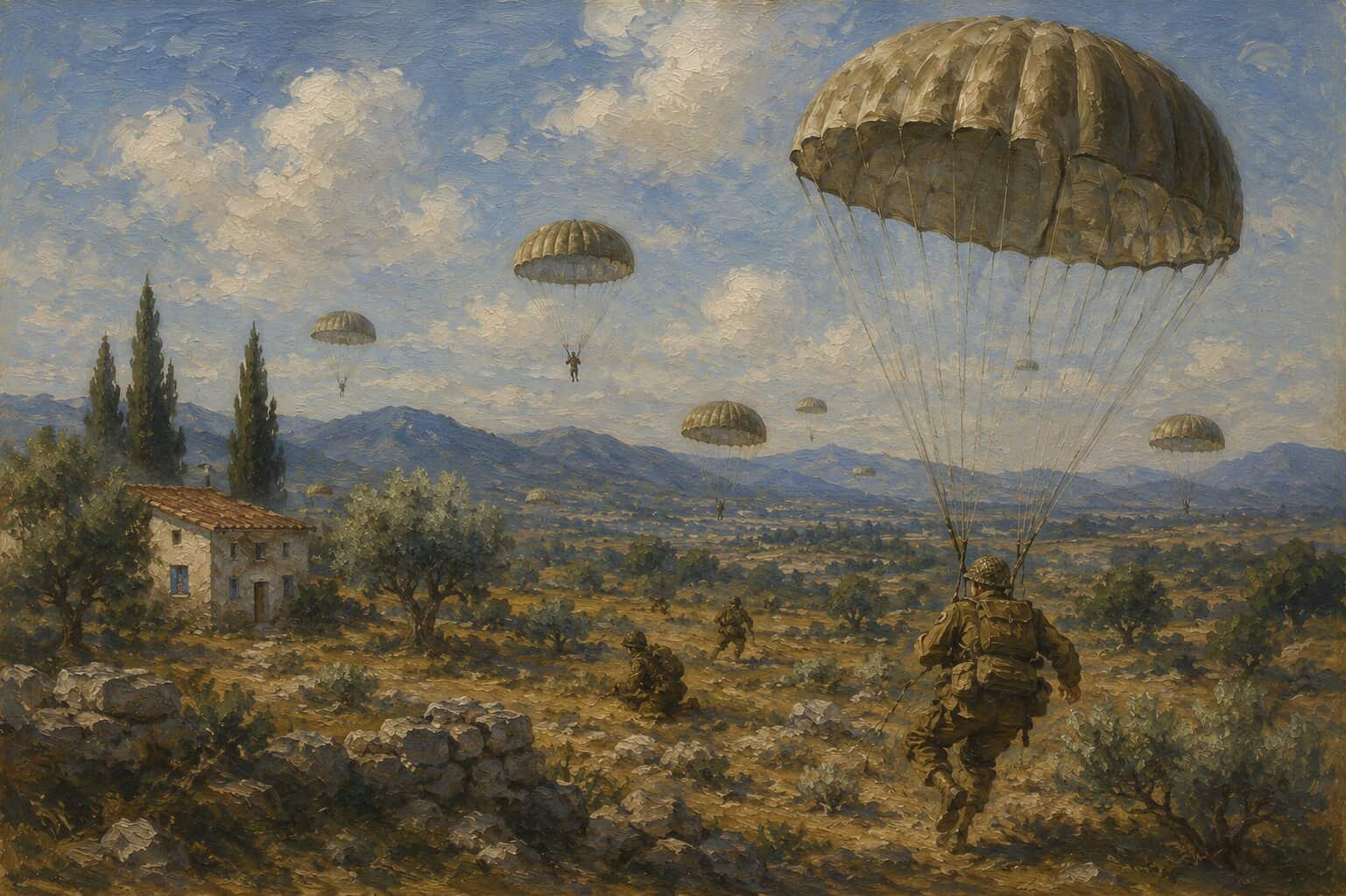
On 12 October 1944, Operation Manna opened its airborne phase in Greece with the landing of British paratroops at Megara airfield, near Athens. A company of the 4th Parachute Battalion, part of the 2nd Independent Parachute Brigade, made the initial descent as German forces withdrew from the country. American troop-carrier aircraft provided the lift for an operation that brought Allied troops into the approaches to the Greek capital.
The Greek Operation Manna belonged to the Allied return to a liberated country and the urgent task of establishing a military presence there. The same codename would later identify the April–May 1945 food-dropping operation over the Netherlands; the Megara landing was a separate undertaking, with its own forces, objectives and operational circumstances.
Air power and the German withdrawal
German withdrawal created an opportunity for Allied forces to enter Greece. British troops had already made smaller landings during September, and the RAF had begun restoring its presence on Greek airfields. On 24 September, 32 Squadron flew Supermarine Spitfire aircraft into Araxos, following the airfield’s liberation the previous day.
The wider air campaign involved the RAF’s Balkan Air Force, whose operations supported resistance forces and attacked communications across the region. During October, Allied aircraft sought to hinder the German retreat from Greece and southern Yugoslavia. Poor weather restricted those efforts, placing practical limits on both offensive operations and the movement of troops by air.
Manna formed part of this broader Allied response to the changing situation. Its troop-carrying role fell to the United States Army Air Forces’ 51st Troop Carrier Wing. The distinction between the American transport force and the RAF’s regional operations is central to understanding how the different air elements contributed to the return to Greece.
RAF aircraft nevertheless formed part of the same airborne operation. Nine Halifaxes carrying supply containers flew to Megara on 12 October alongside fourteen C-47s carrying the paratroops, with the formation operating under heavy fighter escort.
The landing at Megara
High winds caused numerous casualties among the company dropped at Megara and disrupted the airborne programme, forcing the remainder of the brigade’s arrival to be spread over several days.
Securing an airfield near Athens gave the incoming force a practical point of entry. The remainder of the brigade group followed under Brigadier C. H. V. Pritchard, with orders to secure Athens, maintain law and order, and provide relief to the Greek population. These tasks connected the military insertion directly with the problems facing a country emerging from occupation.
The subsequent lift expanded the initial foothold. Between 12 and 18 October, C-47s flew approximately 224 successful sorties into Megara and Kalamaki, carrying personnel and equipment as the Allied presence around Athens expanded. British paratroops entered Athens on 15 October.
An Allied foothold around Athens
The operation demonstrated the importance of transport aircraft in bringing troops and equipment into a rapidly changing theatre. A parachute landing, followed by further airborne movement, helped establish the force required around Athens while the German withdrawal was still reshaping the military situation.
For the RAF, the episode sits within its renewed presence in Greece and the Balkan Air Force’s wider regional campaign. American troop carriers delivered the airborne force, British paratroops secured the ground, and Allied air activity supported the broader return. Megara’s immediate significance lay in that combination: air transport converted an opening created by German withdrawal into an Allied foothold close to the Greek capital.