On This Day, 1939: On 21 October 1939, 46 Squadron Hurricanes intercepted Heinkel He 115 floatplanes over the North Sea in the…
Read the entry →General Atomics MQ-9 Reaper
General Atomics Aeronautical Systems
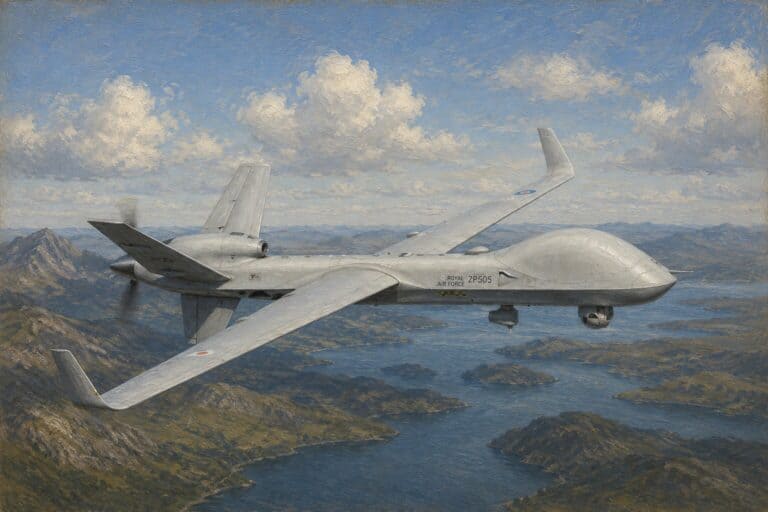
The General Atomics MQ-9 Reaper became the RAF’s best-known remotely piloted aircraft, combining persistent surveillance with precision strike support in Afghanistan and other modern operations.
The General Atomics MQ-9A Reaper became one of the Royal Air Force’s most consequential aircraft of the twenty-first century. Entering British operational service in Afghanistan in October 2007, it combined long-endurance surveillance with the ability to deliver precision weapons when authorised. Its crews could observe an area for hours, follow developing events and provide commanders with a continuous picture of activity on the ground. When the RAF retired the type on 30 September 2025, Reaper had served for eighteen years across two major campaigns and had helped establish remotely piloted aircraft as a permanent element of British air power.
Reaper was never simply an unmanned substitute for a fighter-bomber. It was an intelligence, surveillance and reconnaissance platform whose ability to remain over a target area was often more important than its speed or weapons load. In Afghanistan it supported troops operating in difficult terrain. Later, under Operation Shader, it contributed to the international campaign against Islamic State in Iraq and Syria. Its history also encompassed important changes in RAF organisation, with operational crews based both in the United States and at RAF Waddington in Lincolnshire.
From Predator to Reaper
The MQ-9 was developed by General Atomics Aeronautical Systems as a larger, more powerful successor to the MQ-1 Predator. Predator had demonstrated the military value of a remotely piloted aircraft that could remain airborne for extended periods, carrying cameras and transmitting imagery to operators far from the aircraft itself. The new design, originally known as Predator B, offered greater speed, payload and endurance, along with more scope for carrying weapons and advanced sensors.
Reaper differed markedly from the small tactical drones familiar to many ground units. It was a substantial aircraft with a long, slender wing, a rear-mounted turboprop engine and a complex system of ground stations, satellite communications and supporting personnel. Although it carried no pilot in the cockpit, it was flown and operated by trained aircrew.
The United States Air Force adopted the MQ-9, and Britain subsequently acquired the aircraft to meet an urgent operational requirement in Afghanistan. The need was immediate: British and coalition forces required persistent intelligence and surveillance over widely dispersed operations, often in terrain where threats could develop quickly and where conventional aircraft could not remain overhead indefinitely.
Entry into RAF Service in Afghanistan
RAF Reaper operations began in Afghanistan in October 2007. The aircraft initially concentrated on intelligence, surveillance and reconnaissance, providing imagery and other information to forces conducting operations on the ground. Early British Reapers were unarmed, although the aircraft’s ability to carry weapons soon became part of its operational role.
The deployment formed part of Operation Herrick, the British campaign in Afghanistan. Reaper was particularly valuable in Helmand province, where ground units faced the difficulty of securing roads, compounds and settlements across a large operating area. A remotely piloted aircraft could watch an approach route, monitor suspicious activity or maintain observation of a location while troops moved nearby.
This persistence altered the relationship between air support and ground operations. A fast jet could arrive quickly and deliver a substantial weapons load, but its time over a particular location was limited by fuel, tasking and other commitments. Reaper could remain in the area for much longer, allowing its crew to build an understanding of activity as events unfolded.
The aircraft’s usefulness did not depend on a weapon being fired. Much of its operational contribution came from observation, reporting, identifying possible threats and helping commanders decide what action, if any, was justified.
No. 39 Squadron and Operations from Nevada
No. 39 Squadron was re-formed in 2007 to operate the RAF’s Reaper force. Its personnel were based at Creech Air Force Base in Nevada, where British crews worked within the wider infrastructure established for American remotely piloted operations.
Operating an aircraft over Afghanistan while its mission crew worked in the United States was made possible by satellite communications and a distributed command-and-control system. The aircraft itself deployed to the operational theatre, where a local team supported launch and recovery. Once airborne, control of the mission could be transferred to crews operating from a remote ground station.
This arrangement separated the location of the aircraft from the location of much of its operating crew. It also required coordination among pilots, sensor operators, intelligence specialists, communications personnel, engineers and commanders.
No. 39 Squadron remained closely associated with the RAF’s first generation of Reaper operations. The squadron was disbanded in 2022 as the service reorganised its remotely piloted aircraft force, with operational responsibility centred on No. XIII Squadron.
No. XIII Squadron and RAF Waddington
No. XIII Squadron re-formed at RAF Waddington in October 2012 as the RAF expanded its ability to control Reaper missions from the United Kingdom. Waddington had long been associated with reconnaissance and intelligence aircraft, making it an appropriate centre for the developing remotely piloted capability.
In April 2013 the RAF conducted its first operational Reaper mission controlled from UK soil. The milestone demonstrated that a crew in Lincolnshire could fly and manage an aircraft conducting operations thousands of miles away, supported by the necessary communications and deployed ground organisation.
No. XIII Squadron’s role also marked a cultural shift. Remotely piloted aircrew performed operational flying duties from a permanent base at home, often while the aircraft itself was operating in a conflict zone. The distance between cockpit-equivalent controls and the aircraft did not remove the need for airmanship, tactical judgement or adherence to the rules governing military operations.
The squadron became the principal RAF Reaper unit during the aircraft’s later years, including its service in the Middle East and the approach to retirement.
Airframe, Engine and Performance
The MQ-9A is a medium-altitude, long-endurance remotely piloted aircraft. It is powered by a Honeywell TPE331 turboprop driving a pusher propeller at the rear of the fuselage. Its high-aspect-ratio wing gives it the efficiency needed to remain airborne for long periods while carrying fuel, sensors and mission equipment.
Published figures for the MQ-9A include a wingspan of approximately 20 metres, a maximum speed in the region of 240 knots and a service ceiling around 50,000 feet. Endurance varies with payload, altitude, mission profile and environmental conditions; missions lasting well beyond the normal endurance of a crewed fast jet were central to the type’s value.
Reaper’s landing gear and conventional runway operation distinguished it from smaller tactical unmanned aircraft. It required a prepared operating base, trained launch-and-recovery personnel, maintenance support and reliable communications. It was therefore a deployable aircraft system rather than an autonomous machine that could be sent into combat without substantial infrastructure.
The aircraft was controlled through ground stations and data links. Local line-of-sight communications supported launch and recovery, while beyond-line-of-sight satellite communications enabled mission crews to operate from distant locations.
Sensors, Surveillance and Intelligence
Reaper’s central operational capability was the ability to collect and transmit information over extended periods. Its electro-optical and infrared sensors provided day and night imagery, while radar equipment could support surveillance in conditions where ordinary optical cameras were less effective.
Full-motion video enabled crews and analysts to observe movement, changes in behaviour and developing events. This information could be passed to ground commanders, other aircraft and intelligence organisations. The aircraft could also maintain observation while personnel on the ground assessed whether a suspected threat was genuine.
Persistent surveillance required interpretation. Images alone did not establish the identity or intentions of every person observed. Crews needed to consider context, intelligence from other sources and the possibility of civilian activity. The ability to watch for longer could improve understanding, but it did not eliminate uncertainty.
Reaper also contributed to wider intelligence processes. Material collected during missions could be reviewed and combined with other reporting to help develop a more complete picture of activity in an operational area.
Aircrew and the Remotely Piloted System
The term ‘unmanned’ can obscure the number of people required to operate a Reaper mission. The RAF used trained pilots and sensor operators, supported by mission intelligence coordinators, analysts, engineers and communications specialists.
The pilot was responsible for flying the aircraft and managing the mission in accordance with orders and aviation procedures. The sensor operator controlled surveillance equipment and supported the identification and tracking of objects of interest. Intelligence personnel helped interpret information and place it in a wider operational context.
The aircraft could be controlled remotely, but its use of weapons remained a human decision subject to the same legal and operational framework applicable to other RAF aircraft. Remote operation did not make the aircraft autonomous in the sense of independently deciding whom to attack.
The unusual working environment placed its own demands on personnel. Crews could conduct missions over an active conflict area while physically located thousands of miles away, then return to ordinary life after a shift. The RAF’s experience with Reaper helped establish new practices for training, leadership and the recognition of remotely piloted aircrew service.
Arming the Reaper
Although surveillance was the original priority for British Reaper operations, the aircraft’s ability to carry precision weapons became an important part of its contribution. RAF Reapers were equipped to use AGM-114 Hellfire missiles and laser-guided bombs, including the GBU-12 Paveway II.
Hellfire provided a comparatively small precision weapon suitable for certain targets, while a laser-guided bomb offered a different effect and engagement option. The choice of weapon depended on the target, tactical situation, authorisation and assessment of possible harm to civilians and surrounding structures.
The first RAF Reaper weapon release in Afghanistan took place in June 2008. This was a milestone in British remotely piloted combat aviation, although it did not alter the aircraft’s primary importance as a persistent intelligence and surveillance platform.
Reaper was frequently described as an ‘armed drone’, but that label captured only one part of its activity. Many missions involved watching, reporting and supporting other forces without releasing weapons.
Reaper and Operation Herrick
In Afghanistan, Reaper’s endurance made it particularly useful to troops operating beyond the immediate reach of larger bases. It could support patrols, provide overwatch of routes and observe areas where hostile activity was suspected.
The aircraft’s sensors allowed crews to monitor locations before, during and after a ground operation. This helped commanders assess developing risks, track movement and request additional support where necessary. In some circumstances Reaper could use its own weapons; in others it provided information to aircraft or ground forces better positioned to act.
Its long endurance also enabled continuity. Where a brief observation might leave important questions unanswered, sustained surveillance could reveal patterns of movement and changes in activity over time.
Reaper nevertheless operated within the limits of available intelligence and communications. The presence of a camera overhead could not by itself resolve every ambiguity on the ground, and the use of force remained subject to authorisation and applicable rules of engagement.
Transition to Operation Shader
As the British combat mission in Afghanistan drew to a close in 2014, the RAF redirected Reaper capability towards Operation Shader, the UK’s contribution to the international campaign against Islamic State in Iraq and Syria.
Reaper began supporting the campaign in the autumn of 2014. Its tasks included intelligence gathering, surveillance, reconnaissance and precision strike when authorised. The aircraft worked within a coalition air campaign involving crewed combat aircraft, tankers, intelligence assets and ground-based command organisations.
The operating environment differed from Afghanistan. Missions could involve tracking activity across urban areas and complex front lines, where distinguishing combatants from civilians was especially important. The ability to remain overhead provided continuity for intelligence collection and target assessment.
The RAF publicly reported individual Reaper strikes during Operation Shader, but those announcements represent selected documented events rather than a complete record of every sortie. The operational history should therefore be understood through the wider campaign, not reduced to a count of weapons released.
Achievements and Operational Limits
By December 2017 the RAF Reaper force had accumulated more than 100,000 flying hours. The milestone illustrated how extensively the aircraft had been used since entering service a decade earlier. The RAF later reported a total approaching 150,000 operational hours during the type’s service.
These figures reflected the demands placed on a comparatively small fleet. Reaper provided a capability that could be kept on task for extended periods, but sustained operations required maintenance, aircrew availability, satellite bandwidth, spare parts and deployed support.
The aircraft also had limitations. It was relatively slow, relied heavily on communications links and was best suited to operating where hostile air defences and enemy fighters did not present the same level of threat as in a heavily contested air environment. Its strengths in Afghanistan and Operation Shader did not mean that it could replace crewed fighters or survive every kind of future conflict.
The distinction mattered for RAF planning. Remotely piloted systems expanded the range of tasks that air power could perform, but they remained part of a broader force requiring different aircraft and capabilities.
Retirement on 30 September 2025
The RAF formally retired the MQ-9A Reaper on 30 September 2025, closing an eighteen-year period of British operational service. Its withdrawal followed the planned transition to Protector RG Mk1, a newer remotely piloted aircraft developed from the MQ-9B family.
Protector was designed to offer improved endurance and the ability to operate under a different certification framework, supporting a broader range of operations in controlled airspace. It was not simply a renamed MQ-9A. The newer aircraft incorporated important differences in airframe, systems and the approach to airworthiness.
The transition represented continuity as well as change. Reaper had demonstrated the operational value of long-endurance remotely piloted surveillance and precision strike. Protector was intended to carry that capability forward with new equipment and operating arrangements.
Retirement also marked the end of a chapter closely tied to the campaigns in Afghanistan and against Islamic State. The aircraft that entered service as an urgent response to operational demands had become one of the RAF’s defining platforms of the period.
Historical Significance
The General Atomics MQ-9A Reaper changed how the Royal Air Force could maintain a presence over a battlefield. Its most important contribution was not the novelty of flying without a pilot on board, but the combination of endurance, real-time information and the option of precision action from the same platform.
From Afghanistan in 2007 to its retirement in September 2025, Reaper supported British operations through continuous observation, intelligence collection and, when authorised, armed intervention. No. 39 Squadron’s work from Nevada and No. XIII Squadron’s operations from RAF Waddington demonstrated a new geography of air power, in which the crew, aircraft and supported forces could be separated by thousands of miles.
Reaper also showed the limits of remotely piloted aviation. Its effectiveness depended on people, communications, maintenance, intelligence and the character of the airspace in which it operated. It did not make traditional combat aircraft obsolete, nor did remote control remove the human responsibilities associated with the use of force.
Its lasting place in RAF history is as the aircraft that made long-endurance remotely piloted operations an established part of British combat air power. The transition to Protector continued a capability whose foundations had been laid by Reaper over eighteen demanding years.
| Dimensions | |
| Wingspan | 66 ft 0 in (20.12 m) |
| Length | 36 ft 1 in (11.0 m) |
| Height | 12 ft 6 in (3.81 m) |
| Weights | |
| Empty weight | 4,900 lb (2,223 kg) |
| Max takeoff weight | 10,500 lb (4,763 kg) |
| Performance | |
| Maximum speed | 300 mph (482 km/h) |
| Cruise speed | 194 mph (313 km/h) |
| Service ceiling | 50,000 ft (15,240 m) |
| Range | 1,150 miles (1,850 km) |
| Powerplant | |
| Engines | 1 × Honeywell TPE331 turboprop engine |
| Power | 900 shp |
| Armament | |
| Guns | Capability for precision-guided weapons including Hellfire and guided bombs in RAF service |
RAF UAV Operations and the Rise of StormShroud Systems
How RAF uncrewed air systems evolved from early experiments to operational use, with StormShroud marking a…
27 April 2026 · 5 minRed Arrows History: From Gnat to Hawk and What Comes Next
How the Red Arrows evolved from post-war RAF display teams into the service’s official aerobatic formation,…
20 April 2026 · 5 minFirst Poseidon MRA1 Lands at RAF Lossiemouth
On 13 October 2020, City of Elgin became the first Poseidon to land at RAF Lossiemouth,…
13 October 2026 · 3 min