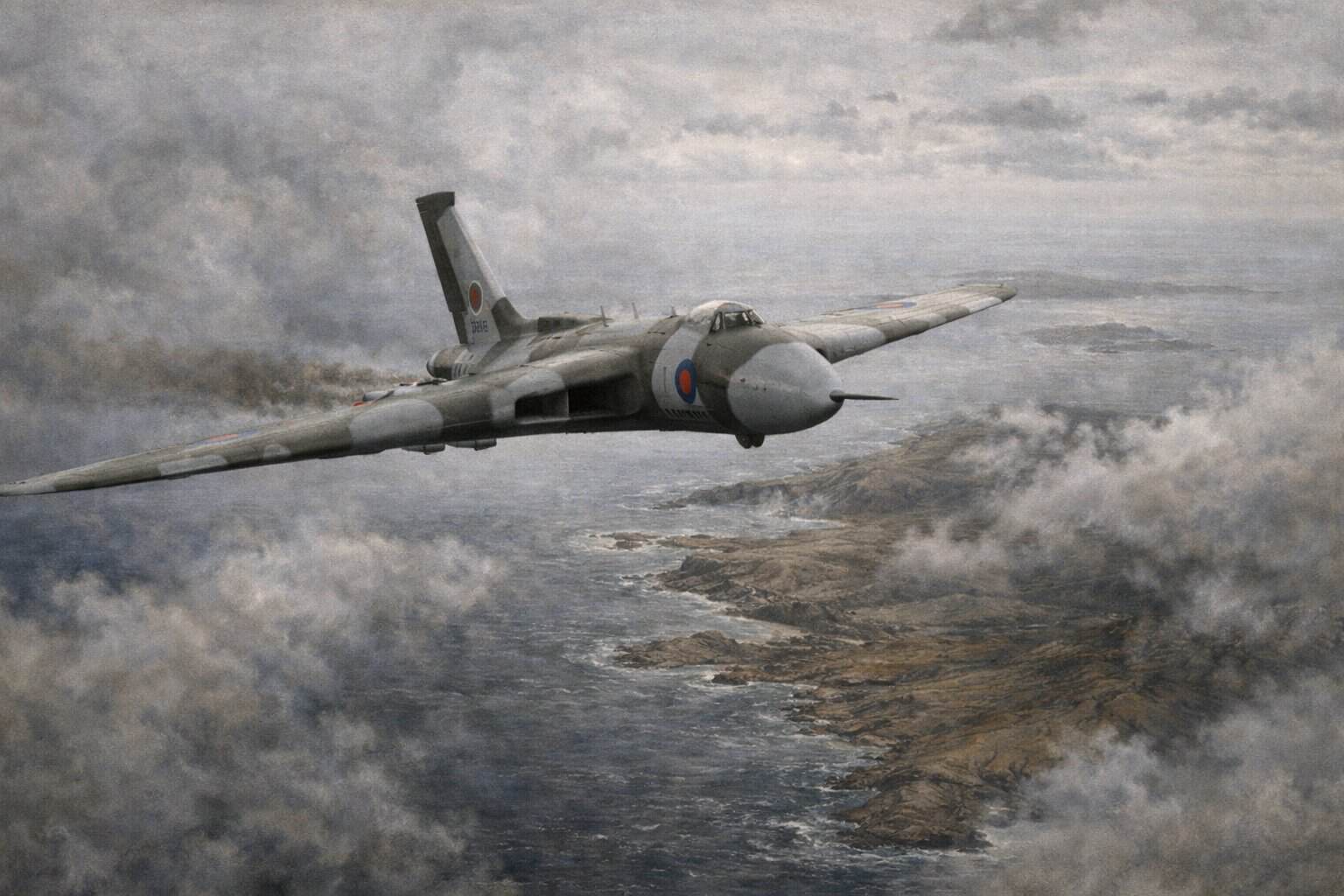
On 11 June 1982, the RAF launched Black Buck 7, the final conventional Vulcan bombing mission of the Falklands War, against Argentine positions and facilities around Port Stanley airfield. The attack itself was carried through into 12 June, but the operation belongs to the closing phase of the campaign when British forces were tightening pressure on the garrison and seeking to limit the enemy’s freedom of movement before the end. By then, Black Buck had already become one of the most remarkable long-range strike efforts in RAF history.
The last of the Vulcan raids
Operation Black Buck had begun in May as a series of extraordinarily long-distance attacks flown from Ascension Island. The aircraft was the Avro Vulcan, a Cold War strategic bomber designed for a very different kind of war, yet adapted in 1982 for a conventional campaign in the South Atlantic. To reach the Falklands and return, each mission depended on a complex chain of Victor tanker support. The effort required careful timing, repeated air-to-air refuelling and exact navigation over an enormous distance.
Black Buck 7 was the last of these bombing operations. It was flown by Vulcan XM607, with Martin Withers again in command, and used the same broad pattern of tanker-backed endurance that had made the earlier sorties possible. Unlike the first raid, which focused on the runway itself, this final bombing mission targeted troop positions and facilities around the airport rather than disabling the strip.
Execution and outcome
The mission showed both the reach and the limitations of such a demanding operation. Its bomb load was intended to burst in a way that would damage aircraft, stores and nearby military installations without unnecessarily ruining a runway that British forces expected soon to need for their own use. In practice, the fusing was wrong and the bombs exploded on impact. Worse still for the immediate tactical result, the pattern missed the intended targets.
Measured narrowly, that made Black Buck 7 less successful than RAF planners would have wished. It did not produce a decisive physical result on the ground. Yet that is only part of the story. The very fact that an RAF bomber could be sent from Ascension to the Falklands in wartime, supported by an elaborate tanker bridge, remained a significant operational achievement in itself. Even unsuccessful attacks could force the enemy to disperse effort, stay alert and account for a threat that could arrive from an immense range.
Why Black Buck 7 still matters
Black Buck has always generated debate about military effect, and Black Buck 7 sits squarely within that discussion. Critics have questioned whether the material results justified the resources involved. Supporters have pointed to the psychological effect, the pressure placed on Argentine planning and the proof of British reach. Both arguments form part of the historical record.
For RAF history, the mission also marks an ending. It was the final conventional Black Buck bombing attack and, in a broader sense, one of the last dramatic demonstrations of the RAF heavy bomber tradition in active combat. The surrender on the islands followed two days later. On this day, Black Buck 7 showed the persistence, ingenuity and sheer technical effort required to deliver air power at the very edge of Britain’s operational reach.