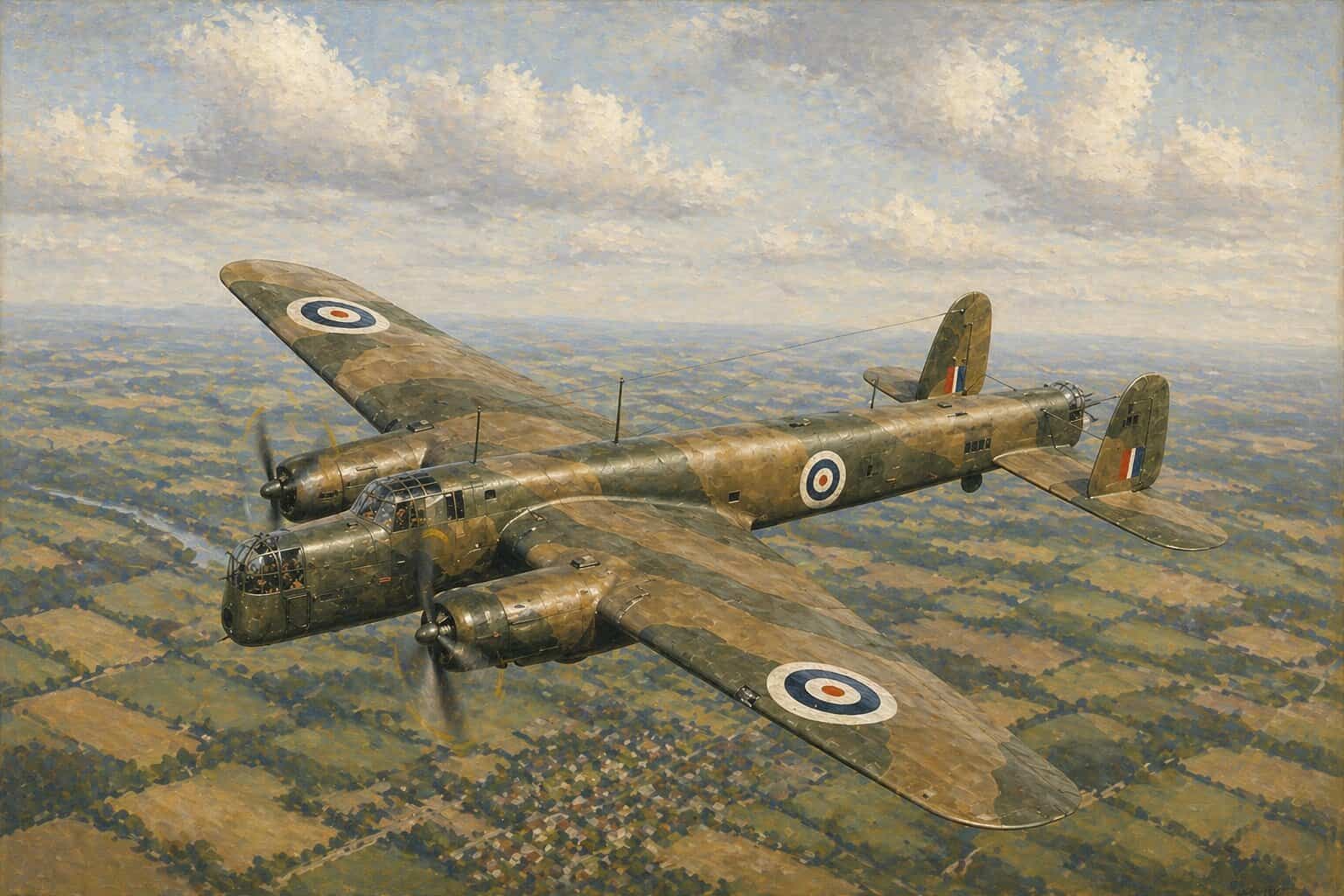
On 10 May 1940, Whitleys of 77 Squadron and 102 Squadron attacked communications west of the Rhine in what is often described as the first deliberate RAF raid on Germany. The operation took place on the opening day of the German offensive in the west. It marked an important step in the transition from the limited air war of the previous months to a broader and more direct confrontation.
The raid has long attracted attention because of its symbolic significance. Before May 1940, British air operations against German territory had been tightly constrained by political caution, strategic uncertainty and concern over escalation. Once the German attack began in the Low Countries and France, those restrictions rapidly weakened. The RAF was now entering a different phase of the war.
The Opening of a New Air Campaign
The force used for the raid came from Bomber Command and flew the Armstrong Whitworth Whitley, one of the RAF’s principal medium bombers of the early war period. The target was communications west of the Rhine, reflecting the immediate British aim of disrupting German movement and military coordination during the first hours of the campaign.
That operational purpose mattered, but the wider meaning of the attack was just as important. This was no longer the hesitant strategic posture of the so-called Phoney War. The outbreak of large-scale land fighting in the west compelled Britain to widen the scope of its air response, and attacks on targets in Germany became part of that shift.
For the crews involved, the mission also represented the growing burden being placed on Bomber Command. Early-war bombing operations were still limited by aircraft performance, navigation difficulties, and uncertain intelligence, while night operations, in particular, demanded a high degree of endurance and discipline. Even so, the RAF was being asked to bring the war to the enemy more directly than before.
Opening Implications
The attack by 77 Squadron and 102 Squadron did not, by itself, transform the course of the campaign in the west. Yet it remains important because it showed how quickly the character of the air war was changing in May 1940. The RAF was beginning to move from restricted, carefully calibrated operations towards the wider bomber offensive that would later define much of the war in the air.
In that sense, the raid sits at the beginning of a much larger story. Bomber Command’s future role was not yet fully formed, and the vast industrial offensive of later years still lay ahead. Nevertheless, this first deliberate raid on Germany pointed towards a new strategic reality in which British bombers would be used not only in support of immediate military needs, but as part of a sustained campaign against the enemy’s capacity and will to fight.
A Turning Point in the Early War
The date is also significant because it coincided with the German invasion of Belgium, the Netherlands and Luxembourg. As the crisis in Western Europe deepened, the RAF faced the urgent need to balance support for the land battle with the war's wider political and strategic demands. Bombing communications west of the Rhine was one expression of that response.
The mission stands as both an operational act and a marker of changing policy. It reflected the speed at which the Western offensive forced Britain to make more extensive use of air power. What had previously been debated in cautious terms was now becoming a wartime necessity.
Place in the Wider Air War
On this day, the RAF carried out what is widely regarded as its first deliberate raid on Germany. The attack by Whitleys of 77 Squadron and 102 Squadron was modest compared with the campaigns that followed, but it remains historically important because it marked the opening of a new phase in Britain’s air war.
For RAF history, 10 May 1940 is a reminder that major air offensives do not begin fully formed. They emerge from moments such as this, when changing military circumstances, political decisions, and operational capabilities combine to push air power into a new role.