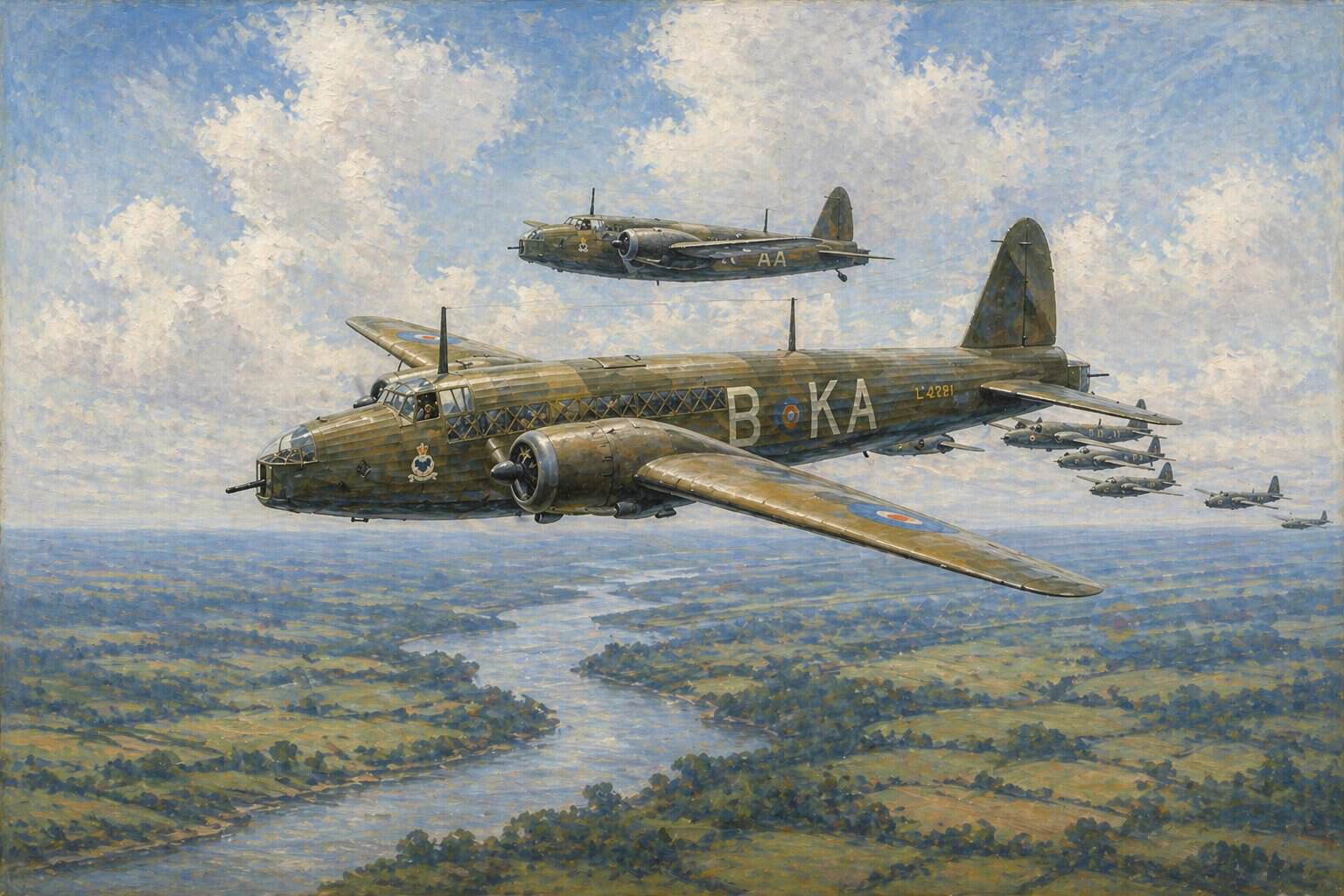
On 15 May 1940, ninety-nine bombers attacked Ruhr targets in Bomber Command’s first large-scale industrial raid, an operation often seen as effectively marking the beginning of the strategic bombing offensive. Coming only days after the German offensive in the west had transformed the character of the war, the attack reflected a rapid shift in British thinking about how to use air power against Germany.
Earlier RAF raids on German territory had been more limited in scale and political intention. Before the crisis in Western Europe deepened, British leaders had been cautious about escalation and selective in the targets they were prepared to authorise. By mid-May 1940, however, the pace of events on the ground was forcing a broader, more direct use of Bomber Command.
A New Phase for Bomber Command
The significance of the raid lay in both scale and purpose. A force of ninety-nine bombers attacking Ruhr targets represented a substantial increase in effort and pointed clearly towards the industrial and economic objectives that would become central to the RAF’s bombing war.
The Ruhr was a logical target. As one of Germany’s great industrial regions, it contained factories, transport links and infrastructure vital to the enemy war effort. An attack there carried strategic meaning beyond the immediate destruction caused on any single night. It showed that Britain was beginning to think in terms of sustained pressure on the enemy’s industrial base.
Bomber Command was still operating under serious limitations. Aircraft performance, navigation, bomb-aiming and intelligence remained imperfect, and the doctrine of strategic air attack was still evolving in practice. Yet despite those constraints, the raid of 15 May signalled a decisive broadening of ambition.
From Limited Raids to Sustained Offensive
The attack should also be understood in relation to the raids that immediately preceded it. The first deliberate raid on Germany on 10 May had already broken an important political and operational barrier. Five days later, this much greater effort showed that the RAF was moving beyond isolated attacks towards a more systematic conception of strategic bombing.
That transition would take time to mature, and the full offensive of later years still lay far ahead. Nevertheless, the raid on Ruhr targets is historically important because it marks the point at which the bomber war began to assume the scale and intention that would later define it.
In this early stage, Bomber Command was not yet the force it would become under Arthur Harris, nor had it solved the major tactical and technical problems of long-range bombing. Even so, the foundations of that later campaign were already being laid in May 1940.
Bomber Command Significance
The raid of 15 May 1940 matters because it showed the RAF beginning to use air power not simply as a tool of immediate battlefield response, but as a strategic weapon directed against the enemy’s industrial capacity. In that sense, it helped establish the logic that would dominate much of Britain’s air war against Germany.
From this point onward, bombing Germany’s industrial heartland was no longer only a prospective policy but an operational commitment. The offensive would change in scale, method and effect, yet this raid marked the point at which Bomber Command began to assume that larger strategic role.