
Across the North Sea, the horizon placed a practical limit on naval power. Warships could control the water around them while remaining uncertain about an enemy force beyond sight. Britain needed to protect merchant shipping, watch the approaches to German naval bases and obtain warning of movements by the High Seas Fleet. Aircraft offered a way to extend that view, provided they could reach the patrol area, survive its weather and communicate what they found.
Between 1914 and 1918, the Royal Naval Air Service developed several answers to that problem. Seaplanes accompanied ships, flying boats searched submarine routes, airships watched over convoys and fighters were carried towards waters beyond their normal reach. These methods demanded close cooperation with the Royal Navy. Their usefulness depended as much on launch arrangements, reporting and recovery as on an aircraft’s performance in flight.
The North Sea air war encompassed many operations across a large maritime theatre. The naval Battle of Heligoland Bight on 28 August 1914 belongs to its opening context; the RAF’s aerial battle over the Bight in December 1939 belongs to a separate war. The First World War story follows the RNAS until April 1918, when the new RAF inherited its maritime work.
That inheritance emerged through repeated trials under operational pressure. The results ranged from unsuccessful attacks and missed reconnaissance opportunities to systematic patrols and destructive strikes against German airships. Together they established an increasingly useful means of observing and influencing events at sea, although decisive control still rested on the wider naval struggle.
Before The RAF: Naval Aviation Enters The North Sea War
British naval aviation entered the war with experience of experimentation but limited experience of sustained operations. Before 1914, ship launches and seaplane trials had shown that aircraft could work with a fleet. The Naval Wing of the Royal Flying Corps provided the organisational foundation from which the Royal Naval Air Service emerged. By the outbreak of war, naval flying had a service of its own and a formidable collection of practical problems to solve.
The North Sea imposed a particular pattern on that work. Britain’s naval strategy required the protection of its own communications and pressure on Germany’s access to the wider seas. The German Bight contained the approaches to Germany’s North Sea ports and fleet bases. It was consequently an important area for observation, but reaching it exposed British forces to a defended maritime environment. Aircraft operating from eastern England faced an outward journey before they could begin useful work near the German coast, followed by the need to return safely.
For naval commanders, the immediate attraction of flight was observation. An aircraft might locate a warship beyond the horizon, examine a stretch of coastline or report an approaching airship. Anti-submarine surveillance added another demand. A surfaced submarine could be seen and potentially attacked, while its decision to dive might itself interrupt an attempt to approach shipping. Each task required aircrew to distinguish a useful contact from the confusing surface of the sea and then turn observation into information someone else could act upon.
Early equipment sharply limited these possibilities. Small aircraft offered little margin for prolonged searches in poor conditions. Wind affected both the outward flight and the fuel needed for the return. Cloud and mist obscured the very waters under observation. Navigation over the sea lacked the frequent landmarks available over land, while wireless communication was still rudimentary. Finding an enemy and transmitting a clear, timely report were separate achievements.
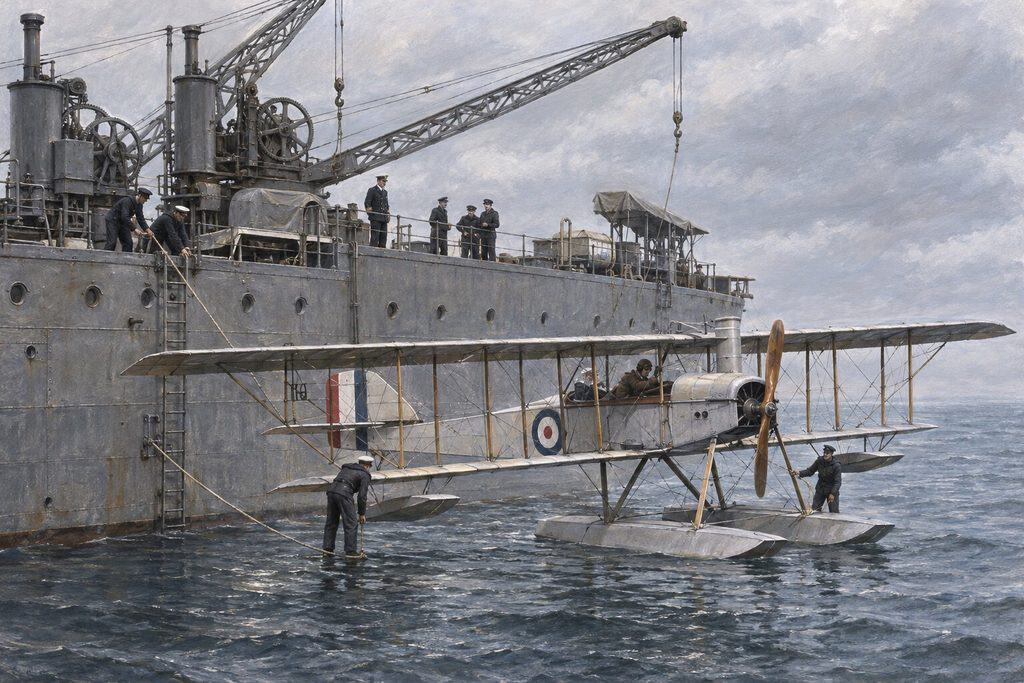
The water also formed part of the flying problem. A seaplane’s ability to alight near a supporting ship depended on conditions at the surface. Recovery required handling equipment, time and cooperation between ship and aircraft crews. A successful flight could therefore end with an awkward or dangerous operation alongside a vessel. Launch and recovery arrangements influenced where the ship could go and how freely it could manoeuvre.
The Battle of Heligoland Bight in August 1914 demonstrated the importance of the approaches to German bases within the naval contest. It was a surface action, occurring years before the RAF existed. The developing air service’s connection to that geography lay in its search for ways to observe and strike across it. German airship stations offered particularly attractive targets: damage inflicted ashore might reduce the enemy’s ability to scout or raid over a much larger area. Bringing aircraft within reach of those stations became an early test of ship-supported aviation.
Cuxhaven: The Christmas Raid And Its Limits
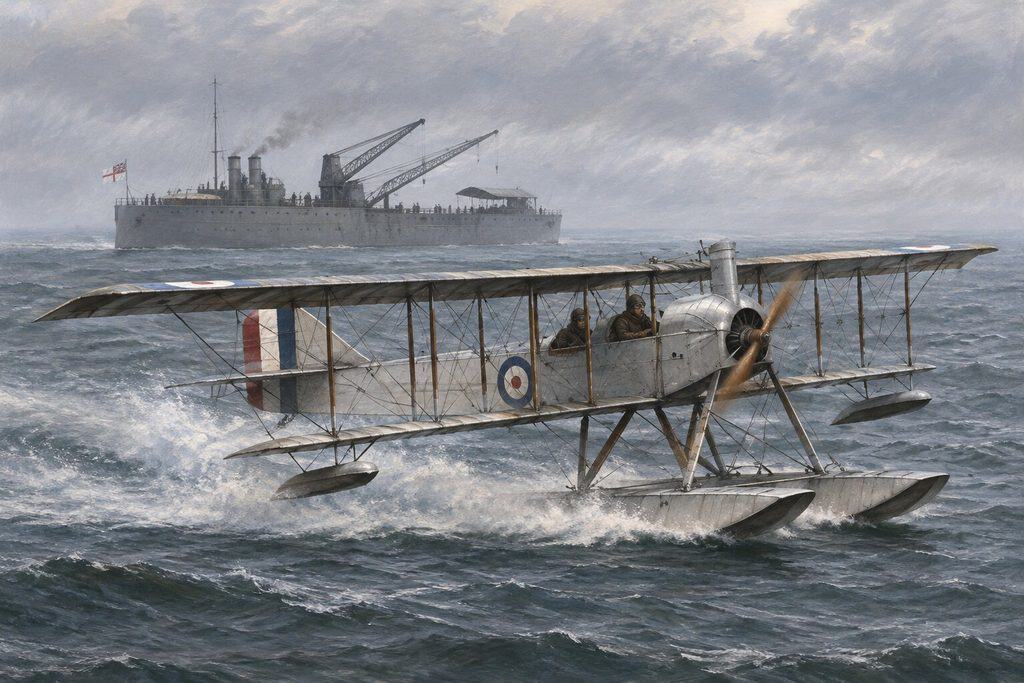
On 25 December 1914, HMS Empress, HMS Riviera and HMS Engadine supported an attack against targets around Cuxhaven, including German Zeppelin facilities. Nine floatplanes were prepared, of which seven got airborne. The operation carried naval aviation beyond coastal observation and into an offensive mission against infrastructure supporting the enemy’s air effort.
Its basic method reflected the equipment available. These were seaplane carriers transporting aircraft that would take off from the water. The ships brought the machines closer to their objectives and provided the means of putting them into the sea. Aircraft range could thereby be applied to the attack itself, instead of being consumed entirely by the journey from a British shore station. The accompanying naval operation was integral to the air attack from its beginning.
Launching from the water created a demanding sequence. The aircraft had to be handled over the side, prepared and sent away while the vessels operated in a potentially hostile area. Launch and recovery required the carriers to stop, restricting the freedom of movement that normally helped protect a ship. The longer these activities took, the greater the difficulty of keeping the supporting force secure. An air mission’s practical cost therefore included the exposure of the vessels that made it possible.
Once airborne, the crews encountered conditions that reduced the effectiveness of their attack. Fog and weather complicated navigation and the search for targets. Limited bomb effectiveness further restricted the damage they could achieve. The Zeppelin facilities represented a clear strategic objective, but carrying an aircraft towards the German coast did not guarantee that its crew could identify and damage the intended target. The chain from transport to launch, navigation and bombing remained fragile.
No German airship was destroyed. Only three aircraft returned to the carriers, although all the crews survived. Those outcomes show both the reach gained through naval support and the difficulty of recovering the flying force after an operation. Aircraft survival, crew survival and target destruction were distinct measures of success. The raid could demonstrate a new operational possibility while delivering little of its intended destructive result.
Cuxhaven also belongs to a specific stage in the history of aircraft at sea. Its floatplanes used the water as their runway. Later operations with wheeled aircraft taking off from a ship’s deck involved different launch arrangements and different recovery problems. Treating the Christmas raid and the later Tondern strike as interchangeable carrier attacks obscures what changed between them. The experiments addressed a common need for offensive reach through different technical solutions.
The immediate lesson was that ship-supported aviation could threaten installations beyond the ordinary reach of shore-based aircraft. Its limitations were equally important. Weather could frustrate target identification, small aircraft could deliver only limited striking power, and the supporting fleet had to accommodate every stage of the flying operation. In subsequent North Sea operations, the same interdependence would appear in a task whose principal objective was information: reconnaissance for a fleet approaching battle.

Jutland And The Fleet’s Airborne Eyes
At Jutland on 31 May 1916, the fleet’s need for timely information exposed the gap between carrying an aircraft to sea and integrating its observations into command decisions. A reconnaissance report had value only if it reached the right commander soon enough to influence movements. Aircraft could widen the area under observation, but their reports still had to pass through a naval communications system operating during a fast-moving engagement.
HMS Campania’s absence reduced the British air resources available. She missed the Grand Fleet’s sailing, set out later and was recalled. Her experience demonstrated an elementary requirement of fleet aviation: the supporting vessel had to be in company and in position when its aircraft were needed. A capability that existed on the service’s books could contribute nothing if the carrier failed to reach the relevant operational setting.
HMS Engadine did launch a Short seaplane. Its crew, Flight Sub-Lieutenant Frederick Rutland and Assistant Paymaster G S Trewin, observed German battlecruiser movements and transmitted three wireless messages to their ship. The flight established that an aircraft could locate useful information during the battle and report it by wireless. The failure came in the onward passage of that information. Engadine could not relay the intelligence effectively to those who needed it across the fleet.
This distinction is important when assessing the flight. Rutland and Trewin’s observation was a genuine reconnaissance achievement. It did not become successful fleet-wide aerial direction. The aircraft’s view, the receiving ship’s knowledge and the commander’s operational picture remained separated by a broken reporting chain. Better observation alone could not resolve that weakness.
Fleet manoeuvre made the problem more demanding. Ships changed position while the aircraft was launching, searching or transmitting. Information could lose relevance during a delay, and a report needed sufficient clarity to be understood alongside other sightings. The launch itself took time and constrained the supporting ship. A commander therefore had to balance the prospective value of an aerial search against the immediate demands of keeping ships in their assigned positions.
German Zeppelins offered a different means of obtaining a wide view, but they too faced difficulties in providing dependable reconnaissance. Weather and visibility affected what could be seen, while observations still required interpretation and communication. Their existence did not give the German fleet an automatically complete picture of British movements. Neither side possessed an airborne system capable of removing uncertainty from the battle.
Jutland consequently revealed an organisational problem alongside a technical one. A useful aircraft required suitable operating arrangements, a reporting route and a commander able to exploit the result. These elements had to function together. An isolated success by an aircrew could otherwise leave the naval situation largely unchanged.
The North Sea’s expanding air effort would increasingly pursue longer-range reconnaissance and more regular patrols. Those developments offered more opportunities to locate an enemy, but Jutland’s communications lesson remained relevant. Whether the contact was a battlecruiser, a submarine or an airship, a sighting had to become an intelligible report and lead to an appropriate response. The next major maritime crisis made that requirement part of a sustained daily campaign.
The U-Boat Crisis And The Felixstowe Patrols
Germany’s intensified unrestricted submarine campaign in February 1917 made the protection of merchant shipping an urgent operational problem. The submarine threatened Britain’s maritime communications across an extensive area. Air operations formed one part of the response, alongside surface patrols and the introduction of convoys from May. Bringing merchant ships together under protection changed the defensive problem at sea; aircraft could help search surrounding waters and interfere with a submarine’s approach.
Different aerial platforms offered different advantages. Shore-based aircraft could cover accessible sea areas, while flying boats combined useful endurance with the ability to operate from the water. British non-rigid airships could remain on patrol for long periods. Tethered kite balloons gave ships an elevated lookout and a visible sign of surveillance. These methods complemented the work of escorts, each contributing observation or deterrence within its own limits.
At Felixstowe, Commander John Cyril Porte and his team addressed the flying boat’s suitability for sustained maritime work. The Curtiss H.12 Large America entered RNAS service in 1917. The RAF Museum describes its endurance as roughly six hours, offering time for a useful search beyond the immediate coast. The Felixstowe F.2A joined in November, incorporating improved hull design. Seaworthiness mattered because a patrol aircraft had to leave the water safely and might have to return to it under difficult conditions. Better hulls widened practical possibilities without making sea state irrelevant.
In April 1917, the Spider Web introduced a systematic patrol grid centred on the North Hinder Light Vessel. It covered roughly 4,000 square miles of the southern North Sea. Its location is important: these patrols addressed submarine traffic farther west than the Heligoland Bight. Their value lay in organising a repeatable search across an area through which U-boats might pass.
A surfaced submarine offered aircrew a chance to observe, report and attack. The opportunity could be brief. Once the submarine submerged, an aircraft might lose both its target and any reliable means of judging the result of an attack. A forced dive could still disrupt the submarine’s movement or preparations, even when no destruction followed. That effect depended on where and when the encounter occurred, especially in relation to threatened shipping.
The patrol itself imposed continuous demands. Navigation had to keep the aircraft within the intended search area. Crew observation had to remain effective over hours of flying above a surface that concealed small targets. Engines, fuel and changing weather determined how much time remained available. German seaplanes added an aerial opponent to the dangers of the maritime environment. Maintaining a patrol system required serviceable aircraft and rested, trained crews as well as a sound plan on a chart.
Claims of destruction require particular care. The RAF Museum records 23 U-boat attacks by North Sea flying boats in 1917 and at least 18 in 1918. Six wartime sinking claims were unconfirmed by post-war German records. The confirmed aircraft sinking of UB 32 discussed in the RAF Historical Society’s maritime study belongs to the Western Approaches and Tresco account, outside the Spider Web campaign.
These results leave room for a measured assessment of patrol value. Reconnaissance and the disruption of surfaced submarine activity could assist protection without producing verified sinkings. Equally, extensive flying did not prove that a particular search scheme was the best use of aircraft. The RAF Historical Society’s study questions whether Spider Web was as productive as convoy escort. The contrast draws attention to the central operational choice: aircraft could search for submarines across an area or concentrate their presence around the ships most in need of protection. Convoys remained crucial to the wider defensive response.
Reaching The Bight With Towed Lighters
The flying boat’s growing usefulness in the southern North Sea left a range problem farther east. Aircraft based in eastern England could not comfortably devote long periods to operations over the German Bight. Fuel spent reaching the area reduced the time available for reconnaissance or cooperation with ships. A longer flight also increased exposure to mechanical trouble and weather before the useful part of the mission had begun.
Porte’s proposal for towed seaplane lighters transferred part of the journey to naval vessels. A lighter could carry a flying boat out to sea behind a towing ship. Ballast tanks allowed the lighter to be partially submerged so that the aircraft could float off. The method promised to place a fuelled aircraft closer to its patrol area, extending operational reach without requiring the entire outward passage to be flown.
The first operational lighter patrol took place on 19 March 1918. Curtiss H.12 8677 and Felixstowe F.2As N4282 and N4513 were towed towards the area near Texel. A second patrol followed on 21 March. Both were RNAS operations, preceding the formation of the RAF on 1 April. Their chronology demonstrates how much of the new service’s maritime practice had already been developed through naval flying.
The March operation also exposed the demands of keeping a flying boat functioning far from home. Norman Magor’s N4282 suffered an engine failure after a skirmish with German seaplanes. Leading Mechanic Sydney Anderson repaired the engine while airborne, an action for which he received the Distinguished Service Medal. The episode gives a concrete human dimension to the range problem. An aircraft carried towards distant waters still depended on its machinery and crew to complete the flight and return.
Lighters shifted the point at which flight began, but they added another layer of sea-air coordination. Towing vessels had to bring their loads into position. The aircraft had to be released and launched in usable conditions. Ships and aircraft then needed to fulfil compatible tasks despite differences in speed, endurance and freedom of movement. Minefields and German reconnaissance complicated operations near the enemy’s defended approaches, while destroyers supporting the tow remained naval assets with their own exposure and responsibilities.
On 29 June 1918, flying boats carried on lighters were intended to support Royal Navy coastal motor boats attacking in the Bight. The small craft needed aerial protection during a venture into waters where German aircraft could locate and attack them. Air cover was therefore part of the operation’s practical security. Rough seas undermined the launch arrangements and the availability of the promised protection.
Only one of the three flying boats, Felixstowe F.2A N4393 flown by Lieutenant Harold Boulding, succeeded in taking off. One of the others was damaged so badly during its attempted departure that it sank, while the third abandoned further attempts after sustaining damage. Boulding completed his reconnaissance patrol, but an engine failure subsequently forced him to land on the water. N4393 was badly damaged and sank, although Boulding and his crew were rescued by a Dutch trawler and later transferred to a British destroyer.
The failure revealed the importance of a shared operating window. Conditions acceptable for the passage of a towing vessel might still prevent a flying boat from taking off. A plan could bring ships, crews and aircraft to the intended area yet fail at the transition from transport to flight. The closer the motor boats’ security depended on the aircraft, the more serious that break became.
By the summer of 1918, the lighter had therefore demonstrated both reach and vulnerability. It offered a resourceful response to the distance between British bases and the German Bight. It also made combined operations dependent on a sequence of actions that the sea could interrupt. The later lighter missions would produce an exceptional individual air victory while confirming the wider difficulty of making every component work together.
The Airship Contest And The Naval Strike
German naval Zeppelins served as scouts as well as instruments of attack. Their ability to range over the sea made them relevant to fleet movements and British operations near the German coast. Their bases were therefore strategically important beyond the individual raids launched from them. Destroying an airship could remove an observer from the maritime contest; attacking its station offered the possibility of damaging that capability before it took flight.
British lighter-than-air operations followed a different pattern. Non-rigid patrol airships supported surveillance and convoy protection, while kite balloons remained tethered to their supporting vessels. The North Sea-class non-rigid airship could routinely remain out for about twenty hours, according to the RAF Historical Society’s maritime study. Such endurance offered persistence that an aeroplane patrol could struggle to match. These British patrol craft should be distinguished from Germany’s rigid Zeppelins in both construction and employment.
The Tondern raid on 19 July 1918 brought wheeled fighters into a ship-supported attack against German airship infrastructure. Seven Sopwith 2F.1 Camels flew from HMS Furious against the base, destroying Zeppelins L54 and L60. The result supplied the destructive effect that the Cuxhaven operation had failed to achieve against German airships in 1914.
Tondern was a Royal Navy carrier operation conducted in the RAF era. The service’s formation had changed the institutional identity of British military aviation, while naval support and operational cooperation remained essential. Furious brought the aircraft within reach and provided their take-off platform. The attack therefore belongs to the history of naval aviation and the RAF’s first wartime year together. Its success should not be turned into a claim that the aircraft landed back aboard Furious after completing the strike.
A different launch experiment produced another airship victory during the operation of 10–11 August. Lieutenant Stuart Culley took off in Sopwith Camel N6812 from a lighter and destroyed Zeppelin L53. He subsequently ditched and was recovered near HMS Redoubt. His flight demonstrated how a fighter could be carried to an operational area beyond the reach offered by a normal departure from shore.
The wider mission fared badly. The accompanying flying boats could not take off, leaving the intended combined operation without an important part of its air support. Six British coastal motor boats were lost or disabled in German air attacks. Culley’s destruction of L53 was a substantial tactical success within an unsuccessful operation. Keeping both outcomes in view prevents the fighter action from concealing the vulnerability of the force it accompanied.
L53 was also a separate loss from L70, destroyed during another German raid on 5 August. The proximity of the events can blur their identities, but their circumstances and airships were distinct. Accurate assessment of the campaign depends on retaining those distinctions instead of merging several engagements into one story of victory.
The final lighter sortie attempt, on 24 October 1918, was abandoned because of weather and sea conditions. By then, deck and lighter launches had shown that fighters could reach and destroy important targets. The experience of the flying boats and motor boats showed the continuing limits of that achievement. Offensive reach had expanded considerably since 1914, while the ability to provide reliable, coordinated air power over the sea remained uneven.
The Maritime Service The RAF Inherited
The formation of the RAF on 1 April 1918 brought together the Royal Flying Corps and Royal Naval Air Service. At sea, the merger transferred an existing body of work into the new organisation. Stations, aircrew, aircraft and patrol routines had already been shaped by years of operations. The RAF’s maritime inheritance included accumulated experience of failure as well as equipment and demonstrated successes.
Felixstowe’s flying-boat work was one important part of that inheritance. Hull research, longer-range aircraft and systematic searches had made sustained offshore patrol more practicable. These activities required a shore organisation capable of preparing aircraft repeatedly, maintaining engines and supporting crews. The aircraft seen over the North Sea represented the visible portion of a continuing effort at their bases. Reliability and regular availability mattered because maritime protection depended on recurring coverage.
The Felixstowe War Flight’s recorded activity gives that effort a defined scale. The RAF Historical Society’s study lists 1,073 patrols and 3,349 flying hours by the end of October 1918, with 28 flying boats lost. These are figures for a particular unit and reporting period. They should not be extended into totals for all British maritime aviation. Within their proper scope, they show the weight of sustained operations behind individual episodes such as the lighter patrols.
The new service also inherited several different relationships with the Navy. Aircraft at shore stations searched areas important to naval operations. Airships and balloons contributed observation around shipping. Carrier aircraft and lighter-borne machines depended directly on vessels for transport or launch. Each arrangement required officers and crews to coordinate across service responsibilities. The merger did not remove the need for naval expertise or give aircraft independent control of the maritime campaign.
Reporting remained central. Jutland had demonstrated the consequences of information failing to move beyond the ship receiving it. Anti-submarine operations required aircrew to report contacts usefully and distinguish a sighting from an attack or a claimed sinking. Lighter operations demanded agreement about where aircraft would become available and what they would support. These were different applications of the same practical requirement: air activity needed a dependable connection to action at sea.
There were clear limits to the inherited force. Weather could close a patrol area or prevent launch. German aircraft could contest British operations. A submarine could submerge, and an aircraft’s departure left a gap unless another means of protection remained. Convoys and surface escorts continued to provide essential security. The RAF entered maritime warfare with useful capabilities, but without an aerial solution to the submarine campaign or a guarantee of uninterrupted reconnaissance.
By the Armistice, British maritime aviation nevertheless possessed a recognisable range of functions. It could search, report, deter, escort in suitable circumstances and attack selected targets. The organisation performing that work in 1918 was not the later Coastal Command. Its historical importance lies in the operational experience passed from the RNAS into the RAF, including a detailed understanding of how air power at sea depended on ships, bases and conditions beyond the aircraft itself.
Conclusion
The North Sea air war turned pre-war possibilities into a working, if uneven, maritime capability. Cuxhaven demonstrated ship-supported reach, Jutland exposed a reporting failure, and the flying-boat patrols brought sustained aerial observation to a defined sea area. By 1918, British aircraft could attack airship bases and operate from improvised launch arrangements far from their home stations. The cost and uncertainty of those operations remained considerable.
The RAF inherited this experience during a war already in progress. Its maritime foundations were built by the RNAS through cooperation with the Royal Navy, technical work at stations such as Felixstowe and repeated operational trials. The lasting achievement was a broader ability to see and act over the sea. It depended on patrol routines, serviceable machines, trained crews and information reaching naval commanders in time. Those practical requirements, established through the North Sea campaign, gave the new service both a maritime role and a clear account of its limits.