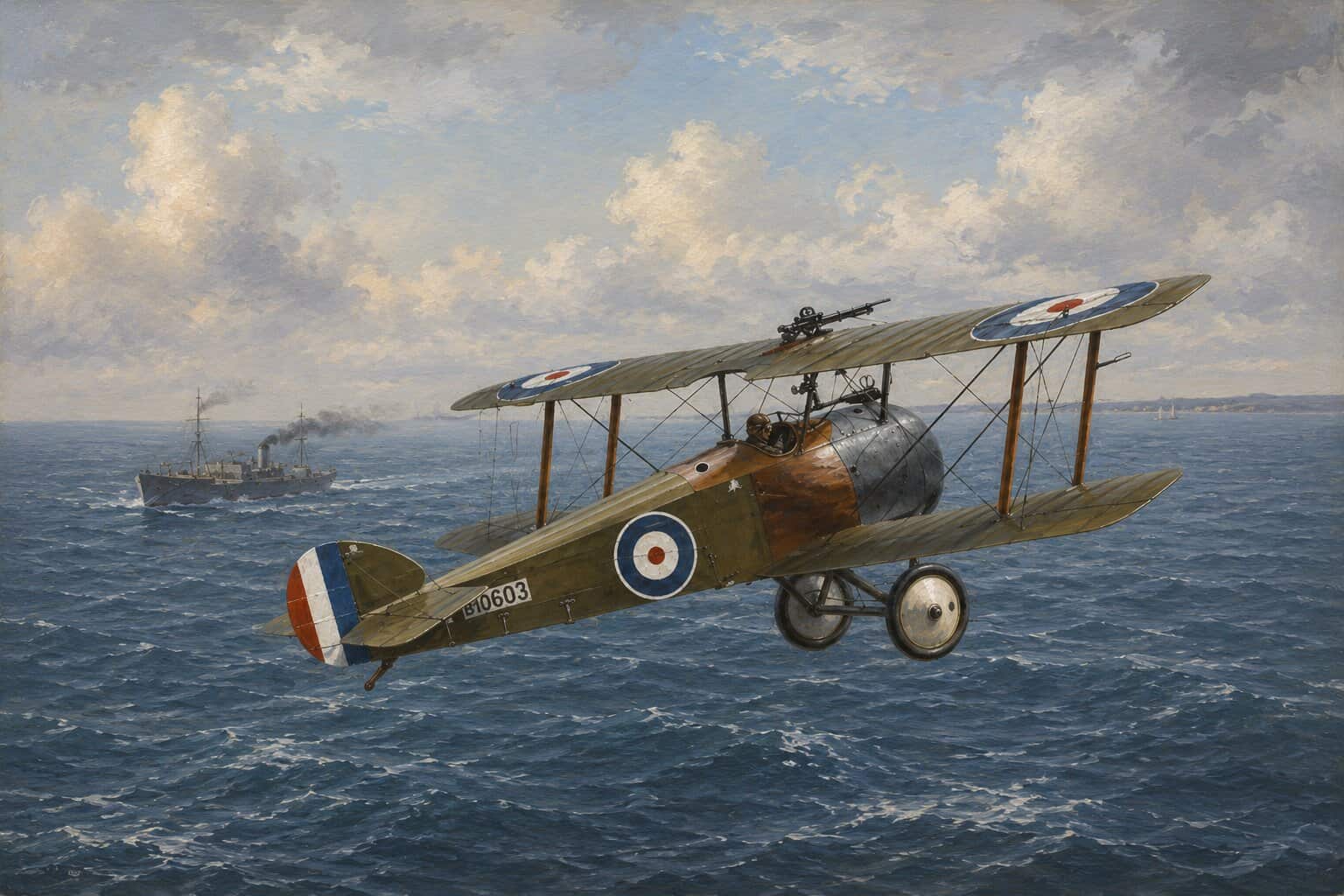
On 19 July 1918, Sopwith Camels launched from HMS Furious carried out the first carrier-borne air strike against a land target, attacking the German airship sheds at Tondern and destroying Zeppelins L54 and L60. The raid was a pioneering moment in naval and air history alike. It proved that an aircraft carrier could project striking power ashore rather than simply serving as a platform for reconnaissance or local fleet support.
A new kind of reach from the sea
The significance of the Tondern attack lay in the method as much as in the damage caused. Aircraft had already shown their military value in reconnaissance, artillery spotting and tactical attack, but launching them from a carrier to strike a fixed objective on land represented a new level of operational reach. The sea no longer had to be merely a barrier between the attacker and the target. It could become the launching ground for offensive air action. That idea would profoundly shape the twentieth century. In 1918, it was still experimental and uncertain, dependent on courage, navigation and technical improvisation. The crews that flew from HMS Furious were operating on the frontier of what air power could become.
Why the airship sheds mattered
Tondern was chosen because the sheds housed German airships that represented a real strategic concern. Zeppelins had been used for reconnaissance and bombing, and they retained military value even as aeroplanes advanced rapidly. Destroying airships on the ground was far more efficient than trying to fight them after launch. The raid combined innovation with clear military logic: strike the vulnerable infrastructure that enabled future operations. The destruction of L54 and L60 yielded concrete results for the attack, but the raid's broader significance extended beyond the loss of two airships. It showed that carefully planned sea-based aviation could strike strategically relevant inland targets. That was a major conceptual step in the evolution of maritime air power.
Carriers, aircraft and the future of war
The Sopwith Camel is most famous as a First World War fighter, yet at Tondern it helped demonstrate something larger than the qualities of any single aircraft type. The raid suggested that carriers could serve as mobile air bases, able to move strike aircraft into positions that would otherwise be difficult to reach. In later decades, that principle would become central to naval warfare. For readers of RAF history, the date also has another resonance. The RAF itself had only recently been created in April 1918, and the Tondern raid belongs to the same era in which British air power was being reimagined on a national scale. Although the operation was a naval initiative, it forms part of the broader story of how Britain learned to think about aviation as an instrument of strategic reach.
A landmark in air power history
The first carrier-borne air strike deserves remembrance because it marks the meeting point of imagination, technology and operational purpose. The attack on Tondern was not merely a colourful first. It foreshadowed an entire way of war in which carriers could deliver air attacks far from home bases and outside the immediate range of land forces. On 19 July 1918, the destruction of the Zeppelins at Tondern revealed what carrier aviation might become long before that future was fully understood. HMS Furious and its Sopwith Camels had demonstrated that sea power could carry offensive air action directly to a shore target, a principle that would shape maritime warfare for the rest of the century.