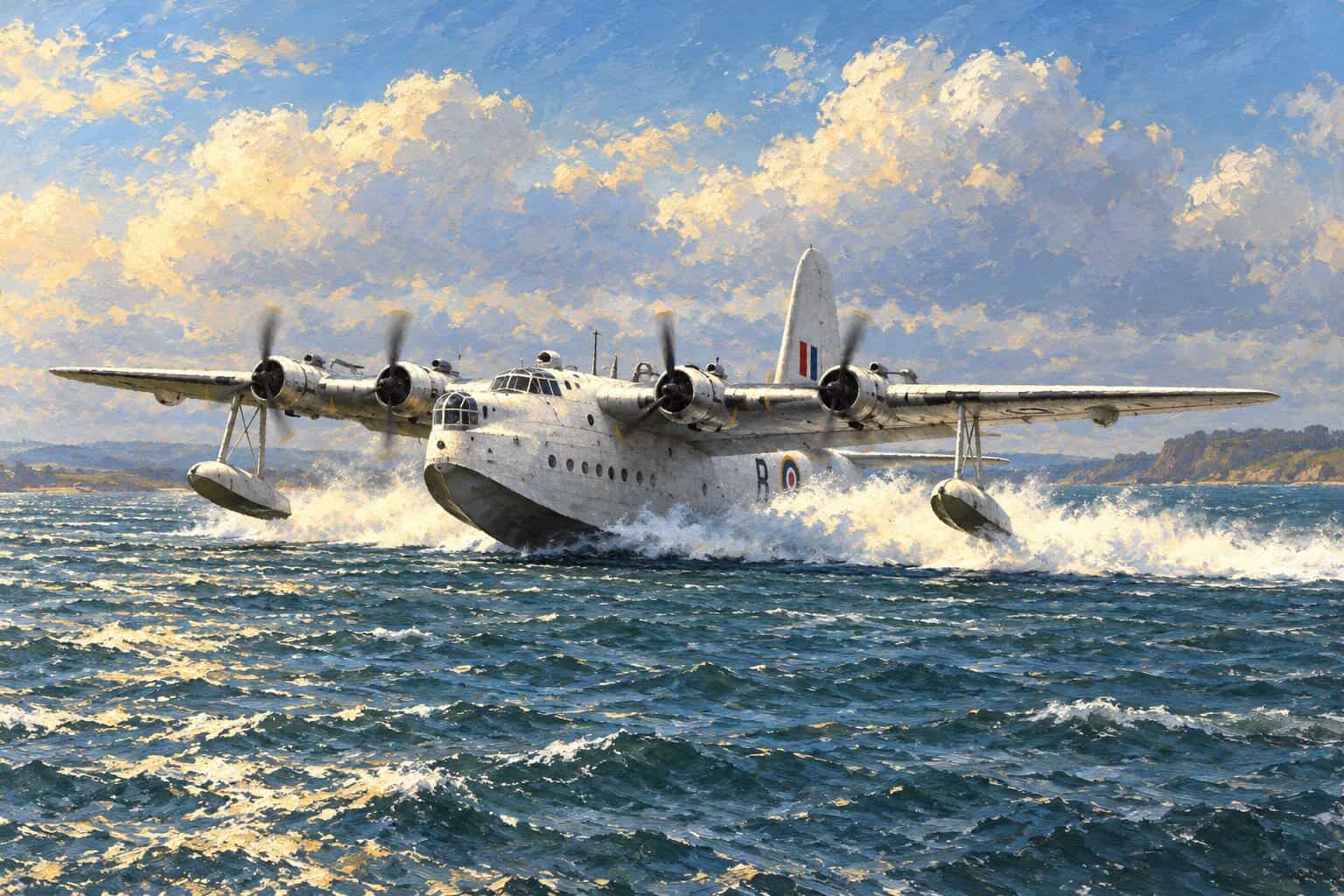
For much of the RAF’s early history, a stretch of sheltered water could offer something that a distant airfield could not: a practical base for a large aircraft carrying enough fuel to remain over the sea for hours. Flying boats connected Britain’s maritime commitments with the geography of its overseas stations. Their hulls were part of a considered operational choice, supported by decades of experience in reconnaissance, navigation and long-distance flying.
The choice produced aircraft of lasting importance. The Supermarine Southampton demonstrated the reach of inter-war maritime aviation. The Short Sunderland became a mainstay of wartime ocean patrol, while the Consolidated Catalina extended the flying boat’s contribution across widely separated theatres. After 1945, Sunderlands carried supplies into blockaded Berlin and flew maritime missions during the Korean War. Their usefulness survived the conflict that had brought them their greatest prominence.
Yet by 1959 the RAF’s flying-boat era had ended. The maritime task remained, but new aircraft, better airfields and changing operational requirements had altered the advantages of operating from water. Understanding that transition requires attention to the shore as well as the aircraft: the slipways, servicing facilities, fuel supplies and sheltered anchorages which made flying possible. The flying boat had answered a particular combination of distance, infrastructure and maritime need. Its retirement followed the gradual disappearance of that combination, while the demand for long-range surveillance over the oceans continued to grow.
From Naval Aviation to an RAF Flying-Boat Tradition
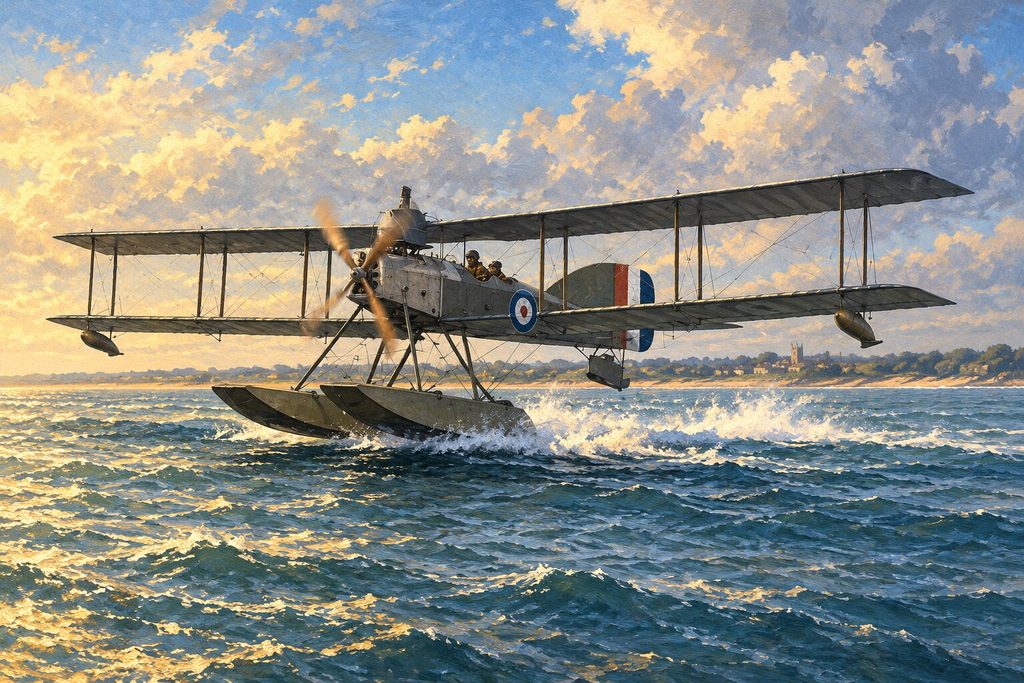
When the RAF was formed in 1918, it inherited the Royal Naval Air Service’s experience of operating aircraft above and upon the sea. Wartime flying boats associated with Felixstowe had already established their value in maritime reconnaissance and anti-submarine work. They belonged to a wider naval aviation system in which aircraft extended the observation available to surface forces and searched waters that ships alone could cover only slowly.
A flying boat carried its occupants and equipment within a hull designed to float and to withstand the forces of taking off and alighting. This distinguished it from a floatplane, whose separate floats supported a more conventional fuselage. For larger maritime aircraft, the boat hull offered a way of combining a substantial internal volume with water operation. The shape also imposed compromises: it had to function efficiently enough in flight while remaining seaworthy on the surface.
The attraction was especially clear where suitable aerodromes were scarce. A harbour or sheltered inlet could provide a landing area for an aircraft whose size and weight would demand considerable preparation on land. Britain possessed ports and maritime connections across its imperial network, and flying boats could make use of that geography. Reconnaissance aircraft could be positioned near shipping routes, naval facilities and the approaches they were expected to watch.
Such access depended on preparation. Fuel had to reach the anchorage, crews and stores required accommodation, and boats were needed to move personnel and equipment between aircraft and shore. Moorings, slipways and facilities for inspection and repair were essential to sustained operations. An aircraft able to alight at a remote inlet could still be stranded there by a mechanical defect for which no suitable support existed.
Water conditions imposed another set of limits. Shelter from ocean swell did not guarantee an easy take-off, and wind, waves, currents and local obstructions all required judgement. An aircraft on a mooring remained exposed to weather. Hull damage and the effects of salt water created maintenance demands absent from an inland grass aerodrome. Flying-boat crews needed practical seamanship as well as airmanship, while their ground organisations included skills and equipment peculiar to marine operation.
The RAF therefore inherited a specialised means of sustaining air power over maritime spaces. The central operational benefit lay in bringing an aircraft with useful endurance to places where water access was easier to arrange than a large aerodrome. During the inter-war years, improvements in engines, structures and reliability made that proposition more convincing. The requirement was enduring: to search distant waters, report what was found and maintain a presence across long sea routes.

The Inter-War Flying Boat Comes of Age
The Supermarine Southampton entered RAF service in August 1925. Its success gave the service an aircraft capable of demonstrating that long-distance maritime aviation could become a repeatable activity. Reliability mattered intensely when routes crossed regions with limited engineering support. Every defect carried the possibility of a prolonged interruption far from the aircraft’s home station.
The Southampton also marked an important change in construction. Early aircraft had wooden hulls, but the advantages of metal construction persuaded the RAF to adopt metal-hulled versions. A rebuilding programme for surviving wooden-hulled aircraft began in 1929. The change addressed a practical operating problem: maintaining a large wooden structure in prolonged contact with water was burdensome, particularly when aircraft were deployed far from major repair facilities.
The Far East Flight made the aircraft’s capabilities conspicuous. Four Southamptons undertook their celebrated cruise in 1927–28, travelling from Felixstowe through the Mediterranean and India to Singapore. The achievement depended upon navigation, organisation and servicing across a chain of stops. Its importance extended beyond the mileage recorded. A formation of large aircraft had demonstrated that the RAF could connect widely separated maritime stations with a degree of reliability that made future deployments more credible.
These journeys also accumulated operational knowledge. Routes had to be assessed through the availability of fuel, shelter and repair arrangements as well as distance on a map. The choice of a stopping place affected how quickly aircraft could be turned round and how well they could survive an enforced delay. Long-distance flying helped expose weaknesses in both the machines and the arrangements that supported them.
For Britain’s overseas commitments, this was a persuasive combination. Flying boats could provide reconnaissance near naval bases, maintain contact along coastal routes and move between regions linked by the empire’s maritime infrastructure. Their presence also served the inter-war practice of demonstrating British military reach. The distinction between a cruise and a useful operational rehearsal could be narrow when both required the same skills of navigation, deployment and distant maintenance.
Civil flying-boat development formed part of the surrounding aviation world. Imperial Airways sought dependable long-distance links between widely separated destinations, and British manufacturers gained experience of large water-based aircraft through that demand. Military requirements added armament, reconnaissance equipment and the burden of sustained patrol. The RAF needed aircraft capable of remaining useful after a long transit, with crews able to search and report effectively.
By the later 1930s, the large monoplane flying boat promised greater capability than the earlier biplanes. The Sunderland drew on Short’s experience of large flying boats, with its design shaped by the military maritime requirement. Its arrival brought the RAF a more modern patrol aircraft just as European tension was turning the protection of sea communications into an urgent wartime requirement.

War Makes the Sunderland Essential
The Short Sunderland entered service in June 1938. When war began the following year, the RAF had only three Sunderland-equipped squadrons, but the type would become central to Britain’s flying-boat effort. Its four engines, internal capacity and endurance suited the demanding task of keeping watch over ocean approaches. Defensive gun positions offered protection on patrols that could carry it beyond friendly fighter cover.
Coastal Command‘s problem was one of area and time. Convoys moved through vast spaces, while submarines could exploit gaps between patrols. An aircraft had to reach the assigned waters, spend enough time searching to make the journey worthwhile and return with a safe fuel reserve. Endurance only became operationally valuable when it produced useful time over the shipping lanes. Hours consumed by the outward and homeward flights could sharply reduce the protection available to a convoy.
A Sunderland patrol consequently involved much more than finding and attacking a submarine. Crews watched for shipping, investigated sightings, maintained navigation over water and passed reports that could help naval forces act. Weather could conceal both friendly vessels and the enemy. Cloud, poor visibility and the changing appearance of the sea complicated observation. The long hours of searching placed considerable demands on concentration and coordination within the crew.
Anti-submarine patrol could achieve useful results without a sinking. The appearance of an aircraft might compel a U-boat to dive, restricting its movement and disrupting its approach to a convoy. A sighting report could redirect escort vessels or prompt further searches. Aircraft and ships contributed different strengths to the same struggle: aircraft searched quickly across wide areas, while surface escorts could remain with a convoy and continue a contact after the patrol aircraft had to return.
The Consolidated Catalina broadened this effort. Its long endurance made it valuable for maritime reconnaissance and patrol, and RAF use of an American design reflected the scale of demand. A Catalina of No. 209 Squadron rediscovered the German battleship Bismarck on 26 May 1941 after British surface forces had lost contact. The sighting helped restore the information needed to continue the pursuit. It demonstrated the strategic importance of locating a surface raider, an aspect of maritime reconnaissance that could be overshadowed by the submarine war. Sunderland and Catalina operations formed part of a larger force which also included land-based patrol aircraft.
Radar changed the patrol aircraft’s possibilities. Air-to-surface-vessel radar, generally known as ASV, helped crews detect shipping when visual searching was restricted. An early Sunderland received ASV equipment during the initial introduction of maritime-search radar in 1940. Subsequent equipment and tactical improvements made electronic detection increasingly important to the maritime air war. Finding a contact still required interpretation, accurate navigation and effective communication if detection was to lead to action.
New equipment also added work inside the aircraft and in its supporting organisation. Operators needed training, sets required maintenance, and reports had to be integrated with the crew’s other observations. The marine environment remained demanding for an aircraft carrying sensitive equipment. Salt-water exposure, moisture and the need to work around an aircraft afloat complicated the broader task of keeping a patrol force serviceable.
The Sunderland’s reputation was earned within this sustained effort. Individual combats and dramatic rescues attracted attention, but repeated patrols carried the greater operational burden. Fuel, crews, maintenance and intelligence all had to be available day after day. The flying boat remained valuable because it could contribute to that persistent presence over the sea, where success depended upon denying the enemy predictable freedom of movement.
More Than the Atlantic
The Atlantic struggle gives only part of the wartime flying-boat story. Britain’s maritime air commitments extended into the Mediterranean and the Far East, where distances, fragmented coastlines and uneven airfield provision created different combinations of difficulty. The same capacity to operate from suitable water could support reconnaissance, transport and evacuation as circumstances demanded.
The Norwegian campaign of 1940 exposed the relationship between geography and access particularly clearly. Long coastlines and fjords offered sheltered water close to areas where the Allies struggled to establish and sustain effective air operations. Sunderlands contributed to the campaign’s reconnaissance and transport work. Water access gave commanders options, but these existed within a wider situation of German air pressure and inadequate Allied control of the skies.
A flying boat bringing personnel into or out of a threatened area still required enough time to approach, alight and complete its task. Loading through an aircraft’s entrances and transferring passengers from small craft were physical operations vulnerable to weather and attack. A sheltered anchorage could ease the marine problem while leaving the aircraft exposed from above. The usefulness of a fjord depended on the tactical situation as well as its suitability for landing.
In the Mediterranean, the struggle to protect sea communications brought flying boats into direct combat with submarines. On 1 August 1941, a Sunderland of No. 230 Squadron attacked the Italian submarine Delfino in the Gulf of Sollum. The aircraft dropped six depth charges, but machine-gun fire from the submarine brought it down. Eight of its twelve crew members died; Delfino rescued the four survivors. The encounter exposed the danger of the final approach against a surfaced opponent. Endurance and searching ability could bring an aircraft into contact, but attacking demanded a close engagement in which the submarine could fight back.
In the Far East, reconnaissance became urgent as Japanese invasion forces approached Malaya. On 7 December 1941, Catalinas of No. 205 Squadron operating from Seletar searched for Japanese invasion shipping in the Gulf of Siam. One aircraft, flown by Flying Officer P. E. Bedell, was lost to Japanese fighters while carrying out the reconnaissance mission. The episode showed the exposure of maritime patrol aircraft operating without secure control of the air. Their reports were needed precisely where hostile forces were concentrating. As the Japanese advance subsequently overran Allied bases, the RAF also lost facilities upon which its patrol organisation depended. The geography that favoured water operation offered no protection against the collapse of the wider defensive position.
Rescue was another valuable possibility, subject to strict limits. The ability to alight near survivors could be decisive in suitable conditions. Open-ocean swell could make landing too dangerous, however, even when the aircraft could find the people who needed help. Crews might have to report a position or assist from the air. The flying boat’s versatility came from the options its hull provided, with the condition of the sea determining which of those options could safely be exercised.
Berlin, Korea and the Post-War Case for Flying Boats
Victory in 1945 left the RAF with proven flying boats, experienced crews and established marine bases. Their continued employment reflected genuine operational utility. Aircraft retirement would depend on the availability of alternatives and on the tasks assigned to the remaining force, while post-war crises could make unexpected demands upon existing capabilities.
The Berlin Airlift supplied a striking example. In 1948, the Soviet blockade made the Western sectors dependent upon supplies brought by air. Sunderlands joined the operation, using the Havel waters in Berlin as their destination. The city’s waterways offered an additional point of entry alongside the land aerodromes on which the main airlift depended. Aircraft designed for maritime patrol could thus contribute to sustaining a city deep inside continental Europe.
The RAF Museum records 4,920 tonnes of freight carried by Sunderlands during the airlift, a useful supplement to the much larger flow of supplies through Berlin’s land aerodromes. That contribution was modest beside the entire operation, but it represented useful additional carrying capacity during a demanding emergency. It also showed how a feature acquired for one military purpose could serve another. A hull intended to support maritime operations allowed freight to arrive by a route that conventional transports could not use.
Waterborne delivery retained its own handling requirements. Cargo had to be moved between aircraft and shore, and suitable conditions were needed at both ends of the flight. The Sunderland’s contribution depended upon a workable chain of loading, flying, unloading and servicing. Berlin therefore demonstrated a specific advantage of water access without establishing the flying boat as a universal answer to the transport problem.
The Korean War gave Sunderlands a different post-war role. Operating from Iwakuni in Japan, Sunderlands of Nos. 88, 205 and 209 Squadrons contributed through rotating detachments in support of United Nations naval operations. Their tasks included maritime patrol, weather reconnaissance and transport within the wider United Nations effort. The arrangement linked the RAF’s Far Eastern flying-boat force with an allied maritime campaign in which naval movements and coastal waters required continuing surveillance.
The scale was substantial. RAF Museum figures record nearly 900 operational sorties and more than 13,350 flying hours by Japan-based Sunderlands during the war. Those totals capture the sustained character of the work. The force’s contribution rested on long missions, dependable servicing and repeated deployment of crews to a theatre distant from Britain. Patrol flying could be important without producing the conspicuous aerial combat associated with the war over the Korean peninsula.
Korea also demonstrates the distinction between an aircraft’s age and its immediate usefulness. A Sunderland could still perform worthwhile maritime duties when supported from a suitable base and assigned tasks within its capabilities. At the same time, continued operations did not settle the question of what should replace it. The RAF could exploit a proven aircraft while developing a future maritime force around different basing arrangements. Berlin and Korea belong to the active operational history of the flying boat, even as the conditions sustaining its longer-term future were changing.
Why the Strategic Equation Changed
The wartime expansion of airfields altered one of the strongest arguments for flying boats. Long, prepared runways became available in many places where earlier aviation had depended upon grass landing grounds or water. Their distribution remained uneven, but the RAF and its allies could increasingly position large land-based aircraft near the maritime areas they needed to cover. The cost of reaching suitable bases from the sea could now be weighed against an existing network of aerodromes.
Land-based aircraft had also demonstrated their ability to conduct long-range ocean patrol during the war. The Consolidated Liberator was an important example of endurance and capacity being obtained without a boat hull. This experience weakened any assumption that distant maritime reconnaissance inherently required water operation. Designers could address the patrol requirement through aircraft whose structures were intended solely for flight and operation from land.
A flying boat’s hull had to reconcile aerodynamic and hydrodynamic demands. It required the strength and shape to withstand water loads, while stabilising floats and other marine features imposed further design penalties. These were reasonable costs when water basing offered a major advantage. As alternative airfields became more accessible, the RAF had stronger grounds to ask whether the same overall aircraft size and power could deliver more useful capability without those requirements.
The comparison extended beyond maximum speed or nominal range. Maritime patrol aircraft needed to carry fuel, weapons, sensors and the people who operated them. Additional equipment affected weight, electrical demand, internal arrangement and maintenance. A faster transit could increase useful time in the patrol area or improve the response to a distant report. A larger useful load could offer a different balance between endurance and armament. These requirements had to be considered together across a complete mission.
The Avro Shackleton, which entered RAF service in 1951, embodied the land-based direction of post-war maritime patrol. It provided a platform for the continuing development of anti-submarine and reconnaissance capability from conventional airfields. Its arrival overlapped with Sunderland service, showing that the transition proceeded across regions and units over time. There was no single moment at which every flying-boat task passed to one replacement aircraft.
Maintenance further influenced the balance. Salt water attacked materials and demanded preventive work; marine equipment, hull inspections and the arrangements for bringing aircraft ashore all consumed resources. A moored aircraft could require servicing under conditions less convenient than those available on a prepared apron or inside a hangar. Land-based aircraft had their own corrosion and weather problems, especially at coastal stations, but they avoided routine immersion and the specialised handling system that went with it.
Cold War anti-submarine work reinforced the importance of an integrated shore organisation. Patrol crews needed access to intelligence, briefings, communications and increasingly specialised technical support. A well-equipped airfield could concentrate those functions with stores, workshops and other aircraft activity. Concentration brought vulnerabilities, but it also offered practical efficiencies when a force had to maintain readiness over long periods. The value of an isolated water landing place declined if the required patrol system could be sustained more effectively elsewhere.
Jet propulsion was therefore only one part of the later story. The piston-engined Shackleton already demonstrated the changing balance before the RAF adopted the Nimrod. Runway construction, landplane performance, equipment requirements and support costs had shifted together. The flying boat’s decline followed this cumulative change in military utility. Its earlier strengths had been real; the price of retaining water operation became harder to justify as the same maritime missions could be undertaken from land with growing effectiveness.
The Last RAF Flying Boats and What They Left Behind
The Sunderland’s RAF service ended in 1959. On 15 May, two aircraft of No. 205 Squadron at RAF Seletar made the RAF’s final operational Sunderland flights. A further flight of Sunderland ML797 on 20 May 1959 is recorded in aircraft-history accounts; the distinction matters when describing the end of flying-boat service. The setting was significant. Far Eastern maritime geography had helped sustain the type after its wartime prominence, and the final aircraft belonged to a force whose work depended upon experience of distant patrol and waterborne operation.
Retirement removed an entire supporting practice as well as an aircraft type. A flying-boat unit organised its working day around moorings, launches, marine weather and the movement of aircraft between water and shore. Crews approached take-off with concerns about surface conditions that differed from those of a runway-based patrol force. Maintenance personnel dealt with a hull and marine fittings alongside engines, instruments and operational equipment. Replacing that system changed the practical culture of maritime aviation.
The central professional skills remained valuable. Navigation over long stretches of sea, disciplined observation, interpretation of contacts and cooperation with naval forces continued to define the patrol mission. The transition placed those skills within aircraft and bases increasingly organised around electronic detection and sustained anti-submarine operations. The sea remained the operating area even when it ceased to be the runway.
This distinction matters when judging the flying boat’s disappearance. The RAF continued to require aircraft that could travel far, remain on station and turn fragmentary observations into useful information. No. 205 Squadron’s conversion to the Shackleton at RAF Changi in 1959 illustrated the handover particularly clearly. The Shackleton and, later, the Hawker Siddeley Nimrod carried the maritime requirement into different technological conditions. Maritime reconnaissance and anti-submarine warfare endured through changes in propulsion, sensors and weapons. The aircraft’s relationship with the water changed more fundamentally than the purpose of the patrol.
The remaining cost of losing water access was genuine. An aircraft confined to land aerodromes could not exploit an anchorage as a temporary landing place or directly reproduce every rescue and transport possibility of a flying boat. Defence choices nevertheless concern the usefulness of a complete force across its expected tasks. Preserving every exceptional capability would have required maintaining aircraft, personnel and infrastructure whose broader advantage had diminished.
The flying-boat era ended after four decades in which the RAF had repeatedly found value in placing large aircraft upon the water. Southampton cruises, Sunderland patrols, Berlin freight flights and Korean maritime missions each depended upon a particular meeting of geography and capability. By the late 1950s, the balance had shifted towards land-based patrol. The RAF retained the ocean mission while relinquishing a basing method that had once made that mission practicable across much of the world.