A wounded soldier in the Malayan jungle presented an urgent transport problem. Roads could be distant, movement on foot slow, and a fixed-wing aircraft unable to reach the clearing where help was needed. When RAF Dragonflies began casualty evacuation work in 1950, the helicopter offered a way across that gap. Its importance lay in bringing air transport close to people who had previously depended on a difficult journey over the ground.
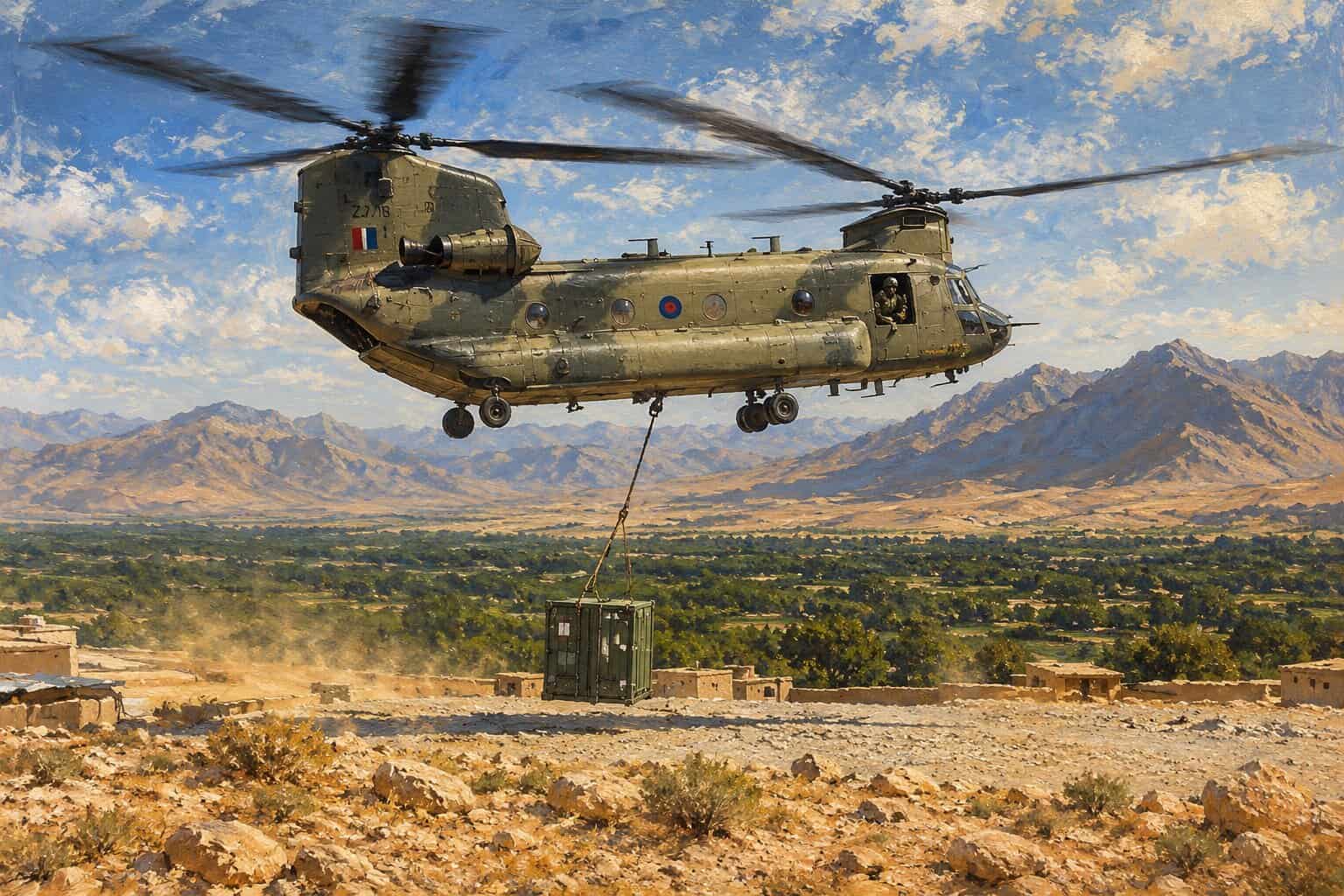
Decades later, RAF Chinooks carried troops, supplies and medical teams across Helmand. Their size, power and equipment belonged to a different generation, yet the underlying requirement remained recognisable: to connect scattered forces with support when terrain, distance or hostile action obstructed surface movement. Between those campaigns, helicopters became a regular part of British military operations, with consequences for the way soldiers could be deployed, sustained and treated.
That change required much more than increasingly capable aircraft. Crews needed techniques for unfamiliar landing sites; engineers had to keep complex machines serviceable far from established workshops; commanders had to reconcile competing demands for transport. Every load carried depended on fuel, weather, aircraft availability and the conditions at its destination.
The RAF provided an important part of this capability alongside the Royal Navy and Army Air Corps. Their separate aircraft and responsibilities remained significant as operations became more closely integrated. From early experiments to modern heavy lift, RAF helicopter history follows the gradual creation of a dependable service from a remarkable but demanding form of flight.

Early Experiments and the Malayan Emergency, 1944–1953
The RAF’s helicopter story began before the Malayan Emergency. The Hoverfly I, the British service version of the Sikorsky R-4, served from 1944, and helicopter pilot training took place at Andover in 1945. These were early steps towards understanding a machine whose handling and employment differed fundamentally from conventional aircraft. Possessing a helicopter, training pilots to fly it and sustaining an operational helicopter unit were distinct achievements, separated by experience as well as time.
A helicopter could approach vertically and remain over a point on the ground. Those abilities opened possibilities for recovery and communication where a runway was unavailable. They also imposed unfamiliar demands. A pilot had to manage the approach to a confined area, judge clearance and power, and leave enough margin for departure with the intended load. A landing site that could be reached with a lightly loaded aircraft did not automatically permit an equally straightforward departure carrying a casualty.
Malaya gave these questions immediate operational importance. Jungle separated patrols from roads and medical facilities, while the canopy and uneven ground restricted suitable landing places. Fixed-wing transport could move supplies over long distances and deliver them to the vicinity of troops, but it could not land in a small clearing to collect a wounded man. For casualty evacuation, the final distance between the patient and an accessible airfield remained a severe limitation.
In 1950 the Far East Air Force Casualty Evacuation Flight formed in Singapore with Westland Dragonflies for work in Malaya. On 14 June 1950, a Dragonfly carried out the first helicopter casualty evacuation by the British armed services, an early demonstration of the aircraft’s value in the campaign. Its task put the helicopter’s unusual capabilities to practical use. Stretcher carriage, the choice of a landing site and the coordination of the collection all became elements of an evacuation system. The gain was the possibility of shortening a difficult journey to treatment, even with aircraft whose carrying capacity was modest.
Weather, fuel and payload constrained each flight. Enough fuel had to be carried for the journey, while the casualty and any accompanying load had to remain within the aircraft’s capabilities. Jungle clearings offered little freedom to improvise when conditions deteriorated. Successful evacuation therefore depended on preparation by people on the ground as well as skill in the cockpit. The aircraft provided the connection; it could not remove every obstacle surrounding the patient.
February 1953 brought the formation of No. 194 Squadron, the first operational RAF helicopter squadron. The Bristol Sycamore also entered service that year. These developments gave a more established organisational and equipment basis to work already demonstrated by the earlier flight. The sequence matters: the Hoverfly introduced experience, the Dragonflies applied helicopter evacuation in a campaign, and squadron organisation helped turn a small capability into a continuing operational service.

Malaya, Suez and the Development of Helicopter Roles, 1953–1960
Once helicopters could reach troops in difficult country, their usefulness extended beyond taking casualties out. Patrols, equipment and essential stores could be moved in. The same clearing might serve as a point of reinforcement, resupply and evacuation, connecting a dispersed ground force with support outside the jungle. Commanders gained options over where troops could operate and how long they could remain there, although those options depended on the available lift.
No. 155 Squadron began operating Whirlwinds in Malaya from September 1954. Their employment broadened the RAF’s helicopter effort beyond the early evacuation work. In June 1959 No. 110 Squadron took over merged helicopter units, another stage in the organisation of an established support role. The Royal Navy’s No. 848 Naval Air Squadron also supported operations in Malaya. Its contribution belonged to the Fleet Air Arm, even when its work served the same ground campaign as RAF flying.
The tactical attraction of movement by helicopter was considerable. Troops could cross country that would otherwise absorb time and effort, and supplies could reach places poorly connected to roads. Yet the number of soldiers or amount of freight required could exceed what a small helicopter force could deliver in one movement. Several flights might be necessary, making timing, loading and the availability of landing sites important parts of the ground plan.
A helicopter arriving in a clearing was also exposed during a particularly demanding part of its flight. Dense vegetation reduced room for manoeuvre, while weather could interfere with both the route and the destination. Increasing the ground force’s reliance on helicopter support therefore increased the importance of reliable aircraft, prepared loads and realistic expectations. A useful new form of mobility still needed alternatives when aircraft were unavailable or conditions prevented flying.
The 1956 Suez campaign demonstrated a different application. During Operation Musketeer, helicopters carried Royal Marines ashore in an assault that was primarily naval. The inter-service Joint Experimental Helicopter Unit, involving RAF personnel, formed part of the wider experience. The helicopter assault was led by naval aviation, while RAF participation in the inter-service experimental unit contributed to the wider development of British helicopter tactics.
Suez showed how helicopters could help move an organised fighting force from its transport towards an objective. That required the coordination of aircraft, troops and loads within an operational timetable. It also linked helicopter employment to the means of bringing the aircraft into the theatre. Jungle support and a helicopter-borne landing posed different immediate problems, but both demanded cooperation between the aviation force and the troops it carried.
Elsewhere, work in Cyprus added search and rescue, communications and training experience to the expanding range of duties. These quieter tasks mattered alongside the more conspicuous combat examples. Repeated flying developed crews and exposed the practical requirements of keeping a helicopter service available. By the end of the decade, rotary-wing aircraft had acquired a place in several forms of military support, each with its own demands on organisation and equipment.

Borneo and Aden: Turbine Helicopters and Tactical Support, 1960–1969
Turbine helicopters increased the scope of RAF support during the 1960s. Greater power and lift offered room for loads that had challenged earlier aircraft, while also bringing substantial engineering demands. The Bristol Belvedere entered service in 1961 as the RAF’s first twin-engined tandem-rotor helicopter. Its distinctive configuration served a practical purpose: moving men and freight on a scale that widened the possibilities of battlefield transport.
In Borneo, No. 66 Squadron operated Belvederes and No. 103 Squadron flew Whirlwinds. During the Indonesian Confrontation of 1962–66, the support of remote posts made air movement particularly valuable. Troops needed supplies, equipment and reinforcement across country where ground communications were difficult. Helicopters could connect those positions with the support behind them, giving dispersed forces access to loads that would otherwise require arduous movement overland.
The transport of equipment and guns was especially important to the meaning of increased lift. Moving troops alone could leave them short of the material required to operate effectively. A helicopter force able to carry heavier loads could help sustain the positions it had helped establish. This brought the needs of the ground commander and the limitations of the aircraft into close contact: the desired load, destination and timing all had to be reconciled before departure.
Borneo also exposed the difference between carrying capacity on paper and useful capacity in a particular operation. Terrain restricted approaches, vegetation constrained landing zones, and weather affected access. A load had to be prepared so that it could be carried and delivered safely. At the destination, people needed to receive it without unnecessarily delaying the aircraft in a confined area. The resulting movement was a joint task, even when one service supplied the helicopter.
No. 26 Squadron operated the Belvedere in Aden, where the physical problems differed from those of the jungle. Heat, dust and demanding country shaped support in Aden and the Radfan. Dust could obscure the pilot’s view near the ground and added to the burdens placed on machinery. Greater power was valuable, but it could not make every landing zone suitable or remove the need to consider exposure to hostile fire.
The Wessex HC2 entered RAF service with No. 18 Squadron at Odiham in January 1964. The RAF’s HC2 was configured for transport and support, whereas naval Wessex variants, including the HAS1, were developed for different Fleet Air Arm requirements. The two services employed their Wessex helicopters in distinct operational roles. In RAF service the HC2 contributed to a force increasingly expected to work directly with ground formations across varied conditions.
These aircraft required an effective maintenance effort as much as confident flying. Serviceability determined how much of the nominal force could actually be tasked. Deployments placed demands on engineering personnel, spare parts and the movement of support equipment, all of which had to follow the aircraft. The helicopter could bypass a difficult stretch of ground, but its own sustainment still required a functioning supply system.
The Belvedere retired in 1969. Its service had demonstrated the value of larger helicopter loads in demanding campaigns, while the Wessex carried support-helicopter experience into a longer period of use. Borneo and Aden left a practical inheritance: lift was most valuable when it was dependable, matched to the ground operation and supported by the engineering needed to keep aircraft flying.
Wessex and Puma: Helicopter Support Becomes Routine, 1964–1981
The Wessex HC2’s later employment in Northern Ireland and United Nations duties in Cyprus showed how helicopter support could become a continuing requirement. These commitments differed from the concentrated demands of a short campaign. They called for sustained availability, crews familiar with local conditions and the ability to carry out repeated movements within an established operational setting. RAF Wessex service in Cyprus continued until 2003, illustrating how long a useful aircraft could remain part of that system.
In such work, transport formed a regular connection between separated locations. Personnel and equipment could be moved with flexibility, while the aircraft remained available for other tasks as circumstances required. Continuity mattered: a force depending on air movement needed an organisation capable of delivering it repeatedly. The history of helicopter support consequently includes the routines of tasking, training and maintenance alongside the more dramatic moments of deployment.
The Puma added a new medium-lift aircraft to the RAF’s force. The first deliveries took place on 29 January 1971; No. 33 Squadron became operational in June that year, followed by No. 230 Squadron in January 1972. These dates mark different stages in bringing a new type into use. Delivery supplied the aircraft, while operational readiness required trained crews and the organisation able to employ and maintain it.
Medium lift offered a useful balance for troop transport and equipment movement. Loads could be matched to a range of tasks without assigning the largest available helicopter to every request. The Puma’s role included support to military operations and humanitarian work, where the ability to reach people and move essential material could be valuable for the same geographical reasons. The purpose of a sortie might change, but careful loading and a suitable destination remained necessary.
The RAF’s support-helicopter organisation developed around training and bases including Odiham and Benson. These provided the setting in which crews learned their aircraft and prepared for deployment. Conversion onto a type was only part of that preparation. Cooperation with troops, understanding loads and operating away from a familiar airfield required skills that linked flying training to the conditions expected on operations.
Combat support and search and rescue shared some abilities, yet they remained distinct responsibilities. Carrying troops or supplies in support of a ground campaign placed different demands on planning and readiness from maintaining a rescue service. Treating every RAF helicopter as interchangeable would conceal these differences. The growing force contained capabilities shaped by particular tasks, even where crews and aircraft could undertake a wider range of work.
By the time the Puma was established, the need for heavier lift remained clear. Medium helicopters could perform many movements, but larger loads required additional capacity. The next major addition would change how much could be moved in an individual sortie, while making the consequences of losing scarce heavy-lift aircraft particularly severe.
Chinook and the Falklands: Heavy Lift Under Pressure, 1980–1982
The first RAF Chinooks arrived at No. 240 Operational Conversion Unit at Odiham in December 1980. No. 18 Squadron reformed in August 1981, establishing an operational unit around the new heavy-lift aircraft. The Chinook complemented the medium-lift force by providing greater carrying capacity. Larger groups of troops and substantial loads could be moved without dividing every requirement among several smaller aircraft.
That distinction mattered to planning. A heavy-lift helicopter could concentrate a useful amount of transport in one sortie, reducing the number of separate movements required for some tasks. It also represented a valuable resource that had to be allocated among competing requests. Where few aircraft were available, maintenance or loss could sharply reduce the movement capacity on which a ground plan depended.
The Falklands campaign brought that vulnerability into stark relief. For Operation Corporate in 1982, five Chinooks embarked in Atlantic Conveyor. One remained at Ascension, while four continued south. This distinction is essential to the subsequent story: the force in the South Atlantic comprised four aircraft, not all five originally embarked.
On 25 May Atlantic Conveyor was attacked while Chinook ZA718, known as Bravo November, was airborne. Three Chinooks were lost aboard the ship. Bravo November survived and continued in theatre, leaving a single aircraft to provide the RAF’s surviving Chinook heavy-lift capability there. The loss abruptly altered the scale of support available to the land campaign.
The consequences extended beyond the aircraft themselves. A movement planned around several heavy-lift helicopters could no longer be carried out on the same basis. Loads and priorities had to be reconsidered against the capacity that remained. Other naval and army helicopters continued to contribute to the wider effort, and their work should remain visible alongside the exceptional story of the surviving RAF Chinook.
Bravo November’s contribution demonstrated the breadth of heavy lift. The RAF Museum credits it, during 18 days ashore, with carrying 2,150 troops, 95 casualties, 550 prisoners and 550 tonnes of stores. Those figures belong to the museum’s account of this aircraft’s work. They encompass several kinds of movement, showing how transport demand changed as the fighting developed and its immediate aftermath created further tasks.
Troop carriage, casualty evacuation and freight movement drew on the same scarce aircraft for different purposes. The value of the surviving Chinook lay in meeting those changing needs, supported by the crews and maintenance effort that kept it available. Its survival on the day of the attack had preserved a capability; continuing serviceability made that capability usable over the following period.
The episode also placed a limit on what could be inferred from an outstanding individual performance. One helicopter’s work could be considerable while still leaving the force with far less lift than intended. Bravo November’s record and the loss of the other three aircraft are inseparable parts of the operational story. Together they showed both the influence of heavy-lift transport on a campaign and the exposure created when a plan relied on a small number of aircraft brought over a long maritime route.
Gulf, Balkans, Iraq and Afghanistan: Joint Battlefield Mobility, 1991–2014
Pumas supported the 1991 Gulf campaign during Operation Granby, followed by service in the Balkans, including Bosnia and Kosovo. These deployments extended medium-lift experience across very different settings. Desert conditions, the geography of the Balkans and the requirements of multinational operations demanded adaptability from the helicopter force. Transport remained the central function, but its practical employment changed with the troops supported and the conditions in which they operated.
RAF Chinooks likewise undertook operational and humanitarian tasks. Their capacity was useful wherever a substantial load needed to reach a place poorly served by surface transport. Such work also emphasised that the aircraft’s military usefulness extended beyond carrying troops into action. The movement of relief supplies and essential equipment drew upon the same crews, loading skills and engineering support required for combat operations.
Joint Helicopter Command was established in 1999 to bring together battlefield aviation more closely. This organisation integrated service-owned capabilities without transferring RAF, Royal Navy and Army Air Corps aircraft into a single service. Their different experience and equipment remained part of the force. Joint organisation sought to connect them more effectively to the needs of ground operations, where the requesting formation’s requirements could cross service boundaries.
During Operation Telic in Iraq, RAF Pumas and Chinooks provided transport, resupply and casualty movement. Medium and heavy lift offered different ways of meeting the demand. Moving a particular group or load required a judgement about capacity, availability and destination. Sustained operations also meant keeping aircraft and crews ready after the initial deployment, with engineering effort continuing throughout the commitment.
In Afghanistan, Operation Herrick placed the Chinook at the centre of important RAF support to troops in Helmand. Troop insertions, supplies for forward bases and underslung freight connected dispersed forces with their support. Each role had its own practical requirements. A troop movement needed coordination with the receiving force; freight had to be prepared for carriage; an underslung load demanded attention to both the route and the delivery point.
Helmand’s conditions complicated these tasks. Heat and altitude affected performance, while dust could degrade visibility during landing. Enemy fire added a threat at the point where the aircraft might be committed to an approach. Escort, crew preparation and the selection and use of landing zones therefore formed part of the transport operation. The capacity to carry a load was only one element in getting it safely to its destination.
Ground maintenance was equally consequential. Aircraft returning from sorties required attention before they could be tasked again, and the serviceable fleet set the practical limit on daily transport. Availability influenced how ground forces could be reinforced and sustained. Commitments could compete with one another, requiring decisions about which movement was most urgent and which could wait.
Aeromedical evacuation gave those decisions an especially immediate human significance. Medical Emergency Response Teams operated aboard Chinooks, bringing medical personnel and equipment into the evacuation itself. The aircraft became a place in which treatment could continue during the journey. According to the Ministry of Defence, blood products were carried aboard these Chinooks from 2008, strengthening the team’s ability to respond to serious injury before reaching hospital care.
This combined aviation and medical capability depended on coordination from the casualty’s location to the receiving facility. The helicopter had to reach the patient, permit collection and depart, while the medical team managed treatment within the aircraft. Helmand therefore carried the original evacuation purpose of the Malayan helicopters into a much more developed system. The gains rested on clinical practice, crew skill and engineering availability together, making casualty care an integral part of battlefield mobility.
Modernisation, Puma Retirement and the Legacy, 2013–2026
The later history of the Puma demonstrated how an established helicopter force could gain capability through modernisation. The HC2 programme introduced upgraded engines and digital avionics, with trials in 2013 and full operational service in 2015. These changes addressed the aircraft’s power and equipment while retaining the familiar medium-lift role. They also required the operational organisation to absorb new systems through training and support.
An upgrade affects more than the cockpit. Crews must understand the equipment on which they rely, while engineers need the knowledge and resources to maintain it. The operational benefit emerges when those elements work together. In the Puma’s case, modernisation continued the service of a type first delivered in 1971, linking a long history of support flying with more recent requirements.
The RAF marked the Puma’s retirement with a farewell flypast on 26 March 2025, bringing its operational service to an end that month. Its retirement closed a lengthy chapter that had encompassed troop transport, overseas operations and humanitarian duties. The Chinook continued as the RAF’s heavy-lift platform, preserving a different part of the transport capability. Medium and heavy lift had served complementary purposes; the continuing presence of one did not make the history or functions of the other interchangeable.
Joint Aviation Command provided the current joint organisational framework. As with its predecessor, the distinction between joint employment and service ownership remained important. Helicopters could contribute to common operational purposes while belonging to separate services, with different units responsible for their use. That distinction was particularly visible in the arrival of Jupiter HC2 aircraft at overseas locations during 2026.
RAF No. 84 Squadron received Jupiter HC2 helicopters in Cyprus in June 2026, and they were flying there by July. In Brunei, Jupiter deliveries in April 2026 were for Army Air Corps No. 667 Squadron. These were separate unit and service developments. The Brunei deployment belonged to the Army Air Corps, while the Cyprus aircraft continued the RAF’s rotary-wing presence on the island.
Chinook training in Norway in January 2026 showed another continuing requirement: preparing crews and support personnel for conditions beyond those encountered in recent desert campaigns. Cold-weather operation demanded attention to a different environment. Readiness for such work depended on practical training, giving crews experience before an operational demand arose. A force developed through jungle, desert and expeditionary service still had to prepare for a wider range of terrain and weather.
Across these changes, the durable achievement was the ability to bring useful transport close to the point of need. A casualty in a jungle clearing and a medical team aboard a Chinook belonged to different periods of equipment and organisation, but both depended on an aircraft able to reach people beyond straightforward surface access. Troops and supplies benefited from the same extension of reach.
The enduring change was operational rather than simply technological. A helicopter could shorten the distance between a wounded soldier and medical care, deliver a gun to an isolated position or move troops when roads were impassable. From Malaya to the Falklands and Helmand, the RAF’s rotary-wing force made those movements possible through the combined work of aircrews, engineers, medical teams and the forces they supported. The machines evolved dramatically; the decisive achievement was making vertical flight a dependable part of military operations.